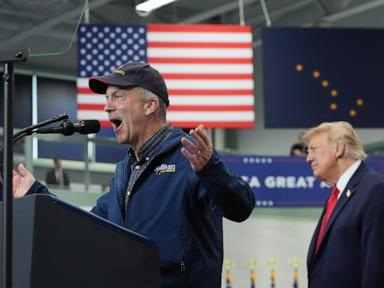
Traveling four time zones west for a single election cycle in a state of roughly 740,000 residents violates standard campaign resource allocation unless the marginal seat value exceeds the travel penalty. Standard coverage of Donald Trump's campaign trip to Alaska treats the visit as a binary signal: either a desperate rescue mission for incumbent Senator Dan Sullivan or a routine show of loyalty to a friendly state. That framing misses the underlying decision calculus. When an executive spends scarce late-cycle time flying across vast distances for a small-population state, the move reflects a shift in marginal return on time, electoral elasticity among nominally aligned voters, and structural friction in a nonpartisan top-four primary and ranked-choice environment.
This analysis deconstructs the strategic argument behind high-cost long-haul campaigning in Alaska, maps where conventional commentary stops short, and examines the operational mechanics governing close races in low-population, high-friction electorates. Verified election reporting and campaign records establish the factual baseline, while strategic mechanisms and behavioral hypotheses explain why a traditionally Republican-leaning state became contested.
Deconstructing the Competitor Narrative
Conventional reporting around the trip relies on three core claims:
- Geographic distance as a proxy for race tightness: Because Alaska sits far from Washington and ranks near the bottom of states by population, a late-stage presidential visit is read as proof that the incumbent is in danger.
- Macroeconomic headwinds eroding baseline partisanship: Elevated inflation and higher gasoline prices linked to conflict in Iran are treated as national drags weakening presidential approval even in states with long Republican streaks in federal contests.
- Policy deliverables as local persuasion: Highlighting oil and gas leasing priorities and diplomatic announcements around an Alaska natural gas project is framed as the primary countermeasure to voter dissatisfaction.
The gap in this reasoning is structural rather than factual. Distance alone does not measure strategic value; time opportunity cost does. A campaign does not evaluate a stop by miles flown in isolation. It compares the expected vote gain per hour of principal time in State A against the expected vote gain per hour in State B, weighted by how decisive that seat is to chamber control. Furthermore, treating a historically Republican state as immune to elastic defection ignores the difference between baseline partisan lean and conditional loyalty. Voters who backed a candidate or party in one cycle can withhold support or split tickets in a subsequent cycle when pocketbook pressures diverge from national identity.
The Four Pillars of Long-Haul Campaign Economics
To evaluate why a campaign commits high-cost executive time to a small-population state, four analytical variables must be separated.
Opportunity Cost of Principal Time
Executive campaign time is strictly bounded in the final weeks before an election. Every hour spent in transit across time zones carries a dual cost: lost direct mobilization time elsewhere and compressed media cycles in faster-moving markets. In a state with a smaller population base than many single metro areas, raw vote volume per rally is inherently capped. For a long-haul stop to be rational under constrained scheduling, at least one of three conditions must hold:
- Chamber leverage: The seat sits near the pivot point of control, making a small vote swing worth a disproportionate institutional return.
- Turnout asymmetry: Base enthusiasm is softer than partisan registration implies, requiring a high-visibility signal to convert passive supporters into cast ballots.
- Down-ballot spillover: A single rally is structured to lift multiple statewide or federal candidates simultaneously across shared media and activist networks.
Elastic Defection Among Prior Supporters
A common analytical error is assuming that past presidential or statewide results lock in future behavior. In practice, voters who supported a party or leader in a prior election form a persuadable or demobilizable tier when economic conditions tighten. Inflation and fuel costs operate directly on household budgets, which can depress enthusiasm among voters who still share cultural or policy alignment on other issues.
This creates a two-stage risk for an incumbent:
- Abstention risk: Prior supporters stay home rather than cross party lines, shrinking the core turnout pool in a lower-turnout midterm environment.
- Cross-pressure risk: Cost-of-living messaging from an opponent with cross-party appeal—such as former U.S. Representative Mary Peltola emphasizing cost-of-living themes—competes directly with national partisan cues.
Whether a visit reverses these pressures is an open empirical question rather than a guaranteed outcome. A rally can re-energize committed activists and reassure fence-sitters on identity and resource policy, yet it cannot instantly lower pump prices or household bills at the grocery store.
Resource Extraction Framing Versus Economic Delivery
Resource-rich states often experience a gap between policy announcements and immediate household relief. Opening acreage for oil and gas exploration or announcing large-scale natural gas investment frameworks signals long-term alignment with extractive industries. However, major energy infrastructure projects involve multi-year permitting, capital commitments, and commercial contingencies—including external government participation that may remain unfinalized.
Strategically, this creates a timing mismatch:
- Short-term voters judge candidates on current prices, wages, and local affordability.
- Long-term industrial bets promise future jobs, royalties, or throughput that may not materialize for years.
Campaigning heavily on energy expansion works best when voters weight future development and federal regulatory posture above near-term cost pressures. When near-term affordability dominates voter decision rules, future project announcements carry less immediate persuasive weight.
Ballot Mechanics and Name Fragmentation
Electoral rules change how small vote shares behave. In a system using a nonpartisan top-four primary followed by ranked-choice general election tabulation, vote splitting and ballot exhaustion or transfer patterns alter final margins. When multiple candidates share similar names or overlapping ideological labels—such as two candidates named Sullivan appearing on the ballot—confusion risk and vote dispersion become tactical variables.
Legal challenges over ballot access, vote tabulation, or certification also enter the strategic calculus when margins are projected to be narrow. Yet court rulings and voter transfer behavior constrain how much external pressure can reshape raw ballot counts. If a leading candidate crosses an outright majority of votes cast in the initial count, ranked-choice transfers do not change the outcome, and post-election litigation faces a higher factual hurdle unless specific counting errors are proven.
Operational Playbook for Contested Low-Population Races
Analysts and campaign strategists evaluating tight contests in small-population, high-friction states can apply a four-step diagnostic sequence:
- Audit baseline elasticity before trusting historical margins. Compare recent polling and approval trends against prior election benchmarks rather than relying on multi-cycle streaks. Identify the exact share of prior-cycle voters expressing hesitation.
- Map cost-of-living friction against long-horizon promises. Separate voters motivated by immediate household expenses from voters motivated by multi-year resource development or federal alignment. Avoid treating future project announcements as a substitute for near-term economic reassurance.
- Model multi-candidate dispersion and transfer paths. Account for every candidate on the general election ballot, including same-name or minor-party contenders, and evaluate how secondary preferences or outright majorities affect the finish line.
- Price travel time against marginal persuasion. Measure a principal visit by whether it moves undecided or wavering voters in high-yield precincts, not merely by the spectacle of long-distance travel.
Analytical Limitations and Blind Spots
No single framework captures every variable in a volatile election cycle. Public polling in lower-population states often carries wider margins of error and smaller sample sizes than national surveys, making late momentum harder to verify in real time. Late-arriving mail, overseas, or absentee ballots can also shift tallies after initial election-night reports, delaying clarity on whether a race requires ranked-choice tabulation or is settled outright. Finally, external shocks—ranging from global energy price spikes to late campaign disruptions—can alter voter priorities faster than static strategic models predict.
Strategic Action for Campaign Decision-Makers
When a traditionally safe seat tightens late in the cycle, campaign leadership should stop treating historical partisan lean as a floor and reallocate late-stage resources strictly toward closing persuadable defection among prior supporters. That means pairing any high-profile surrogate or executive appearance with concrete, near-term cost-of-living messaging and disciplined ballot-chasing operations, while preparing legal and communications teams early to rely on verifiable vote counts and statutory certification rules rather than speculative vote-transfer claims.