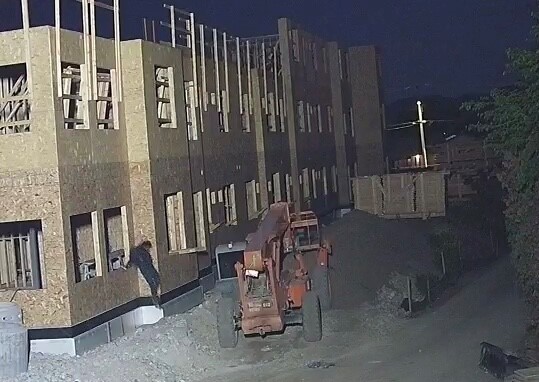
A single individual standing on a darkened construction site moments before a massive blaze destroys a multi-million-dollar housing development is a stark image. It is also an increasingly common one across Canada. When a massive fire ripped through a major residential construction site in Penticton, British Columbia, local authorities quickly turned to security footage showing an unauthorized person on the property just before the flames erupted. This incident highlights a severe vulnerability in the North American housing market. Fire investigators and industry analysts are realizing that these fires are not isolated acts of random vandalism. They represent a systemic security and financial crisis that threatens to halt housing development when affordability is already at a breaking point.
The immediate reaction to a construction site fire is to treat it as a localized criminal matter. Police release a grainy security camera photo, appeal to the public for tips, and the local news moves on. This approach misses the broader economic forces driving these incidents.
Building sites are inherently vulnerable. They are loaded with exposed timber, accelerants like propane cylinders, and lack the active suppression systems—such as triggered sprinklers and fire-rated drywall—that protect finished buildings. For an arsonist, a wood-frame apartment complex under construction is a massive tinderbox. For a developer, it is a catastrophic financial liability.
The Broken Economics of Site Security
Securing a sprawling residential construction site is an expensive logistical nightmare. Most developers rely on passive measures like chain-link fencing, basic motion-activated lighting, and third-party remote video monitoring. The Penticton incident proves these measures are failing.
Security cameras are reactive. They record the crime, but they rarely prevent it. By the time a remote operator spots an intruder and dispatches local police or private security, a fire set with simple accelerants can become uncontrollable within ninety seconds.
The financial calculation for developers has shifted dramatically. High interest rates have squeezed profit margins on multi-family developments. When material costs rise, site security is often one of the first line items to be trimmed or outsourced to the lowest bidding virtual guard service.
This is a critical error. The true cost of a construction fire extends far beyond the immediate property damage. A total loss event triggers a complex chain reaction of economic pain that impacts the entire community.
- Insurance fallout: A single major arson incident can cause regional insurance premiums for mid-rise wood-frame projects to skyrocket by thirty to fifty percent. Some insurers are exiting the construction market entirely, leaving developers struggling to secure the coverage required to break ground on new projects.
- Supply chain disruptions: When a project burns, months of specialized ordering—from custom HVAC units to engineered wood trusses—are wiped out instantly. Reordering these materials pushes the project to the back of the queue, delaying completion by eighteen to twenty-four months.
- Labor displacement: Subcontractors and tradespeople suddenly find themselves without a job site. In a tight labor market, these workers quickly move to other developments, meaning the affected developer faces a severe labor shortage when trying to rebuild.
Why Fences and Cameras Are No Longer Enough
The traditional security perimeter is obsolete. An iron gate and a warning sign will not deter a determined individual. To protect these vital housing projects, the construction industry must shift toward active, multi-layered defense strategies.
Physical barriers must become smarter. Instead of simple fencing, forward-thinking developers are implementing anti-climb rigid hoarding panels that eliminate handholds. Access points require strict biometric authentication or scannable QR codes for workers, completely eliminating the risk of lost keys or compromised gate codes.
On-site technology needs an overhaul. Standard motion-detection cameras trigger hundreds of false alarms a night due to wind, debris, or stray animals, leading to operator fatigue and slow response times. Modern sites require edge-computing thermal cameras that specifically detect human heat signatures and sudden temperature spikes.
If a thermal camera detects a human shape in a high-risk zone after hours, it should automatically trigger high-intensity strobe lights and targeted directional acoustic devices. The goal is to make the environment so hostile and disorienting that the intruder flees before they can strike a match.
The Regulatory Gap in Fire Prevention
The responsibility cannot fall solely on developers. Local municipalities and building departments are operating with outdated code enforcement frameworks that fail to account for the speed and scale of modern wood-frame construction.
Current municipal bylaws frequently allow massive timber structures to sit unprotected for months while framing is completed. Fire departments are often left in the dark regarding the specific hazards present on a site at any given week.
Cities must mandate stricter fire safety plans before issuing building permits for large-scale residential projects. These plans should include mandatory, temporary standpipes that are extended upward as each floor is framed, ensuring firefighters have immediate access to water on upper levels.
Municipalities could also require the early installation of non-combustible stairwells and elevator shafts, which act as natural fire breaks during the construction phase.
The Human Factor and Community Impact
Every burned skeleton of an apartment building represents families who cannot move into a home. In regions facing severe housing shortages, the destruction of fifty or one hundred planned units cripples municipal growth targets and keeps local rental markets unsustainably tight.
There is also the unquantifiable strain on emergency services. A major construction fire requires a massive deployment of apparatus and personnel, stripping the rest of the city of fire protection for hours. The radiant heat from these blazes regularly damages adjacent occupied homes, displacing innocent residents and multiplying the economic damage.
The individual caught on camera in Penticton is a symptom of a broader structural failure. Until the development industry treats physical asset protection with the same seriousness as structural engineering, these spectacular, destructive blazes will continue to disrupt Canadian cities and drive the cost of housing higher for everyone.
Developers must stop viewing comprehensive security as an optional line item. It is a fundamental requirement of modern urban construction.