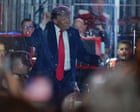
Donald Trump stood on a stage built to resemble the White House exterior, looking out over a crowd gathered on the National Mall. Stealth bombers roared overhead. Military bands played. Lee Greenwood sang his signature anthem for what felt like the thousandth time.
The immediate reality is that the official opening of the United States semiquincentennial has been converted into a standard partisan rally. This transformation occurred after mainstream musical acts pulled out, corporate sponsors grew anxious, and the official nonpartisan planning apparatus was entirely supplanted by a private, administration-aligned entity known as Freedom 250. What was originally envisioned a decade ago as a unifying national milestone has instead become a heavily monetized, deeply polarized spectacle designed to boost an administration facing a thirty-seven percent approval rating ahead of the upcoming midterm elections. Also making headlines in this space: The Deadly Illusion of Foreign Disaster Aid.
The shift from national unity to political theater did not happen overnight. It is the result of years of quiet maneuvering, executive orders, and the aggressive monetization of public space.
The Million Dollar Reflection
The physical transformation of Washington for this milestone is visible to anyone walking down the National Mall. The most controversial change is the Lincoln Memorial reflecting pool. Following a direct order from the president, the National Park Service undertook a fourteen million dollar renovation project to line the historic pool and paint it what officials called an American flag blue. More information regarding the matter are covered by The New York Times.
The results have been disastrous. Within weeks of completion, the polyurethane liner began to peel away in massive sheets. Algae blooms, fed by summer heat and stagnant water, turned the patriotic blue into a murky, neon green.
The administration blamed the failure on vandals, calling them thugs and bad people, though park engineers privately admitted the materials used were fundamentally unsuited for a shallow, sun-exposed body of water. Government watchdogs are already tracking the contracts awarded for the project. The work went to a newly formed entity with deep ties to major campaign donors, bypassing the standard competitive bidding process usually required for national historic landmarks.
This infrastructure failure serves as an apt metaphor for the broader organization of the anniversary. The glossy veneer is peeling, revealing a complex web of special interest access and financial opportunism.
The Shell Game of Freedom Two Hundred Fifty
For years, a congressional commission called America 250 was tasked with planning the nation's big birthday. It was structured to be nonpartisan, balancing lawmakers and citizens from both major parties. That commission has been effectively sidelined.
Power has shifted to Freedom 250. This private nonprofit group was established with the explicit backing of the administration to run the Great American State Fair, a sixteen-day event taking over the National Mall from late June through the middle of July. Because Freedom 250 is structured as a private entity rather than a government agency, it operates outside the scope of traditional federal transparency laws.
It does not have to disclose its donors in real time. It does not have to adhere to federal procurement regulations.
Congressional investigators have begun revealing the extent of this arrangement. Documents presented at recent House hearings indicate that Freedom 250 has been actively selling access to corporate interests, offering prime placement on the National Mall in exchange for multi-million-dollar donations. Major energy conglomerates, defense contractors, and technology firms have bought up space for pavilions, effectively turning a public park into a corporate trade show.
One of the most striking examples of this commercialization was a recent Ultimate Fighting Championship event held directly on the National Mall. The optics of a for-profit sports entertainment company commandeering public land surrounding national monuments drew fierce ethical criticism. Ticket packages for the event ran into the thousands of dollars, completely pricing out the ordinary citizens the anniversary was supposed to celebrate.
When the Headliners Walked Out
The rally on Wednesday night was never supposed to be a rally. The original schedule called for a massive, bipartisan concert series intended to kick off the state fair. The lineup featured a broad cross-section of American musical history, including the country singer Martina McBride, the Motown legends The Commodores, and the early hip-hop artist Young MC.
They all quit.
The mass exodus began when artists realized the extent to which the event programming was being integrated into the administration's political apparatus. Internal memos leaked to the press showed that performers were being asked to sign agreements that included restrictions on political speech and required participation in events alongside administration officials.
Fearing a public backlash and the alienation of large segments of their fanbases, the artists pulled out one by one. Whole states followed suit, withdrawing their official participation from the state fair pavilions due to concerns over the overtly partisan tone.
The president reacted with characteristic defiance. He took to social media to blast the departing musicians as singers with no talent who put audiences to sleep. He promised that he would step into the void himself, bringing the hottest people and creating the biggest rally in history.
The resulting lineup on Wednesday night reflected a dramatically narrowed cultural scope. The national anthem was performed by Alexis Wilkins, a country singer whose primary public prominence stems from being the girlfriend of FBI Director Kash Patel. The rest of the evening was carried by standard rally regulars like opera singer Christopher Macchio and Lee Greenwood.
The crowd was dedicated but noticeably smaller than the historic turnouts predicted by organizers. Large gaps were visible toward the back of the cordoned-off sections of the Mall, where vendors hawked turkey legs, burgers, and an endless array of flag-themed merchandise.
A Midterm Strategy Wrapped in the Flag
The timing of this massive nationalist celebration is not accidental. The nation is less than five months away from critical midterm elections that will determine control of both houses of Congress. The administration is struggling.
Economic indicators show that inflation continues to outpace wage growth, leaving middle-class families squeezed by the rising cost of basic necessities. Interest rates remain stubbornly high, driven by an expanding federal budget deficit that shows no signs of slowing down. Significant investments in artificial intelligence have stimulated portions of the stock market, but those gains have been accompanied by widespread anxiety over job displacement, making the rapid construction of massive data centers a flashpoint in local politics across the country.
The administration is attempting to use the anniversary to shift the national conversation. The core message of the rally focused heavily on a recent interim deal with Tehran aimed at ending the deeply unpopular conflict in Iran. The president claimed credit for reopening the Strait of Hormuz and bringing down global oil prices, framing the development as the beginning of a new golden age.
Political analysts remain skeptical that a single rally, or even a month of fireworks and state fairs, can fundamentally alter the electoral landscape. The underlying economic anxieties are too deeply entrenched. Voters rarely base their congressional selections on historical commemorations; they base them on their household budgets.
Erasing the Uncomfortable History
The ideological struggle over America's two hundred fiftieth anniversary extends far beyond logistics and corporate sponsorships. It is an active battle over the historical narrative itself.
Early in his second term, the president signed an executive order aimed at purging public monuments and national parks of what the administration termed ideological indoctrination. Under this directive, park educational materials, museum exhibits, and historical markers across the country were audited. Information detailing the history of slavery, the displacement of Indigenous populations, and the ongoing impacts of the climate crisis was systematically removed or scaled back.
A federal judge recently intervened, ordering the administration to halt the removals and reinstate the original educational materials, calling the administration's actions legally deficient. The legal battle is ongoing, but the intent remains clear. The administration is seeking to project a sanitized, uncomplicated version of American history that aligns perfectly with its political brand.
The upcoming calendar of events reflects this philosophy. The state fair features structured programs like Make America Healthy Again Mondays, tying public health messaging directly to current administration slogans. Another upcoming event, labeled the Patriot Games, will feature high school students competing in physical and mental challenges for college scholarships, an initiative critics describe as an attempt to introduce nationalistic formatting into youth sports.
The celebration is scheduled to culminate on July 4 with another massive rally on the National Mall, promising the largest pyrotechnics display in human history. Millions of dollars will be spent. The sky will light up over the peeling paint of the reflecting pool.
The corporate pavilions will remain open, their private security guards keeping the public away from the VIP areas where donors mingle with policymakers. The six state-of-the-art mobile museums, known as Freedom Trucks, will continue their corporate-sponsored tours through the forty-eight contiguous states, carrying sacred founding documents that have been removed from the National Archives for the first time in history.
A nation's history is not a corporate asset to be leased out to the highest bidder during an election year. When the fireworks finally fade and the state fair stages are dismantled, the structural problems facing the country will remain exactly where they were before the music started.
For a deeper dive into how this event came together, you can watch this report outlining Trump's Great American State Fair events which covers the initial planning of the Freedom 250 celebrations and how the musical lineup shifted into a partisan gathering.