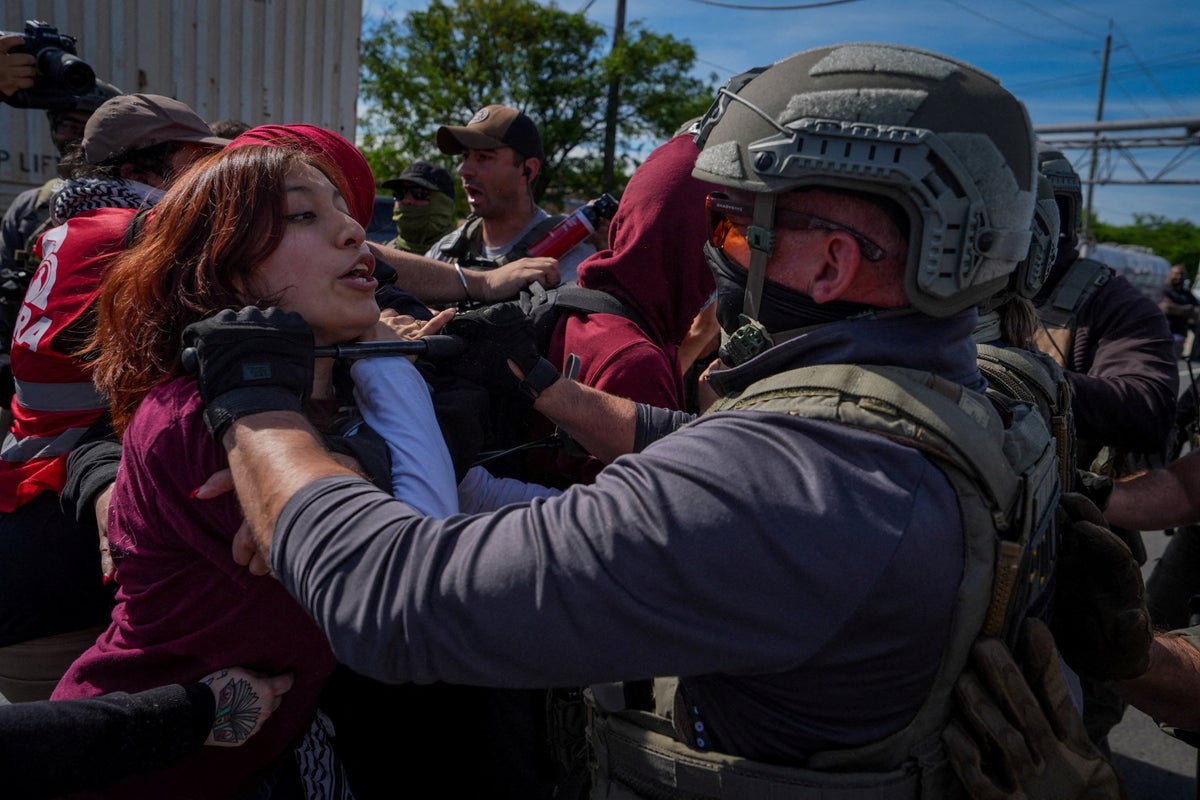
The federal immigration enforcement system relies on a quiet bargain: out of sight, out of mind. That bargain broke down entirely at the Delaney Hall detention center in Newark, New Jersey, where nearly 300 detained migrants launched a coordinated hunger and labor strike. When federal agents deployed chemical irritants against protesters—including sitting U.S. Senator Andy Kim—and forced a prominent organizer’s husband into a transport van, the reality of America’s privatized immigration system spilled directly onto Doremus Avenue. This escalating crisis exposes a deep structural rot within U.S. Immigration and Customs Enforcement (ICE) and its heavy reliance on private prison conglomerates.
The official narrative from the Department of Homeland Security (DHS) is unyielding. A spokesperson insisted that all detainees receive three balanced meals a day, clean water, and 24-hour emergency medical care, flatly stating that "there is no hunger strike at Delaney Hall at this time." Discover more on a connected subject: this related article.
The ground reality tells a different story. Striking detainees, family members, and a growing coalition of federal and state lawmakers describe an environment defined by spoiled food, severe medical neglect, and overt administrative retaliation meant to crush internal organizing. This standoff is not merely a localized dispute over facility conditions. It is the predictable outcome of a multibillion-dollar enforcement apparatus designed to maximize bed occupancy while minimizing public accountability.
The Machinery of Commercialized Confinement
Delaney Hall is operated by the GEO Group, one of the largest private corrections corporations in the world. To understand why a facility with a 1,000-person capacity faces persistent allegations of serving food contaminated with live worms and withholding basic medical treatment, one must look at the underlying financial incentives. Private detention operators secure contracts based on per-diem rates per bed. Profit margins depend heavily on keeping operational costs down. Food services, medical staffing, and sanitation are frequently the first areas targeted for cost reduction. Further journalism by NPR delves into similar views on this issue.
This corporate model creates a dangerous disconnect between oversight and execution. While ICE maintains national detention standards on paper, actual enforcement of those standards in privately run facilities is notoriously weak. When internal conditions deteriorate, detainees have virtually no formal channels for grievance. The judicial process offers little relief. Senator Kim noted following an oversight visit that the local immigration court docket is hopelessly backlogged, pointing to a single judge saddled with 74 cases in a single day. Some detainees have languished inside the facility for nearly a year waiting for a simple hearing, while others remain locked up despite already possessing valid habeas corpus rulings or signed deportation orders.
When legal and administrative avenues fail, a hunger strike becomes the final, desperate mechanism of political agency available to a captive population.
The Semantics of Starvation
To suppress the political impact of these strikes, ICE employs rigid bureaucratic definitions that conflict directly with biological reality. The agency defines a formal hunger strike as the voluntary refusal of nine consecutive meals or going completely without sustenance for 72 hours.
Immigrant rights advocates argue this threshold is an intentional optimization designed to delay federal intervention and obscure the scale of internal protests. Expecting an already undernourished and medically vulnerable population to meet a strict 72-hour zero-intake metric before acknowledging their protest allows the agency to issue blanket denials to the press.
ICE Hunger Strike Definition vs. Field Reality
┌─────────────────────────────────┬──────────────────────────────────┐
│ Bureaucratic Threshold          │ Detainee and Advocate Reality   │
├─────────────────────────────────┼──────────────────────────────────┤
│ Refusal of 9 consecutive meals │ Immediate collective work stop   │
│ 72 hours of total fasting       │ Severe pre-existing malnutrition │
│ Official medical monitoring     │ Phone and communication blackouts│
└─────────────────────────────────┴──────────────────────────────────┘
While federal officials leaned on these semantic technicalities to deny the protest's existence, facility staff took swift, practical measures to contain it. According to community organizations, guards restricted access to tablets and phones shortly after detainees communicated their strike plans to outside allies. Cutting off communication is a classic institutional tactic. It prevents internal momentum from aligning with external political pressure, effectively isolating the strikers from legal counsel and the media.
Retaliation Under the Cover of Darkness
The flashpoint that brought the crisis to a head occurred outside the facility's gates. Gabriela Soto, an organizer with the advocacy group Eyes on ICE, witnessed federal agents forcing her husband, Martin Soto Hernandez, into a white transport van. According to Soto, her husband had been questioned by immigration officers regarding the demonstrations outside and was asked if the protests would cease if he were released. Hernandez was reportedly dragged into the vehicle despite a standing judicial order for his release.
The move looked less like routine law enforcement and more like targeted retaliation against a high-profile family. When a crowd of community members moved to block the vehicle from leaving the property, the institutional response escalated sharply. At approximately 1:25 a.m., ICE officers cordoned off the street, deploying batons and pepper spray to disperse the crowd. The chemical spray struck several demonstrators, including Senator Kim, who later confirmed the use of force by federal agents.
The reliance on physical escalation to handle an oversight visit and a civilian protest underscores the defensive posture of an agency accustomed to operating without external interference. New Jersey Governor Mikie Sherrill publicly demanded immediate entry to Delaney Hall, signaling a sharpening rift between state leadership and federal immigration enforcement. Sherrill joined a growing chorus of local politicians calling for the permanent closure of the facility, arguing that the recurring crises at the site prove mass private detention is inherently unmanageable.
A Legacy of Institutional Failure
The chaos is part of a long-standing pattern. Delaney Hall has been a source of intense controversy since its reopening. In June 2025, a major riot broke out among detainees protesting a severe lack of drinking water and regular meals. Months later, a migrant named Jean Wilson Brutus died in custody less than 24 hours after entering the facility. ICE did not publicly report his death until a full week had passed, sparking intense demands for an independent autopsy and a federal investigation into corporate medical neglect.
A similar dynamic played out in April 2026 at the North Lake Processing Center in Baldwin, Michigan—the largest ICE facility in the Midwest. There, congressional Democrats raised alarms over another alleged hunger strike that followed 87 emergency medical calls in a seven-month span, many for unresponsive or unconscious individuals. In that instance, just as with Delaney Hall, ICE issued immediate public denials, claiming that reports of subprime conditions were entirely false.
The striking similarity in how these crises unfold across different states points to a systemic strategy. When faced with systemic failure, the operational playbook remains uniform: issue categorical denials, sever internal communications, transfer key organizers under the cover of night, and use aggressive physical containment against public scrutiny.
The immediate challenge for federal oversight is no longer just verifying the quality of the food or the availability of medical care inside these facilities. The real challenge is addressing a structure that insulates private contractors from the legal standards applied to the rest of the justice system. As long as federal immigration policy treats detention as a commercial commodity, the human cost will continue to spill out into the streets, regardless of how many chemical irritants are used to keep it contained.