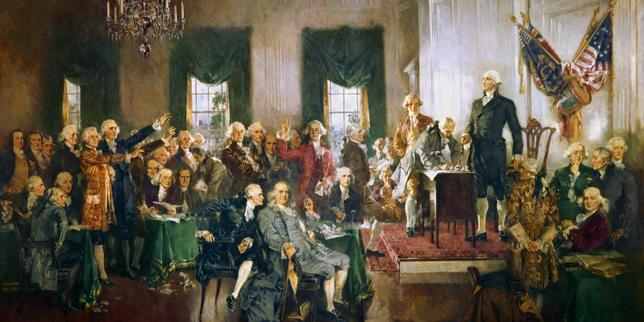
The survival of a sovereign state over a 250-year horizon depends not on national mythmaking, but on the structural durability of its institutional design. When the Second Continental Congress adopted the Declaration of Independence in July 1776, it did not create a functional state apparatus; it issued a high-risk geopolitical declaration backed by an unformed military coalition. The subsequent transition from an unstable alliance of thirteen independent colonies into a single federal marketplace required an analytical framework capable of balancing state sovereignty against collective security. By dissecting the systemic flaws of the Articles of Confederation and evaluating the equilibrium mechanics engineered during the 1787 Philadelphia Convention, we can isolate the operational principles that allowed the American republic to navigate institutional decay, economic crises, and structural realignments.
The Structural Inefficiencies of the Articles of Confederation
The first iteration of the American governance model, formalized under the Articles of Confederation, failed due to an unhedged operational vulnerability: the decentralization of tax authority and monetary policy. The system operated on a structural deficit where the continental government possessed the authority to declare war and incur debt, but lacked the enforcement mechanism to compel member states to fulfill financial requisitions.
This structural asymmetry created a cascade of systemic failures:
- The Fiscal Bottleneck: Revenue generation relied on voluntary state contributions. Between 1781 and 1786, the national treasury received less than one-fourth of the capital mandated by Congress, leading to structural insolvency and default on foreign loans.
- Monetary Fragmentation: Without a unified currency sovereign, individual states engaged in competitive currency devaluations and protectionist trade tariffs. This restricted interstate commerce and lowered aggregate GDP.
- The Enforcement Deficit: The requirement for a unanimous vote (13 of 13 states) to amend the Articles created a legislative veto block. This made incremental policy correction impossible.
The vulnerability of this design became clear during Shays’ Rebellion in 1786. The central government’s inability to deploy a standing military force to secure domestic infrastructure exposed the existential risk of absolute decentralization. The Philadelphia Convention of 1787 was not an idealistic gathering; it was an urgent structural pivot to resolve an unsustainable fiscal and security crisis.
The Equilibrium Engine: Three Pillars of Institutional Counterweight
To prevent the concentration of authority that characterizes autocratic systems, while avoiding the paralysis of the Articles of Confederation, the framers engineered an institutional design based on structural tension. This model treats political power as a fluid dynamic that must be continually split and redirected against itself.
                  [Constitutional Equilibrium Engine]
                                   │
         ┌─────────────────────────┼─────────────────────────┐
         ▼                         ▼                         ▼
 [The Bicameral Split]     [Executive Agency]      [Judicial Insularity]
  • Population vs. State    • Veto & Command        • Life Tenure
  • Legislative Inertia     • Enforcement Hub       • Constitutional Review
The Bicameral Split and the Representation Function
The legislative branch was divided to solve a regional conflict of scale between high-population states (the Virginia Plan) and low-population states (the New Jersey Plan). The Connecticut Compromise established an asymmetrical bicameral legislature:
- The House of Representatives: Tied directly to demographic density via a regular census, ensuring that majoritarian interests govern fiscal allocations.
- The Senate: Grants equal representation (two seats per state), creating an anti-majoritarian check designed to stabilize long-term policy against short-term popular volatility.
This structural friction guarantees that federal legislation requires both a majoritarian consensus and a geographic consensus to pass, reducing the velocity of federal expansion.
Executive Agency and the Enforcement Hub
Unlike the plural executives typical of classical republics, the American model concentrates executive authority into a single unitary actor. This configuration prioritizes operational speed and decisive command over foreign policy and domestic execution. To prevent this concentration from devolving into tyranny, the executive was bound by an intricate cost function: the presidential veto can be overridden by a two-thirds supermajority in both legislative chambers, and funding for executive agencies remains completely dependent on the House of Representatives.
Judicial Insularity and Structural Review
The third pillar establishes an independent judiciary with life-tenured appointments. By decoupling judicial survival from electoral cycles, the design insulates the court from short-term political pressures. While the text of the 1787 Constitution did not explicitly detail the mechanism of judicial review, the structural logic outlined in Federalist No. 78 established the judiciary as an essential barrier against legislative overreach, ensuring that statutory law remains subordinated to the foundational architecture.
Regional Exploitation and the Systemic Compromise
The construction of the American republic was constrained by a deep economic divergence: the agrarian economy of the Southern states relied heavily on slave labor, whereas the Northern states were transitioning toward commercial, maritime, and early industrial models. This divide threatened to halt the convention, forcing a series of transactional compromises that left a legacy of structural instability.
The Three-Fifths Compromise quantified human bondage for the purposes of legislative apportionment and federal taxation, artificially inflating the political weight of Southern states in the House of Representatives and the Electoral College. This distortion allowed slaveholding states to command a disproportionate share of federal power for the first seven decades of the nation's existence.
The inclusion of the Fugitive Slave Clause and the twenty-year moratorium on banning the transatlantic slave trade demonstrate that the original constitutional design prioritized immediate geopolitical union over moral coherence. The structural failure to resolve this fundamental contradiction led directly to institutional paralysis, ending in the American Civil War in 1861. The conflict proved that when an institutional framework fails to accommodate underlying economic and social realities, the system faces violent re-calibration.
Strategic Play for Institutional Endurance
Managing or evaluating complex organizational frameworks over long periods requires clear tactical rules drawn from the mechanics of the 1787 design.
Enforce Structural Tensions
Do not eliminate internal friction. Just as the separation of powers prevents single-point failure by design, modern large-scale organizations must maintain independent, adversarial auditing and compliance divisions. Removing operational friction for short-term efficiency increases long-term systemic risk.
Build Explicit Adjustment Channels
An institutional framework must possess a formal mechanism for self-correction. The Article V amendment process serves as a safety valve, allowing the system to update its foundational laws without complete structural collapse. Systems lacking clear, rule-bound methods for adaptation eventually break under unexpected historical pressures.
The primary limitation of the American model lies in its high resistance to change, which can lead to prolonged political polarization when the amendment process becomes gridlocked. As the republic reaches its 250th year, its survival depends on its ability to utilize these built-in adjustment channels to resolve deep structural mismatches between eighteenth-century institutional architecture and twenty-first-century technological and economic speeds.