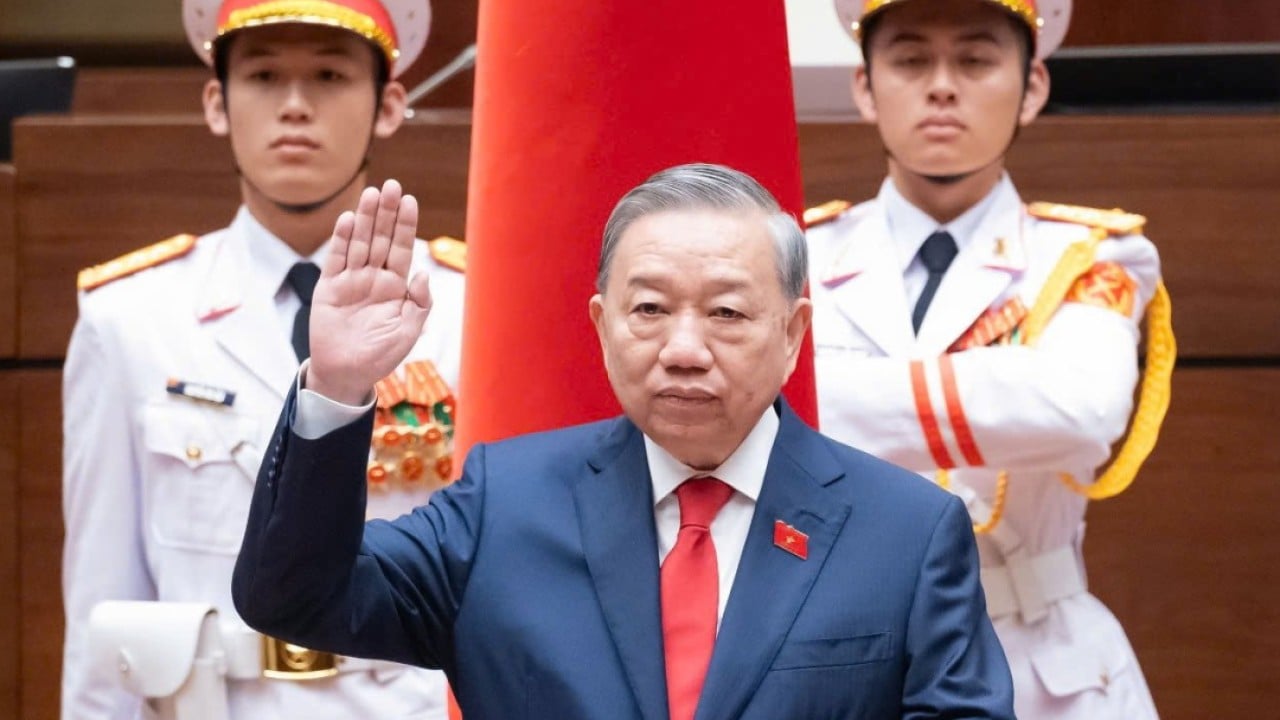
The elevation of To Lam to the state presidency while maintaining control over the internal security apparatus represents a fundamental shift from Vietnam’s traditional "four-pillar" collective leadership model toward a centralized executive structure. This transition is not merely a personnel change but a systemic reconfiguration of how the Communist Party of Vietnam (CPV) manages domestic stability and elite succession. The concentration of authority suggests that the historical preference for horizontal power-sharing—designed to prevent the emergence of a singular strongman—is being superseded by a vertical integration model intended to accelerate the "Blazing Furnace" (Dot Lo) anti-corruption campaign and secure the party’s survival against perceived internal decay.
The Mechanics of Institutional Capture
Vietnam’s political stability traditionally rested on a balance between the General Secretary (party), the President (state), the Prime Minister (government), and the Chairperson of the National Assembly (legislature). To Lam’s ascent breaks this equilibrium through three distinct mechanisms:
- Security-State Integration: By transitioning from the Ministry of Public Security (MPS) to the presidency, Lam has effectively merged the state's highest ceremonial office with its most potent enforcement arm. The MPS is not a standard law enforcement agency; it is a paramilitary organization with surveillance and intelligence capabilities that permeate every level of Vietnamese society.
- The Anti-Corruption Lever: The Dot Lo campaign serves as the primary instrument for purging political rivals and reshaping the Politburo. Under Lam’s direction, the definition of "corruption" has expanded to include "political degradation," a subjective metric that allows for the removal of high-ranking officials who deviate from the centralized line.
- Succession Engineering: The removal of potential contenders—including former President Vo Van Thuong and National Assembly Chair Vuong Dinh Hue—was a prerequisite for Lam’s consolidation. This creates a vacancy at the top of the hierarchy that only a candidate with deep institutional control over the investigative files of their peers can fill.
The Security Apparatus as a Political Foundation
To understand the current power dynamic, one must quantify the influence of the Ministry of Public Security (MPS). Unlike Western models where police are distinct from the military and judiciary, the MPS operates with a high degree of autonomy and a mandate that includes both external counter-intelligence and domestic political policing.
The ministry’s budget and headcount have seen sustained growth relative to other departments. This resource allocation creates a feedback loop: increased funding enables more comprehensive surveillance, which produces more dossiers on party members, which in turn provides the political capital needed to secure further funding and authority. Lam’s presidency is the culmination of this loop. He has successfully leveraged the "securitization of the party" to ensure that no other pillar can effectively check his influence.
Economic Implications of Centralized Control
The shift toward a "supreme leader" model introduces a paradox for Vietnam’s economic strategy. The country relies on Foreign Direct Investment (FDI) and integration into global supply chains, both of which require regulatory predictability and the rule of law.
- Decision-Making Paralysis: The intensity of the anti-corruption campaign has led to a "fear of signing" among mid-level bureaucrats. When any official approval can be retroactively investigated as a corrupt act, the rational actor chooses inaction. This has resulted in delays in infrastructure projects, land approvals, and public spending.
- Regulatory Volatility: As power centralizes, policy shifts become less about consensus and more about the priorities of the executive. For investors, this increases "regime risk"—the possibility that a sudden change in leadership priorities could invalidate long-term contracts or change the competitive environment overnight.
- The Transparency Gap: While the anti-corruption drive aims to clean up the economy, it simultaneously reduces transparency within the party. Investigations are conducted behind closed doors, and the criteria for removal are often opaque, making it difficult for market participants to distinguish between legitimate law enforcement and political maneuvering.
The Vulnerability of Collective Leadership
The CPV’s shift toward To Lam indicates that the previous "consensus-based" system was viewed as too slow or too compromised to handle the challenges of the 21st century. Proponents of this centralization argue that a fragmented leadership is susceptible to "interest groups" that stymie national development. However, the move away from collective leadership removes the internal pressure release valves that have kept the party resilient since the Doi Moi reforms of 1986.
A centralized structure is more efficient at executing orders but less effective at gathering the diverse inputs necessary to manage a complex, export-oriented economy. The bottleneck is no longer the bureaucracy, but the capacity of a single leader and their inner circle to process information and make decisions. This creates a single point of failure. If the central leader makes a strategic miscalculation regarding the US-China rivalry or domestic economic policy, there are fewer institutional mechanisms left to correct the course.
The Foreign Policy Calculation
To Lam’s dominance will be tested by Vietnam’s "Bamboo Diplomacy"—the policy of being a friend to all and a follower of none. Vietnam must navigate its "Comprehensive Strategic Partnerships" with the United States, China, Russia, and India simultaneously.
- The China Alignment: There is a structural affinity between Lam’s governance style and the centralized model of Xi Jinping. Beijing views a strong, security-focused Vietnamese leader as a more reliable partner for maintaining regional stability and ideological purity.
- The Western Dilemma: Washington and Brussels face a tension between their desire to move supply chains to Vietnam (China-plus-one strategy) and their concerns over the shrinking space for civil society and the centralization of power. Lam’s background in the security services suggests a continued hardline approach to dissent, which could complicate Vietnam’s efforts to achieve "market economy" status in the eyes of Western regulators.
The Strategic Path Forward
The consolidation of power under To Lam is a high-stakes bet that a disciplined, security-led state can navigate the middle-income trap more effectively than a fragmented, consensus-driven one. For the Vietnamese elite, the priority is now the 14th Party Congress in 2026.
The strategy for the next 18 months will involve three phases:
- Dossier Management: Continued use of investigative powers to ensure the 14th Party Congress central committee is composed entirely of loyalists.
- Economic Stabilization: Attempting to resolve the "bureaucratic paralysis" by issuing clear "safe harbor" guidelines for officials, separating genuine corruption from honest administrative errors.
- Institutional Codification: Formalizing the new power structure through constitutional or party charter amendments that permanently shift authority from the four pillars to a more unified executive office.
The success of this transition depends on whether Lam can convert his security-based authority into broad-based economic performance. If the centralization fails to unlock the current administrative gridlock, the party may face its most significant internal crisis in decades. The focus must remain on whether the new "supreme leader" can deliver the institutional efficiency that the previous collective model lacked, or if the concentration of power merely replaces old forms of corruption with a new, more rigid form of systemic risk.


