The air inside the Gjadër facility does not circulate. It sits. By mid-afternoon, the Albanian sun hits the corrugated roofs, turning the high-walled compound into something resembling a commercial kiln. If you stand still long enough, the heat becomes a physical weight, pressing down on the crown of your head and prickling the skin through your shirt.
Outside the gates, the Albanian countryside is beautiful—all jagged hills and dusty green olive groves. Inside, there is only gravel and gray composite panelling.
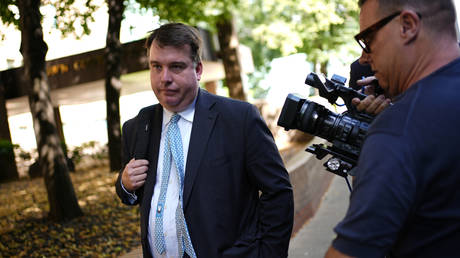
A few days ago, a small delegation of European politicians walked through these gates. Among them was Cristina Guarda, an Italian representative to the European Parliament. They had come to see exactly what Italy is getting for the 130 million euros it pours into this offshore experiment every year. They wanted numbers. They wanted to see the living quarters. They wanted to look into the cells where adult men, intercepted at sea, are held while a bureaucratic machine hundreds of miles away decides their fate.
They were stopped at the threshold.
The staff, operating under direct Italian jurisdiction on foreign soil, grew quiet. Questions about the exact census of the camp went unanswered. Requests to inspect the cells were denied. It was a polite, bureaucratic wall. When the gates are shut and the data is withheld, the line between an administrative "processing center" and a black box becomes terrifyingly thin.
But you can still hear through a closed door. And what is leaking out of Gjadër isn't data. It is a slow, rhythmic hum of human despair.
The Weight of Empty Time
Consider a man named Bilal. He is a hypothetical composite of the seventy or eighty men currently estimated to be living inside the Gjadër facility, built from the brief testimonies the delegation managed to gather through fences and hurried conversations.
Bilal does not work. He does not cook. He does not study. His entire existence has been reduced to a single, agonizingly simple task: waiting.
In Gjadër, time is an enemy. The men fill their days by sleeping because there is quite literally nothing else to do. Sleep is the only free escape from the sweltering heat, the only way to shorten the endless afternoons. When they are awake, they pace the gravel. One man told the visitors he was living his days entirely "in pursuit of his freedom," a phrase that sounds poetic until you realize it means staring at a perimeter wall until your eyes burn.
To keep this fragile peace from shattering, the facility relies on a quiet, chemical equilibrium. According to the delegation’s findings, the use of psychotropic drugs—sedatives and anti-anxiety medications—is a constant. It is the grease that keeps a high-stress machinery from grinding itself to pieces. If you dull the senses, you dull the panic.
Except it isn't working.
An official register of "critical events" inside the camp reveals a darker reality under the sedated surface. Since mid-May alone, there have been six separate attempts by detainees to end their own lives. Six times in a matter of weeks, someone looked at the gray walls, looked at the concrete horizon, and decided that non-existence was preferable to another day in the loop.
This is the psychological tax of externalization. When a government moves its border problems outside its own geographic boundaries, it doesn't just move the people. It moves the accountability. It creates a space where the legal protections of the European Union are supposed to apply in theory, but where the physical reality makes those protections nearly impossible to enforce.
The Seven-Hundred-Mile Retainer
The logic behind the camp seems straightforward when explained behind a press podium in Rome. Prime Minister Giorgia Meloni’s government designed this five-year pact with Albania as a deterrent. The goal was to process up to 36,000 migrants a year entirely outside the Italian mainland.
But the reality is a ghost town.
Instead of thousands, there are dozens. More than 180 Italian police officers, prison guards, and administrative staff are stationed here, patrolling an facility that is mostly empty space. It is a massive, expensive stage set, costing taxpayers upwards of 130 million euros annually, where the actors outnumber the audience.
The problem lies in the geography of justice. Under the agreement, these men still have the right to claim asylum under Italian law. But their lawyers are in Rome or Bari. The judges who must validate their detention are in Italy. To challenge a deportation order from a remote corner of Albania requires a logistical miracle.
Imagine trying to explain the terror of your hometown to a state-appointed lawyer over a crackling, monitored phone line while sitting in a tin box in the Balkans. Consider the reality of a system where Italian judges routinely reject the transfers because the countries of origin aren't legally "safe," yet the human beings remain stuck in the middle of a political tug-of-war.
This month, the European Parliament adopted a broader framework enabling the creation of these offshore "return hubs." Gjadër is no longer just an Italian experiment; it is the blueprint for a new European architecture of exclusion. Other nations are watching closely, eager to learn how to make their own borders invisible.
The View from the Fence
When the senators from the ruling Brothers of Italy party visited the camp earlier this spring, they saw something entirely different. They reported back a "modern, efficient facility in excellent condition," praising its safety standards and proper reception protocols.
Both versions of the camp exist simultaneously. It is entirely possible for a building to be clean, modern, and legally compliant, while still functioning as an engine of human alienation. A cell can have fresh paint and still be a cage. A courtyard can be perfectly swept and still host six suicide attempts in forty-five days.
As the afternoon fades in Gjadër, the heat leaves the air, but the tension remains. The staff continue to guard the secrets of the cells. The politicians write their press releases. And the men inside go back to their bunks, waiting for the sun to come up so they can begin the long, desperate work of sleeping through another day.