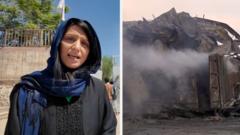
The debris of a drug rehabilitation center in Kabul now serves as a grim testament to the volatile security vacuum currently defining the Afghan-Pakistani border. When Pakistani airstrikes crossed into Afghan airspace targeting alleged TTP (Tehrik-i-Taliban Pakistan) hideouts, they didn't just hit tactical positions; they demolished a facility meant for the most vulnerable members of a broken society. This escalation signals a dangerous new phase in regional relations where domestic political pressure in Islamabad is manifesting as lethal kinetic action in Kabul. The strike highlights a fundamental breakdown in the "brotherly" relationship once expected between the Taliban government and the Pakistani military establishment.
The Geography of Miscalculation
Military strikes are surgical only in press releases. On the ground, the reality is messy, loud, and often tragic. The facility in question, located in a region already struggling with an influx of displaced persons and a rampant narcotics epidemic, was an unlikely target for high-level counter-terrorism operations. By hitting a civilian-focused infrastructure, the strikes have provided the Taliban administration with a powerful narrative of victimhood, shifting the focus away from their own inability—or unwillingness—to restrain the TTP. For an alternative perspective, check out: this related article.
Pakistan’s frustration is not unfounded, but its execution is failing. For years, Islamabad banked on a friendly government in Kabul to provide "strategic depth" and a secure western flank. Instead, they found a neighbor that views sovereignty as absolute and refuses to act as a proxy for Pakistani security interests. The TTP has used this friction to its advantage, launching increasingly sophisticated raids into Pakistan’s Khyber Pakhtunkhwa province before retreating across the Durand Line.
The strikes were meant to be a deterrent. They were a message sent in fire. However, the message received by the Afghan public was one of foreign aggression, not counter-terrorism. When a rehab center becomes a casualty of a geopolitical grudge match, the local population loses faith in both the neighbor who dropped the bombs and the government that failed to stop them. Further coverage regarding this has been shared by USA Today.
The Narcotics Crisis Amidst the Rubble
Afghanistan is currently battling one of the highest addiction rates in the world, a lingering hangover from decades of war and a collapsed economy. The Taliban’s ban on poppy cultivation, while strictly enforced in many provinces, has done little to help those already hooked on methamphetamine and heroin. Facilities like the one hit in Kabul are rare and desperately needed.
The Irony of Target Selection
- Vulnerability: Rehab centers often house hundreds of men in cramped conditions, making any kinetic strike a high-casualty event.
- Infrastructure: These buildings are frequently converted warehouses or older residences that lack the structural integrity to withstand modern munitions.
- Visibility: Unlike hidden insurgent camps, these facilities are public and known to local authorities, making their destruction an undeniable public fact.
The choice of target suggests either a catastrophic intelligence failure or a reckless disregard for civilian life. If the goal was to eliminate TTP leadership, hitting a public health facility in a populated area represents a gamble that has clearly backfired. Intelligence on the ground in Afghanistan has become notoriously "noisy" since the US withdrawal, with local informants often settling personal or tribal scores by feeding false coordinates to foreign intelligence agencies.
A Failed Proxy Strategy
The current animosity is the logical conclusion of a decades-long policy that prioritized militant proxies over state-to-state stability. Islamabad spent years supporting the Afghan Taliban’s insurgency against the US-backed Republic, under the assumption that a Taliban victory would secure the border. This was a massive miscalculation. The Afghan Taliban and the TTP share a common DNA, a common ideology, and a common history of fighting side-by-side. Expecting the former to betray the latter was a fantasy.
Now, the Pakistani state finds itself in a "blowback" cycle. The TTP has been emboldened by the Taliban’s success in ousting a superpower. They see no reason why they cannot achieve the same in Islamabad. By launching airstrikes into Afghanistan, Pakistan is attempting to force the Taliban’s hand through economic and military pressure. But the Taliban leaders are men who spent twenty years in caves and mountains; they do not bend easily to the threat of force.
The Economic Leverage
Pakistan still holds significant cards, but they are playing them poorly.
- Trade Corridors: Much of Afghanistan’s trade flows through the port of Karachi.
- Refugee Repatriation: The ongoing expulsion of Afghan refugees from Pakistan is a direct pressure tactic.
- Border Crossings: Frequent closures at Torkham and Chaman stifle the Afghan economy.
Despite these levers, the strikes represent a shift from "grey zone" pressure to overt warfare. This transition usually indicates that all other diplomatic and intelligence-led options have failed.
The Sovereignty Trap
The Taliban’s response has been predictable and fierce. They have moved heavy weaponry toward the border and issued warnings of "consequences." For a regime that bases its entire legitimacy on having ended foreign occupation and restored Afghan pride, a violation of their airspace is an existential threat. They cannot afford to look weak.
This creates a dangerous feedback loop. Pakistan strikes because it feels insecure. Afghanistan reacts with belligerence because it must defend its sovereignty. The TTP, meanwhile, thrives in the chaos, using the tension to recruit more fighters and further entrench themselves in the border regions.
The destruction of the rehab center is not just a localized tragedy. It is a symptom of a regional security architecture that is fundamentally broken. There is no clear mechanism for conflict resolution between Kabul and Islamabad. The traditional "jirgas" and diplomatic channels are being bypassed in favor of drone strikes and artillery duels.
The Human Cost of Strategic Blunders
Beyond the geopolitical posturing lie the individuals who were seeking a way out of the darkness of addiction. For them, the rehab center was a place of hope, however meager. The blast that leveled the walls also shattered the lives of the staff and residents who had nothing to do with the TTP or the Pakistani military’s grievances.
We see a pattern emerging where civilian infrastructure is increasingly caught in the crossfire of "deniable" or "limited" military actions. The international community, largely distracted by conflicts in Ukraine and the Middle East, has offered little more than perfunctory statements of concern. This indifference only encourages further escalations.
The Taliban are now faced with a choice: do they continue to harbor a group that is bringing fire down upon their cities, or do they risk a domestic rift by cracking down on their ideological brothers? Conversely, Pakistan must decide if it wants to turn a neighbor into a permanent enemy. The current trajectory suggests a long, bloody stalemate where the only certainty is more collateral damage.
The smoke clearing over the Kabul rehab center reveals a stark reality. There is no military solution to a problem rooted in decades of shared extremism and porous borders. Every bomb dropped on Afghan soil serves as a recruitment poster for the very insurgents Pakistan seeks to destroy. If the goal was security, the result has been the exact opposite. The border is more volatile, the rhetoric is more toxic, and the bodies in the rubble are a reminder that in this game of strategic depth, it is the civilians who pay the ultimate price.
Military force without a viable political strategy is just noise and blood. Islamabad is currently providing plenty of both, while Kabul remains defiant, sheltered by the same rugged geography that has thwarted every attempt to tame it. The cycle of strike and counter-strike is not a strategy; it is an admission of failure.
Stop looking for a clean exit from this mess. There isn't one. The rubble in Kabul is a permanent scar on a relationship that was built on a foundation of sand. Until both sides acknowledge that their proxy games have failed, the border will continue to bleed.