The Invisible Freight
A silent, aluminum cylinder roughly the size of a microwave drifts five hundred miles above the Pacific Ocean. To the naked eye, it is just another piece of expensive metallic driftwood catching the glare of a distant sun. But inside its pressurized chassis, something unprecedented is happening. A tiny, specialized silicon processor hums, chewing through gigabytes of raw, thermal telemetry data captured moments ago from a typhoon swirling over Asia.
Down on Earth, we are accustomed to thinking of space as a mirror. For decades, satellites did little more than bounce signals from Point A to Point B, or snap photographs to be processed hours later by massive, climate-controlled server farms in Virginia or Beijing. The sky was dumb. The ground was smart.
That architecture is breaking down.
Consider a hypothetical intelligence analyst we will call Sarah. She sits in an unmarked building outside Washington, D.C., watching a digital map of the South China Sea. In the old way of doing things, when a reconnaissance satellite passed over a port of interest, it beamed raw, high-resolution imagery back to a ground station. From there, the data traveled via fiber-optic cables to a centralized data center, waited in a queue, and was finally parsed by an algorithm to detect new naval deployments. Total elapsed time: forty-five minutes.
In a modern conflict, forty-five minutes is an eternity. Hypersonic missiles bridge continents in less time.
Now, look at the alternative. The satellite passing overhead doesn't just look; it thinks. It runs localized artificial intelligence models right there in the vacuum. It discards the useless data—the empty ocean water, the cloud cover—and beams a single, hyper-compressed alert directly to Sarah’s terminal: Destroyer leaving drydock. Heading 180 degrees. Total elapsed time: ninety seconds.
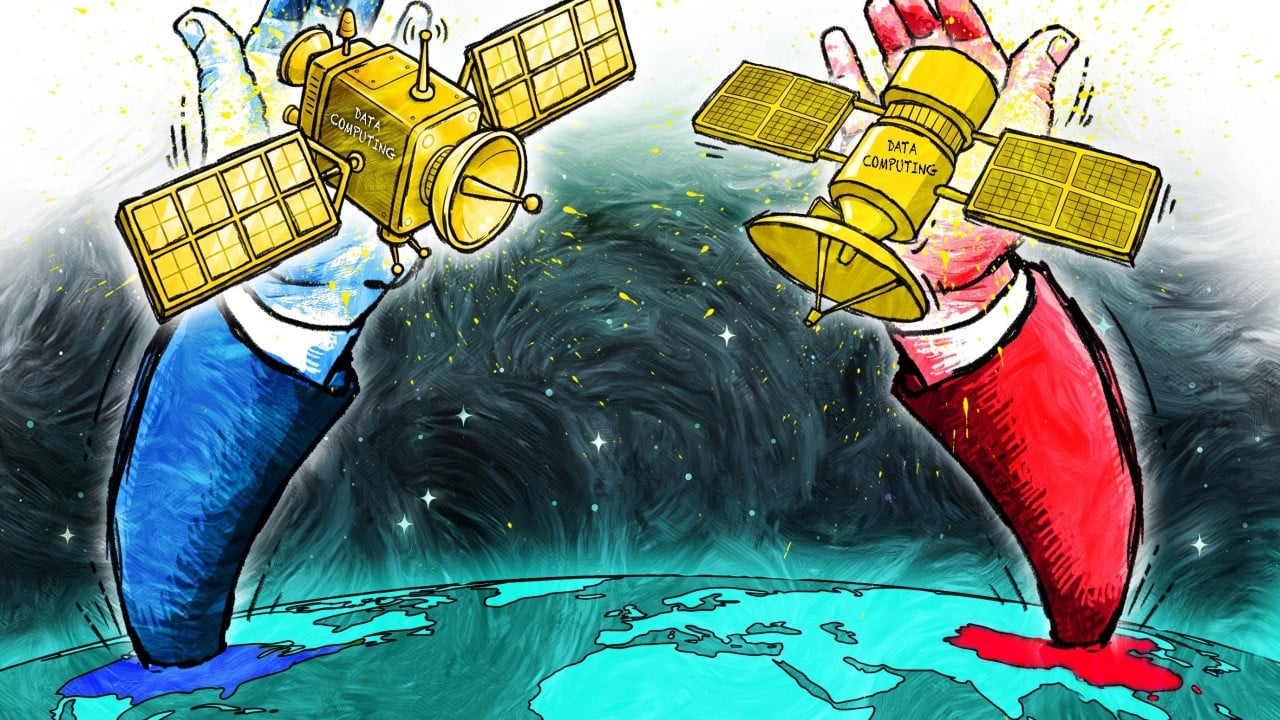
This is the birth of orbital edge computing. It is the reason the United States and China are quietly locked in a frantic, trillion-dollar scramble to turn Low Earth Orbit (LEO) into the world’s next tech stack. The nation that wins this race will not just possess better eyes in the sky. They will possess the brain that controls them.
Why the Cloud is Starving
To understand why tech giants and military strategists are looking to the stars, you have to understand the fundamental lie of the terrestrial internet. We call it "the cloud," a term that evokes something weightless, omnipresent, and ethereal.
In reality, the internet is a series of brutal, concrete warehouses stuffed with copper, silicon, and fans that scream twenty-four hours a day to keep machines from melting. These data centers consume terrifying amounts of water and electricity. More importantly, they are bound by the most stubborn speed limit in the universe: the speed of light.
When you send a request from a smartphone, that signal travels through air and glass fibers. It takes time. For a consumer loading a video, a delay of one hundred milliseconds is a minor annoyance. For an autonomous drone dodging anti-aircraft fire, or an automated financial trading algorithm executing a billion-dollar short position, that same delay is fatal.
The ground is simply getting too crowded, too slow, and too vulnerable.
If a nation wants to cripple its rival's digital infrastructure today, the targets are obvious. You cut the undersea cables snaking across the Atlantic floor. You bomb the massive server complexes in Europe or North America.
But if you move the critical processing nodes into the sky? If you distribute your compute power across a constellation of ten thousand interconnected satellites? Suddenly, your network becomes effectively immortal. You cannot bomb a cloud that has no physical address.
The Great Silicon Exodus
The transition from terrestrial data centers to space-based networks is not a speculative vision for the next decade. It is happening right now, driven by a radical drop in the cost of reaching orbit.
For fifty years, launching anything into space required the budget of a sovereign nation. Satellites were bespoke, billion-dollar masterpieces designed to last twenty years without a single hardware upgrade. They were terrified of innovation because innovation brought risk.
SpaceX changed the math. Reusable rockets turned launch into a logistics business rather than a scientific miracle. Suddenly, putting a kilogram of payload into orbit became cheap enough for commercial tech companies to treat satellites like smartphones—disposable, iterative hardware meant to be upgraded every few years.
Microsoft and Amazon quickly realized that whoever controls the orbital infrastructure controls the future of enterprise software. Microsoft partnered with defense contractors to test Azure space cloud capabilities, aiming to give deployed soldiers the ability to run heavy analytics on tactical laptops without needing a connection back to a home base. Amazon launched its Project Kuiper constellation, not merely to provide satellite internet, but to anchor its AWS cloud ecosystem firmly in the upper atmosphere.
Beijing viewed these developments with profound alarm.
Chinese military journals began publishing urgent analyses of the Starlink constellation during the early stages of the Ukraine conflict. They watched as Elon Musk’s civilian network kept Ukrainian artillery units connected under heavy Russian electronic warfare. The lesson was clear: commercial space infrastructure is inherently strategic.
In response, China initiated its own mega-constellations, such as the "G60 Starlink" project out of Shanghai. The goal is to blanket the night sky with thousands of state-owned satellites equipped with advanced processing units.
This is not a race for prestige. It is a race for data sovereignty. If a country can force international data traffic to route through its orbital nodes, it gains unprecedented leverage over global commerce and intelligence.
The Hostile Vacuum
Yet, building a data center in space is an engineering nightmare that defies conventional logic.
Step inside a terrestrial server room, and you are met with a wall of cold, conditioned air forced through perforated floor tiles. In space, there is no air. There is no convection to carry heat away from a hard-working microprocessor.
When a computer chip runs at high speeds, it generates immense thermal energy. On Earth, fans and liquid cooling loops dissipate this heat into the atmosphere. In the vacuum of space, heat has nowhere to go. It can only escape via radiation, a painfully slow process. Run a standard commercial graphics card in an orbital slot without massive, heavy thermal shields, and it will literally cook itself to death within minutes.
Then comes the radiation.
Our atmosphere shields us from a constant bombardment of solar flares and galactic cosmic rays. Up in LEO, these high-energy particles tear through silicon like microscopic bullets. They don't just destroy hardware; they flip bits. A single cosmic ray hitting a memory module can change a 0 to a 1 in a line of code.
If that bit happens to be part of a guidance command for an orbital thruster, the satellite might suddenly fire its engines and plunge into the atmosphere to burn up.
Engineers are forced to play a psychological game of trade-offs. They can use ancient, heavily shielded, "space-hardened" chips that are virtually indestructible but possess the computing power of a 1990s graphing calculator. Or, they can use modern, fragile chips and build complex, redundant software architectures that constantly check for errors, accepting that a percentage of their hardware will inevitably lose its mind in the dark.
The Silent Chokepoint
The true battlefield of this conflict is not the hardware itself, but the bandwidth connecting it.
Traditional satellites communicate using radio frequencies. Radio waves spread out as they travel through space, becoming weak, distorted, and easily jammed by an adversary with a decent transmitter on the ground. Furthermore, the radio spectrum is strictly regulated by international bodies; there are only so many lanes available on the highway.
The solution is lasers.
Optical inter-satellite links use precise, invisible laser beams to pass data from one satellite to another at gigabit speeds over thousands of miles. This creates a literal web of light in the sky. Because laser beams are incredibly narrow, they are nearly impossible to intercept or jam without placing a physical object directly in the line of sight.
Imagine an American satellite over Central Asia collecting data. Instead of trying to broadcast that data through local jammer fields down to a vulnerable ground station, it flashes a laser to a sister satellite over the Indian Ocean, which passes it to another over Africa, and then over the Atlantic, landing the data securely in an Ohio server farm in less than a second.
China recognizes that breaking these laser webs is critical. Their research has shifted toward directed-energy weapons—ground-based lasers designed not necessarily to blow a satellite into shrapnel, but to blind its optical sensors, rendering its high-speed communication arrays useless.
The stakes extend far beyond military dominance. The country that perfects orbital edge computing will dictate the terms of global agriculture, climate science, and disaster response.
A farmer in Iowa or the Xinjiang province will no longer wait for a weekly crop report. They will receive real-time, AI-driven notifications from the sky telling them precisely which acre of soil is running dry, calculated by an orbital processor that analyzed the infrared signature of their fields twenty minutes prior.
The Shifting Horizon
We are moving toward an era where the boundary between the digital and the physical completely dissolves. For decades, humanity treated space as an empty, pristine theater—a place to look at, to admire, or to fear from a distance.
Now, we are filling that emptiness with our thoughts, our algorithms, and our rivalries.
The sky is no longer just an expanse of air and starlight. It is a living, thinking infrastructure that watches us, calculates our movements, and routes our secrets through the cold. We look up at the night sky and see a timeless quiet, blissfully unaware of the fierce, invisible torrent of data burning through the dark just above our heads, rewriting the rules of power on the world below.