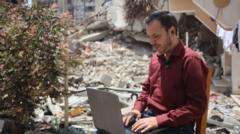
The screen glows in the dark. It is not the light of a streetlamp, nor the steady amber of a bedroom clock. It is the cold, insistent glare of an integrated development environment, casting sharp shadows across a cracked wall in Gaza.
Power comes in stolen gasps here. A generator hums three streets away, coughing diesel fumes into the night air. A frayed ethernet cable, spliced together with electrical tape and stubborn hope, links a battered laptop to a mobile hotspot that drops its signal every twenty minutes.
To the rest of the world, this is a remote workspace. To the person sitting in that chair, it is an airlock.
Let us be entirely clear about what remote work means in a place under siege. It is not about casual flexibility or wearing pajama bottoms to a morning sprint review. It is an act of quiet defiance. It is a lifeline woven from fiber-optic threads, stretching across blockades, checkpoints, and indifferent borders, connecting minds trapped in concrete enclosures to corporations thousands of miles away.
Think of code as water. It needs no physical passport. It slips through cracks, bypasses walls, and refuses to be blockaded. When physical movement is restricted to zero, when every exit is sealed and every port is closed, the mind remains the final sovereign territory.
Consider a hypothetical developer named Tariq. He is twenty-six, though the lines carved around his eyes make him look forty. Before the current crisis, he worked in a sleek co-working space in Gaza City with beanbag chairs, an espresso machine, and a high-speed fiber connection that made downloading a gigabyte take seconds. That office is now a heap of twisted rebar and grey dust.
Tariq now works from the corner of a crowded school classroom turned temporary shelter, sitting on a thin foam mattress, his laptop balanced precariously on a plastic storage bin. Around him, children cry softly in their sleep. The ambient noise is a cacophony of shared misery. Yet, on his screen, he is fixing a memory leak in a React Native application for a fintech startup in London.
He types. The bugs vanish. The pull request gets merged. To the engineers in London reviewing his code, Tariq is just a handle on GitHub pushing commits at odd hours. They know he faces power cuts. They send messages asking if he is safe, but the work waits for no one. The sprint cycle spares no sympathy for geopolitics.
This is the strange duality of the modern knowledge economy. It is fiercely digital yet intensely physical in its consequences.
For decades, economic development models for conflict zones relied on physical aid packages, humanitarian handouts, and subsistence survival. But survival without purpose is a slow erosion of the soul. Tech work offers something radical. It offers agency. It pays in hard currency that can buy flour when the markets are empty. It offers professional dignity to people who are otherwise reduced to statistics on the evening news.
The statistics tell a stark story. Before the escalation of hostilities, Gaza boasted a burgeoning tech sector. Thousands of young graduates poured out of local universities every year, fluent in Python, JavaScript, and machine learning, fluent in the universal grammar of logic. They were building outsourcing hubs, winning contracts with international clients, and planting seeds of a digital economy.
Then came the fractures.
Infrastructure does not merely get damaged; it vaporizes. Subsea cables are severed. Cellular towers are reduced to skeletal steel. The cost of a gigabyte of mobile data skyrockets as supply chains collapse. Yet, brilliant minds find a way. They pool their meager resources, charging batteries from solar panels rigged to apartment balconies, walking miles to find a pocket of 4G coverage, trading shifts on shared laptops like soldiers guarding a strategic trench.
Why do they do it?
Money, yes. Survival demands it. Flour costs ten times what it did a year ago. Cooking gas is a luxury remembered only in faded photographs. But dig deeper. Listen to what these workers say when you ask them why they don't just give up and stand in the breadlines all day.
They talk about flow states. They talk about the moment a complex algorithm finally compiles, the pure intellectual adrenaline of solving a difficult architectural problem. In a reality defined by chaos, code is pure order. If you write the syntax correctly, the computer obeys. It does not care where you were born. It does not check your ID at a checkpoint. For a few uninterrupted hours, Tariq is not a refugee in a war zone. He is simply a senior software engineer optimizing a database query.
That mental escape is as vital as the protein bars bought with his wages. It preserves humanity against a system designed to strip it away.
There is a broader lesson here for the global tech community. For years, Silicon Valley and European tech hubs chased diversity metrics and remote talent pools in predictable places—Eastern Europe, Latin America, Southeast Asia. They looked at the Middle East through the narrow lens of conflict and instability, seeing only risk, never potential.
They missed the resilience.
When you hire someone who debugs production code while artillery shells echo in the distance, you are getting an engineer who possesses a level of grit that cannot be taught in a bootcamp. They do not complain about minor toolchain friction. They do not quit when a deployment fails. They have survived worse than a broken build pipeline.
Yet, hiring from Gaza is an administrative nightmare. International wire transfers get flagged by paranoid compliance departments. Payment processors block accounts originating from certain zip codes out of an abundance of legal caution. The financial architecture of the global economy is built on walls, not bridges, and it frequently mistakes the victims of a blockade for security threats.
Change is happening, slowly, unevenly. Decentralized networks, crypto-adjacent payroll rails, and rogue-hearted startup founders are finding workarounds. They are routing payments through trusted intermediaries, establishing micro-trust networks, and treating talent as what it is: universal and borderless.
Imagine what happens when the infrastructure is finally rebuilt. Imagine a Gaza with stable gigabit fiber, reliable solar grids, and a generation of developers who cut their teeth coding under impossible pressure. They will not just re-enter the global market. They will dominate it. Because adversity is the ultimate accelerator of competence.
The screen dims. The battery indicator blinks red. Ten percent. Five.
Tariq hits command-s one last time. He pushes the final commit. The message uploads just as the generator outside splutters and dies, plunging the room back into absolute shadow.
He closes the lid. The laptop goes dark. But across the ocean, on a server in a brightly lit data center, his work is running, breathing, alive.