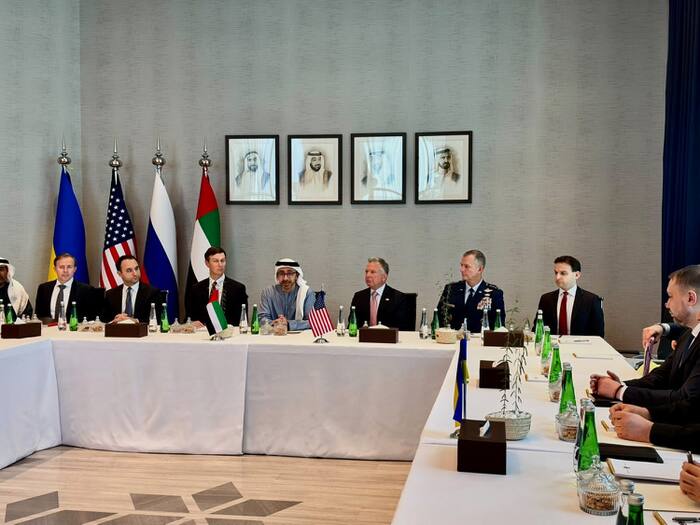
Diplomats have gathered in Abu Dhabi for US-mediated talks aimed at ending the Russia-Ukraine war, marking a high-stakes shift from open battlefield attrition to quiet, back-channel bargaining in the Persian Gulf. While official statements frame these discussions as a step toward stability, the reality inside the negotiating rooms involves hard compromises over territorial control, long-term security guarantees, and economic leverage. Neither Moscow nor Kyiv enters the United Arab Emirates from a position of absolute strength, forcing Washington to act less as a neutral referee and more as a power broker managing a frozen conflict.
Surface-level coverage tends to treat diplomatic summits as sudden breakthroughs. They rarely are. When envoys sit down in a neutral capital after years of mechanized warfare, they are usually codifying realities already established on the ground rather than inventing new ones out of thin air.
Why Abu Dhabi Became the Chosen Venue
Geopolitics dictates geography. Geneva, Vienna, and Helsinki once served as the default stages for East-West diplomacy during the Cold War and its immediate aftermath, but those European cities lost their utility the moment sanctions regimes hardened and airspace closed. Russian officials face severe travel restrictions across the European Union, while Ukrainian leaders refuse to meet on territory perceived as overly sympathetic to the Kremlin, such as Minsk.
The United Arab Emirates stepped into that vacuum with calculated precision. Abu Dhabi maintains open communication channels with Washington, Moscow, and Kyiv simultaneously. Over the past several years, Emirati officials have quietly facilitated multiple prisoner-of-war swaps between Russian and Ukrainian forces, proving they can keep sensitive negotiations out of the press until agreements are signed.
Money and energy also grease the diplomatic wheels. The UAE sits inside OPEC+ alongside Russia, giving Abu Dhabi direct economic ties to Moscow's primary revenue stream. At the same time, the Emirates rely heavily on American defense hardware and security partnerships, giving Washington substantial influence over the host nation. For a US administration looking to broker a settlement without giving either belligerent a home-field advantage, Abu Dhabi offers something increasingly rare in modern statecraft—a venue where everyone can land their planes without triggering an immediate diplomatic crisis.
The Architecture of Back-Channel Diplomacy
When talks begin in a place like Abu Dhabi, the real work happens far away from the main conference tables. Formal plenary sessions are largely theater, designed for official photographers and carefully worded press releases. The actual bargaining occurs in hotel suites, secure lounges, and bilateral side meetings where mid-level technical experts hash out the mechanics of a ceasefire.
These technical tracks usually split into distinct working groups:
- Line of Contact Monitoring: Determining who verifies a ceasefire, what satellite or drone surveillance is permitted, and how violations are penalized.
- Prisoner and Civilian Exchanges: Establishing verification protocols for detainees, deported children, and missing personnel.
- Economic and Sanctions Relief: Mapping out which financial restrictions are lifted first, and in what sequence, as specific military benchmarks are met.
- Transit and Trade Corridors: Securing maritime routes in the Black Sea and overland transit for agricultural and industrial goods.
What Washington Actually Wants Out of the Room
American foreign policy rarely operates on pure altruism, and the push for US-mediated talks on ending the Russia-Ukraine war reflects cold strategic math. Prolonged high-intensity warfare in Eastern Europe drains Western artillery stockpiles, strains defense industrial bases, and ties down diplomatic bandwidth that Washington wants to redirect toward the Indo-Pacific.
A negotiated settlement—or even a durable armistice—allows the United States to cap its open-ended financial and military commitments in Europe. Yet American negotiators face a brutal constraint. If Washington pushes Kyiv into accepting terms that look like capitulation, it shatters the credibility of US security assurances globally. Allies from Warsaw to Taipei are watching closely to see whether American backing holds firm or folds when domestic political fatigue sets in.
To thread that needle, US envoys typically rely on coercive diplomacy. This means using the promise of future weapons deliveries and reconstruction funding as a carrot for Kyiv, while threatening tighter secondary sanctions on Russian energy buyers as a stick for Moscow. Whether that dual pressure works depends entirely on whether both sides believe Washington has the political stamina to follow through on its threats.
The Territorial Trap Neither Side Can Escape
Every negotiation over the Russia-Ukraine war eventually slams into the same brick wall—sovereignty over occupied land. International law is unambiguous about borders, yet military reality on the ground creates facts that diplomats cannot simply wish away.
For Kyiv, ceding territory formally is political suicide. Ukrainian leadership faces a population that has endured massive casualties, displaced millions, and absorbed sustained attacks on civilian infrastructure. Signing away sovereign land in exchange for a piece of paper—especially after the failure of the 1994 Budapest Memorandum and the Minsk agreements of 2014 and 2015—invites internal upheaval and guarantees that future generations will fight the same war again.
Moscow operates under a completely different set of pressures. The Kremlin has already written annexed Ukrainian regions into the Russian constitution. Returning territory that Russian forces bled to capture would undermine the domestic narrative of state strength that keeps the current leadership secure. Moscow's negotiators want formal recognition of their territorial gains, permanent neutrality for Ukraine, and the dismantling of Western sanctions.
The Korean Armistice Model
Because formal territorial concessions are impossible for Kyiv and territorial withdrawals are unacceptable to Moscow, negotiators frequently look toward historical workarounds. The most prominent is the Korean Armistice Agreement of 1953.
Under a hypothetical Korean-style framework, neither side recognizes the other's legal claim to disputed territory. Instead, fighting stops along a heavily fortified demilitarized zone, freezing the conflict in place without a formal peace treaty. Ukraine would retain its legal claim to all internationally recognized borders while agreeing not to use military force to retake occupied areas. In exchange, Kyiv would receive bilateral security agreements from Western nations, funded reconstruction, and a path toward European Union integration.
The flaw in this model is obvious to anyone who has studied the Korean Peninsula over the last seventy years. An armistice does not end a war; it merely pauses it. Without a permanent political settlement, both sides spend decades heavily armed, staring across a fortified border while skirmishes and cyber warfare simmer just below the threshold of full-scale invasion.
Security Guarantees and the Paper Shield Problem
If Ukraine agrees to stop fighting without reclaiming all its territory, Kyiv's immediate demand is ironclad protection against a future Russian offensive. Ukrainian officials repeatedly point out that Russia used the pause after the 2014 annexation of Crimea to rebuild its military, harden its economy against sanctions, and launch a full-scale invasion eight years later.
Nobody in Kyiv trusts a Russian signature on a ceasefire document. They want hard security guarantees, which immediately raises the question of NATO membership.
Moscow views Ukrainian entry into NATO as an existential red line, making it a non-starter at the negotiating table. Washington and several major European capitals are equally hesitant to extend Article 5 mutual defense obligations to a country with an active border dispute, fearing it could pull American troops directly into a nuclear-armed conflict with Russia.
Negotiators in Abu Dhabi are therefore exploring middle-ground security architectures:
- The "Porcupine" Defense Strategy: Flooding Ukraine with long-range strike capabilities, dense air defense networks, and domestic arms manufacturing capacity so that any future invasion becomes prohibitively expensive for Moscow.
- Bilateral Mutual Defense Pacts: Individual treaties with the United States, the United Kingdom, France, and Germany that obligate those nations to supply immediate weapons, intelligence, and financial aid if Russia attacks again, stopping just short of deploying ground troops.
- European Peacekeeping Contingents: Deploying non-US European troops to monitor buffer zones, creating a tripwire effect that complicates Russian military planning without formally involving NATO command structures.
Each of these options carries massive execution risk. Weapons pipelines depend on future election cycles in Western democracies. A bilateral treaty signed by one American president can be watered down or ignored by a successor.
The Hidden Economic Leverage on the Table
While maps and troop movements dominate headlines, the sharpest knives in Abu Dhabi are drawn over money. Russia's war economy has proven more resilient than Western analysts predicted in 2022, largely due to pivot trade with Asia and state-directed military spending. However, high interest rates, labor shortages, and degraded energy infrastructure are steadily eroding Moscow's long-term fiscal health.
Russian negotiators view sanctions relief as a primary objective. Specifically, Moscow wants access to global financial messaging systems, the unfreezing of roughly $300 billion in immobilized Russian central bank assets held mostly in Europe, and the lifting of restrictions on maritime oil insurance and high-tech industrial imports.
Those frozen sovereign assets represent the single largest piece of financial leverage held by the West. Washington and Brussels have already moved to use the interest generated by those funds to back loans for Ukraine. Putting the principal itself on the negotiating table creates a stark choice for Moscow:
| Negotiating Lever | What Moscow Wants | What Washington and Kyiv Demand |
|---|---|---|
| Frozen Central Bank Assets | Full unfreezing and return of sovereign reserves to stabilize the ruble and state budget. | Permanent confiscation or redirection of funds to pay for Ukrainian post-war reconstruction. |
| Energy and Tech Sanctions | Removal of price caps, tanker restrictions, and export controls on microelectronics. | Phased, reversible relief tied strictly to verified troop pullbacks and ceasefire compliance. |
| Black Sea Maritime Access | Unrestricted commercial shipping from Russian ports and sanctions relief for agricultural exports. | Demining of shipping lanes and ironclad guarantees against strikes on Ukrainian grain ports. |
If Western negotiators give up sanctions relief too early, they lose their only non-military mechanism to enforce compliance once the shooting stops. If they refuse to budge on sanctions entirely, Moscow has little economic incentive to freeze a war that keeps its domestic population rallied around the flag.
Why Spoilers Could Derail the Summit Before It Starts
Diplomacy does not happen in a vacuum, and talks in Abu Dhabi remain vulnerable to events far outside the conference room. In modern conflicts, military operations often intensify right before and during peace negotiations as each side tries to grab one last piece of leverage to improve its hand at the table.
A sudden breakthrough on the front lines, a high-profile strike on critical infrastructure, or an intelligence leak revealing secret concessions can blow up months of quiet preparation overnight. Hardliners in both Moscow and Kyiv actively look for ways to sabotage compromises they view as betrayal. Within the Russian security apparatus, influential factions view perpetual confrontation with the West as essential to maintaining domestic control. Within Ukraine, civil society and veterans' groups wield immense moral authority and will fiercely resist any deal perceived as trading blood for empty promises.
European allies also complicate the equation. While Washington leads the mediation effort, European Union nations bear the brunt of the refugee crisis, energy market disruptions, and long-term reconstruction costs. If European leaders feel sidelined by a bilateral US-Russia understanding reached in the Gulf, they can quietly stall the sanctions relief or financial packages required to make the deal stick.
The Cold Reality of Negotiated Endings
History shows that wars rarely end when both sides suddenly discover a shared desire for peace. They end when the cost of continuing the fight exceeds the political pain of making compromises that were unthinkable a year earlier.
The US-mediated talks in Abu Dhabi are not a sign that Moscow and Kyiv have reconciled their fundamental differences. They are a recognition that attrition has pushed both nations—and their external backers—toward the limits of what they can sustain without risking catastrophic internal strain. Any agreement emerging from the Persian Gulf will be messy, incomplete, and deeply unpopular with hardliners on every side.
Watch the sequencing of the concessions rather than the rhetoric of the communiques. If the talks produce verifiable, step-by-step mechanisms—where specific sanctions are lifted only after independent monitors confirm troop withdrawals or ceasefire adherence—then real diplomacy is underway. If the summit yields only vague commitments to "continue dialogue" while artillery fire continues unabated along the front, Abu Dhabi will be remembered as just another tactical pause in a long war.