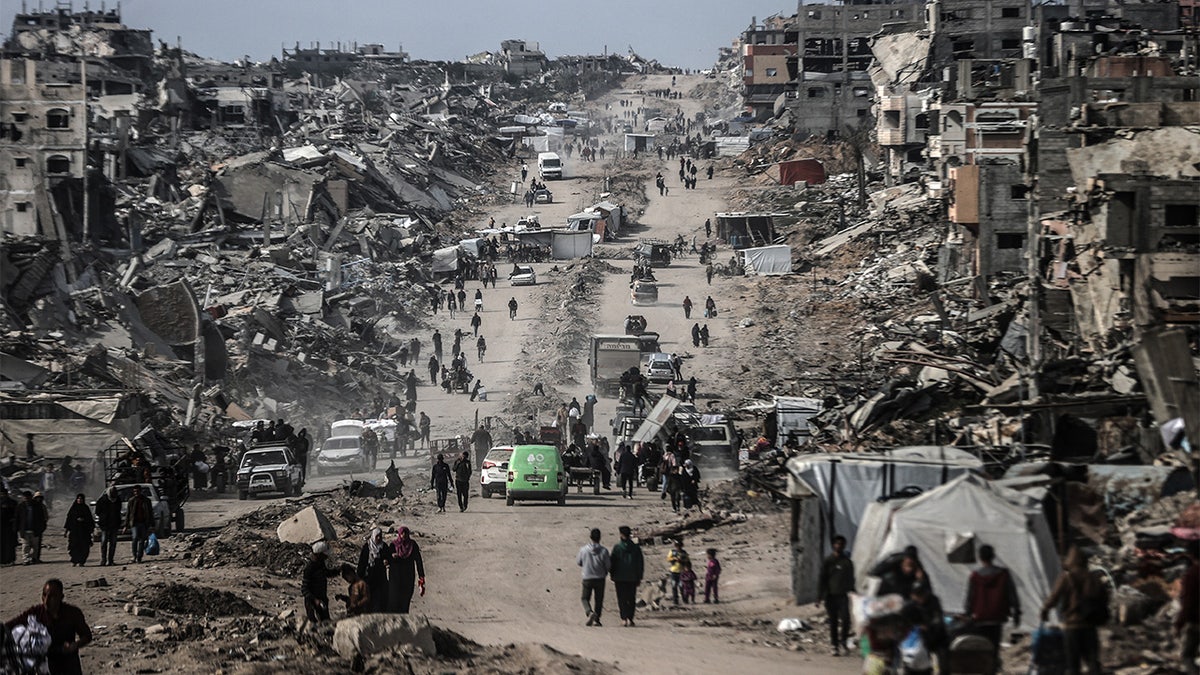
The dust in Tehran has a specific weight. It clings to the windshields of yellow taxis idling in the snarled traffic of Vali-e-Asr Street, a fine, gritty residue of the Alborz mountains and the dry plains beyond. On a Tuesday afternoon, a shopkeeper named Arash—let’s call him that, though his name matters less than his anxiety—wipes this dust from a display of transistor radios. He isn’t looking at the price tags. He is listening.
He is listening for a sound that hasn't arrived yet, but one that a high-ranking military official just promised is "likely" to return.
When a general stands before a microphone and speaks of renewed war with the United States, the words don’t just travel through copper wires and fiber-optic cables. They land in the kitchens of houses in Isfahan. They settle in the dormitories of Shiraz. They vibrate in the pockets of sailors in the Persian Gulf. For the strategist, "likely" is a percentage on a slide deck. For the person holding a grocery bag, "likely" is the sound of a door locking that might never open again.
The official statement was clinical. It spoke of regional deterrence, of "inevitable" confrontations, and the shifting geometry of Middle Eastern power. But there is nothing clinical about the trajectory of a ballistic missile or the silence of a drone. To understand what is happening between Washington and Tehran, we have to look past the podiums and into the eyes of the people who have spent forty years living in the shadow of a volcano.
The Weight of History on a Single Thread
To understand the present, we must acknowledge the ghost of 1980. For many in the West, history is a series of chapters in a textbook. In Iran, history is a physical scar. The Iran-Iraq War lasted eight years. It was a meat grinder that claimed nearly a million lives. Everyone there remembers someone who didn't come home. That collective memory acts as a dampener on the rhetoric, yet it also fuels the fire of defiance.
When the General says war is likely, he is tapping into a reservoir of survivalist pride. He is telling a story of a nation that cannot be broken. But beneath that pride is a logistical reality that is far more fragile than any military parade suggests.
Consider the Strait of Hormuz. It is a narrow neck of water, barely twenty-one miles wide at its tightest point. Roughly one-fifth of the world’s total oil consumption passes through this throat every single day. If you want to understand the "invisible stakes," don't look at the missiles. Look at the insurance premiums for a single VLCC (Very Large Crude Carrier). When the rhetoric spikes, those premiums don't just rise; they explode.
This isn't just about the price of gas in a suburb in Ohio. It is about the ability of a factory in Shenzhen to keep the lights on. It is about the cost of a loaf of bread in Cairo. The world is a web of invisible threads, and every time a commander speaks of "renewed war," he is pulling on those threads until they hum with tension.
The Math of Miscalculation
War is rarely a choice made in a vacuum. It is usually the result of a series of small, logical steps that lead to an illogical destination.
Imagine two ships in the Persian Gulf. It is 3:00 AM. The humidity is so thick you can feel it in your lungs. On one side, a young U.S. Navy lieutenant, barely twenty-four years old, watches a radar screen. On the other, an Iranian Revolutionary Guard captain, perhaps only a few years older, maneuvers a fast-attack craft. Neither wants to die. Neither wants to start a global conflagration.
But the air is charged. The political rhetoric from their respective capitals has told them that the other is an existential threat. A sudden movement, a misunderstood radio transmission, or a technical glitch in a navigation system—these are the sparks.
The General says war is likely because he believes the political paths are closed. When diplomacy becomes a dead language, the only thing left to speak is steel. This is the danger of "likely." It becomes a self-fulfilling prophecy. If you believe a punch is coming, you tighten your fist. When the other person sees your fist tighten, they swing.
Logic fails when fear takes the wheel.
The Invisible War Already in Progress
While we wait for the "big" war, we often miss the small ones being fought in the dark. The General’s comments ignore the fact that the conflict is already happening. It’s in the code.
For years, the U.S. and Iran have been engaged in a shadow war of bits and bytes. This isn't the war of 1944. There are no beachheads. Instead, there are sudden blackouts in provincial cities. There are gas station pumps that refuse to dispense fuel. There are centrifuges that spin themselves into scrap metal because a line of code told them to.
The human element here is different. It’s the surgeon who loses power in the middle of a delicate operation. It’s the family that can’t buy fuel to get to work because the payment system is frozen. This is the "renewed war" the General speaks of, but he frames it in the language of the 20th century. He speaks of "clashes," while the reality is more like a slow-motion strangulation.
The sanctions are another front. To a politician, a sanction is a "tool of statecraft." To a parent in Tehran trying to find specialized medicine for a child with a rare heart condition, a sanction is a wall. It is a physical barrier between their child and a healthy life. When the military official speaks of the likelihood of war, he is speaking to a population that feels they have been under siege for a generation.
The Geometry of the Region
The conflict isn't just between two nations. It is a tectonic shift.
If war breaks out, it won't stay within the borders of Iran. It will bleed. It will spill into Lebanon, where Hezbollah sits with a massive arsenal pointed south. It will flare in Yemen, where the embers of a long-standing conflict are always ready to be fanned. It will ripple through Iraq, a country that has spent the last two decades trying to find its feet while two giants wrestle on its chest.
We often talk about "proxy wars" as if they are board games. They aren't. They are real people in real villages whose lives are the currency spent by larger powers. The General knows this. He knows that Iran’s "depth" isn't just its geography; it’s its influence. By saying war is likely, he is reminding the world that if Iran goes down, it will pull the pillars of the temple down with it.
It is a strategy of mutual ruin.
The Silence After the Speech
After the General leaves the stage, the cameras are packed away. The headlines are written. The markets in London and New York react with a predictable shudder.
But what happens in the quiet moments?
Back on Vali-e-Asr Street, Arash the shopkeeper finishes wiping the dust off his radios. He turns one on. He hears the news, the same news we are reading now. He doesn't panic. He doesn't run. He has heard this before. He has lived through the "likely" and the "imminent" and the "inevitable" for decades.
There is a profound exhaustion in being a pawn on a global chessboard.
The tragedy of the General’s statement isn't just the threat of violence. It is the theft of the future. When war is "likely," you don't invest in a new business. You don't plan a long-term project. You don't dream of what your city might look like in ten years. You just try to survive the next twenty-four hours.
The "human-centric narrative" of this conflict is one of interrupted lives. It’s the student who won't study abroad because visas are frozen. It’s the artist whose work will never be seen outside their own neighborhood. It’s the basic human desire for a boring, stable, predictable life, being sacrificed on the altar of geopolitical "deterrence."
The Edge of the Knife
We are currently standing on a blade.
On one side is the possibility of a grand bargain—a way to bring Iran back into the fold of the global economy in exchange for verifiable limits on its ambitions. On the other side is the General’s "likely" war.
The distance between these two outcomes is surprisingly small. It’s the thickness of a diplomat’s folder. It’s the length of a phone call that no one wants to make first.
The official’s words are a warning, yes. But they are also a plea for relevance. In a world where the U.S. is increasingly focused on the Pacific and China, the Middle East is fighting to remain at the center of the conversation. There is a terrifying logic in the idea that if you can’t be loved, you must be feared; and if you can’t be feared, you must be dangerous.
As the sun sets over the Alborz mountains, the shadows stretch long over Tehran. The city begins to glow with a million lights. From above, it looks like any other metropolis—vibrant, breathing, full of people who want nothing more than to eat dinner with their families and sleep in peace.
The General has his maps. The President has his briefings. But the real story is written in the heartbeat of the person who hears the word "war" and wonders if they should buy extra flour tomorrow.
We are not watching a movie. We are watching a slow-motion collision of histories, egos, and survival instincts. The drums are beating in the distance. They have been beating for a long time. The only question that remains is whether anyone has the courage to stop the rhythm before the music becomes a funeral march.
The dust continues to fall. It settles on the radios, the taxis, and the silent monuments of a city that has seen too many empires rise and fall to be easily shaken, yet remains terrified of the one thing it cannot control: the moment when "likely" finally becomes "now."