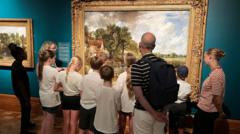
John Constable’s The Hay Wain has finally returned to the Suffolk landscape that inspired it, marking the first time the 1821 masterpiece has been exhibited in the region. The painting, which anchors the National Gallery’s collection in London, is the centerpiece of a high-security exhibition at Ipswich Museum designed to celebrate the bicentenary of the artist's peak creative years. While local tourism boards herald the move as a cultural triumph, the reality behind the scenes reveals a staggering logistical nightmare. Transporting a fragile, priceless artifact worth tens of millions of dollars into a regional museum requires an aggressive overhaul of local security, strict environmental engineering, and a level of financial risk that smaller institutions can rarely sustain.
Moving a masterpiece is never just about art. It is an exercise in military-grade logistics.
The Invisible Fortress Behind the Masterpiece
Regional museums are designed for local history, not international treasures. To clear the National Gallery’s stringent loan requirements, Ipswich Museum had to undergo a radical, multimillion-dollar infrastructure upgrade. The building essentially needed to become a vault.
Museum security relies on layers of deception and physical deterrence. For The Hay Wain, this meant retrofitting a historic structure with reinforced ballistic glass showcases, active vibration-monitoring sensors, and a dedicated biometric access system for handlers. The exact transport route from Trafalgar Square to Suffolk was kept classified, utilizes decoy vehicles, and relied on armed escorts.
Then there is the physical threat of activism. In recent years, climate protestors have targeted high-profile art across Europe, including an incident where activists glued themselves to this exact painting's frame. Bringing the piece to a more vulnerable regional venue magnifies the risk profile. Security personnel at the venue have been replaced with specialized contractors trained in rapid-response crowd control and chemical-solvent countermeasures.
The Microclimate War
The biggest threat to an oil painting on canvas isn't a thief. It is the air.
The Hay Wain is over two centuries old. The tension of its canvas, the adhesion of the ground layer, and the brittle stability of the oil paint rely on absolute atmospheric consistency. The National Gallery mandates a strict environment of 21°C (70°F) with a relative humidity variance of no more than plus or minus 5%.
Maintaining these metrics in a modern, purpose-built facility is difficult. Doing so in an older regional building is a logistical battle. The museum had to install a localized microclimate micro-HVAC system within the exhibition gallery itself.
- Relative Humidity: High humidity causes the canvas to expand, leading to paint flaking. Low humidity causes contraction, cracking the centuries-old varnish.
- Particulate Filtration: Regional systems must handle increased foot traffic without allowing dust, outdoor pollen, or clothing fibers to settle near the artwork.
- Gaseous Pollutants: Older buildings often outgas volatile organic compounds (VOCs) from historic wood or old paint, which can chemically degrade historic pigments over a prolonged exhibition run.
If the climate control fails for even three hours, the structural integrity of the paint layers faces irreversible micro-fracturing. The museum had to install redundant backup generators and triple-filtered air loops just to qualify for the loan.
The Economics of Cultural Patrimony
This exhibition exposes a deep divide in how national heritage is managed. The UK’s major cultural assets are heavily centralized in London, forcing regional populations to travel to the capital to experience their own history. Decentralizing these works is culturally democratic, but financially punitive.
The cost of insurance premiums, specialized transit, and infrastructure upgrades for this single loan could have funded the museum’s regional outreach programs for a decade. Local governments frequently subsidize these high-profile loans in the hope of a tourism boom, yet the economic return is rarely guaranteed. The surge in foot traffic often strains local infrastructure without generating sustained, long-term economic development.
Furthermore, the environmental footprint of moving a single painting under climate-controlled, high-security transport runs directly counter to the green initiatives championed by modern arts organizations. It requires a dedicated fleet of temperature-regulated vehicles burning fuel to move an object that was already safely housed in a world-class facility.
The Local Reality
Outside the museum walls, the landscape Constable painted no longer exists. The pristine, idyllic rural economy depicted in The Hay Wain has been replaced by industrial agriculture, modern flood defenses, and the creeping pressures of commercial development. Standing in Suffolk looking at the canvas creates a jarring disconnect between historical romanticism and modern ecological reality.
The painting functions as a ghost. It returns to a birthplace that has outgrown it, housed inside a temporary fortress that costs more to maintain per week than the surrounding neighborhood's average annual income.
The logistical theater required to stage this homecoming proves that masterpieces are no longer just art. They are geopolitical entities, anchored by heavy capital and protected by walls of technology. The triumph of bringing the painting to Suffolk is real, but it highlights a uncomfortable truth: our cultural institutions are spending millions to simulate the past inside a box, while the world outside continues to erode.