The water does not arrive with the dramatic roar of a cinematic tidal wave. It creeps. It seeps through the floorboards of kitchenettes in North Jakarta, smelling of salt, sewage, and old engine oil. It claims a doorstep in April, a lower cabinet by August, and an entire neighborhood by the following monsoon.
For decades, the people of Jakarta have played a slow-motion game of chess with the Java Sea. They raise their beds on concrete blocks. They build makeshift brick dikes outside their storefronts. But the sea is not playing. It is winning.
Jakarta is sinking. Not figuratively, and not at the leisurely pace of normal geological shifts. In some northern districts, the ground is dropping by up to ten centimeters every single year. It is a metropolis of over ten million souls literally drowning under the weight of its own existence.
To understand why a nation would decide to abandon one of the most economically vibrant megacities on Earth and hack a brand-new capital out of the ancient rainforests of Borneo, you have to stand in the mud of Jakarta first. You have to feel the damp desperation of a city running out of time.
The Weight of Ten Million Lives
Imagine a young woman named Ayu. She is a composite of the dozens of residents who fight the daily commute along the gridlocked arteries of the current capital. Every morning, she wakes up to the sound of pumps. If the pumps fail, her street becomes a canal.
The crisis is a classic tragedy of unintended consequences. Jakarta does not have a reliable piped water system for its massive population. Because of this, millions of homes, high-rises, and industrial plants shove deep wells into the earth, sucking up groundwater from the underlying aquifers.
Think of the ground beneath Jakarta as a giant, wet sponge. As the water is drained, the sponge dries out. The microscopic spaces compress. Under the immense pressure of concrete skyscrapers, asphalt highways, and millions of moving vehicles, the empty sponge simply collapses. The city crushes itself from the top down, while the rising ocean presses in from the sides.
Climate change adds fuel to the fire. Rising sea levels and increasingly volatile tropical storms mean that the thirteen rivers crisscrossing Jakarta can no longer empty into the bay. Instead, the water backs up, spilling over concrete walls and turning urban roads into rushing torrents. Experts estimate that by 2050, a third of the city could be entirely submerged.
Politicians tried engineering solutions. They proposed massive sea walls—a giant bird-shaped dike in the bay known as the Great Garuda. But infrastructure takes time, billions of dollars, and political stability. Meanwhile, the water keeps rising.
So, the government decided to do something radical. They decided to leave.
The Green Mirage of Nusantara
Roughly two thousand kilometers away, across the Java Sea on the vast island of Borneo, the silence of the rainforest is being shattered by the roar of heavy machinery. This is East Kalimantan, the site of Nusantara, Indonesia’s future capital.
The contrast is jarring. Jakarta is a hyper-dense, chaotic explosion of neon, exhaust fumes, and colonial history. Nusantara is a blank slate. Or, at least, that is how the planners see it.
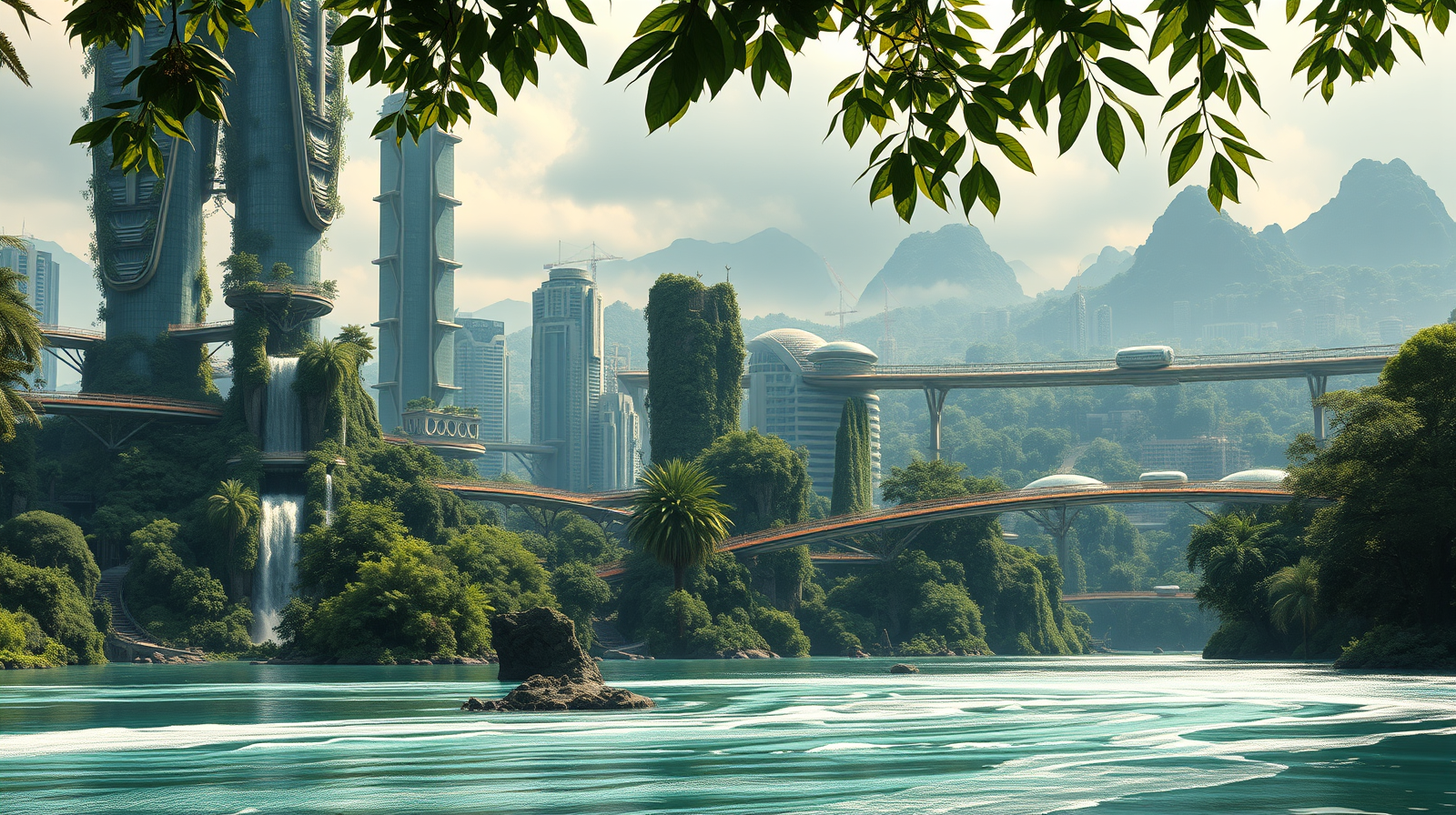
The vision is almost utopian. The government promises a "smart, green, forest city." They paint a picture of a metropolis powered entirely by renewable energy, where electric shuttles glide down tree-lined avenues, and seventy percent of the urban area remains dedicated to green space. It is designed to be a walkable, sustainable paradise—the anti-Jakarta.
But building a city from scratch in the middle of a tropical jungle is an act of breathtaking hubris.
The logistical hurdles are staggering. Millions of tons of building materials must be shipped across oceans and hauled through rough terrain. The cost is projected to clear thirty-four billion dollars. The government hopes private investors will pick up the majority of the tab, but international capital can be skittish when asked to bankroll a city that currently exists mostly in digital renderings and architectural models.
Then there is the human cost of the cure.
The Forest Has Eyes
The rainforest is never truly empty. Long before the surveyors arrived with their GPS equipment and orange high-visibility vests, indigenous communities called these hills home.
Consider the perspective of a local elder from the Balik tribe. For generations, the forest was not a "blank slate" or an "underdeveloped economic zone." It was a grocery store, a pharmacy, and a church. The medicinal plants gathered from the undergrowth cannot be replaced by a modern clinic in a smart city. The graves of ancestors cannot be relocated to a designated municipal cemetery without tearing the fabric of a culture.
As the bulldozers clear the eucalyptus plantations and secondary forests to make way for government buildings and presidential palaces, the local population watches with a mixture of awe and profound anxiety. They are promised jobs, development, and inclusion. But history suggests that when a massive influx of urban elites arrives from Java, the original inhabitants are often pushed to the margins, becoming spectators to their own displacement.
Furthermore, environmentalists are sounding alarms that echo across the globe. Borneo is one of the world's great carbon sinks, home to orangutans, clouded leopards, and pygmy elephants. While planners insist Nusantara is being built on logged land rather than pristine primary rainforest, the scale of construction inevitably fractures habitats.
Roads cut through migration corridors. Increased human activity brings the risk of devastating forest fires. The very act of building an eco-city risks destroying the ecosystem it claims to celebrate.
The Ghostly Echo of Capitals Past
History is littered with the ghosts of purpose-built capitals.
Brazil built Brasília in the 1950s to move its center of gravity away from Rio de Janeiro. Today, it is celebrated for its modernist architecture but criticized for being a cold, car-centric city that lacks the organic soul of an old urban center. Myanmar built Naypyidaw in secret, resulting in a bizarre, echoing expanse of twenty-lane highways that remain largely empty.
Cities are not just collections of buildings arranged on a grid. They are living organisms. They grow out of centuries of accidental encounters, street-side food stalls, late-night arguments in smoky cafes, and the shared trauma of surviving floods. You can build a palace, a parliament, and a supreme court, but you cannot easily manufacture culture.
Will the civil servants forced to relocate from Jakarta find happiness in the quiet, orderly streets of Nusantara? Or will they spend their weekends flying back to the chaotic, sinking, beautiful mess of the old capital because that is where their families, their favorite restaurants, and their memories reside?
The True Stakes of the Exodus
The move to Nusantara is often framed as a local political project, the grand legacy of a departing president. But it is actually a preview of the twenty-first century.
Jakarta is not alone. From Houston and Miami to Lagos and Dhaka, major coastal cities around the planet are facing the exact same math. They are running out of land, running out of water, and running out of time. The global elite will watch Indonesia’s experiment with a intense, nervous curiosity. If Indonesia can successfully move its capital, it provides a blueprint for the climate migrations of the future. If it fails, it serves as a multi-billion-dollar cautionary tale.
Meanwhile, back in North Jakarta, the tide comes in again.
Ayu watches the water lap against the top step of her home. The government offices might move to Borneo, the politicians will give speeches in air-conditioned halls surrounded by pristine jungle, and the national treasury will shift its focus to the new shiny jewel of the archipelago.
But the millions who cannot afford to move will remain. They will keep buying concrete blocks. They will keep raising their beds. They will keep listening to the rhythmic, desperate hum of the pumps, praying that the sponge holds for just one more generation.
The sea does not care about master plans. It just keeps climbing.