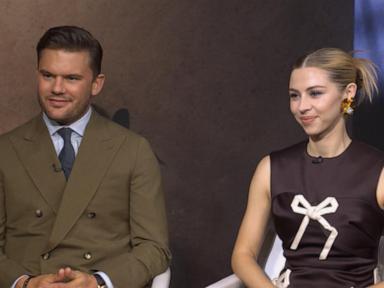
When Starz expanded its flagship historical time-travel property with Outlander: Blood of My Blood, skeptics predicted a superficial cash grab that would dilute the original narrative. Instead, the second season has doubled down on the structural mechanics of the universe, forcing characters to confront the heavy price of shifting across centuries. During recent preview events featuring core cast members Harriet Slater, Jamie Roy, and Jeremy Irvine, the conversation inevitably drifted past the on-screen drama and toward a more philosophical query: if given the choice, where and when would they actually time travel?
Yet, treating the temporal mechanics of the show as a whimsical thought experiment misses the darker narrative current running through the scripts. The writers are not merely playing with a sci-fi trope for dramatic convenience. They are systematically establishing how historical dislocation destroys personal identity. You might also find this related story useful: The Optics of Deception Evaluating the Structural Mechanics of Nonfiction Meta-Cinema.
To understand why the second season feels markedly heavier, one must look at the structural shift in how the narrative handles the stones at Craigh na Dun. In the early days of the original series, the phenomenon of sliding backward through centuries was treated as an isolated, terrifying anomaly that happened to Claire Randall. The prequel universe changes that calculus entirely by embedding the mechanics of temporal movement directly into the foundational bloodlines of the clans.
As recent episodes have underscored through revelations involving Julia Moriston, played by Hermione Corfield, passage through the stones is governed by biological and hereditary filters that defy simple romanticized notions of jumping to a preferred era. The show relies on a specific premise: that moving through time requires an inherited biological predisposition, often tied to pregnancy or direct lineage. For a hypothetical example, if an ordinary individual were to stand atop the mystic rocks without this genetic marker, nothing would happen except a cold Scottish mist blowing over bare granite. The universe of the franchise guards its doors fiercely. As extensively documented in latest reports by Rolling Stone, the effects are widespread.
When actors are asked during promotional circuits where they would jump if given a literal portal, their answers lean toward the romantic. They mention Elizabethan London, the roaring twenties, or quiet moments in pre-industrial European hamlets. But the series itself offers a far more brutal counter-argument.
Historical eras before modern medicine and labor laws are meat grinders for the unprepared. Henry Beauchamp, portrayed by Jeremy Irvine, encounters a world of rigid social strata and violent political rebellion that strips away the safety nets of twentieth-century life. The romance of kilts, clans, and cobblestones quickly dissolves when weighed against trench warfare, sectarian blood feuds, and the constant threat of execution for treason.
The brilliance of the second-season arc lies in its refusal to treat the past as a theme park. Executive producers and writers have leaned heavily into the socio-political friction of the Jacobite rebellions, showing how personal choices ripple outward to affect whole populations. When Brian Fraser (Jamie Roy) and Ellen MacKenzie (Harriet Slater) navigate their respective duties, their choices are constrained by an unyielding historical track. They cannot simply rewrite outcomes because they possess modern foresight; they are actors trapped inside a machine built by centuries of inherited grievance.
This brings us back to the core appeal of the franchise. Audiences do not tune in for historical accuracy alone. They tune in to watch ordinary human attachments strain against extraordinary circumstances. When the cast discusses the psychological toll of being separated across centuries—a central theme of the current episodes—they are pointing to the ultimate cost of temporal displacement. You do not just change your geography; you sever your connections to everyone who understands your references, your language, and your grief.
The temporal mechanics of the show will undoubtedly face further scrutiny as the narrative hurtles toward its climax. Theorists and fans dissect every line of dialogue for clues about hidden bloodlines and future loops. But beneath the speculation lies a sobering reminder. Time does not negotiate with those who try to outsmart it.
The stones remain silent, indifferent to who passes through them or what modern comforts they left behind.
Watch the official season preview for a look at the escalating tensions
This preview video offers an unfiltered look at the high-stakes conflicts and emotional separations driving the current season's narrative arc.