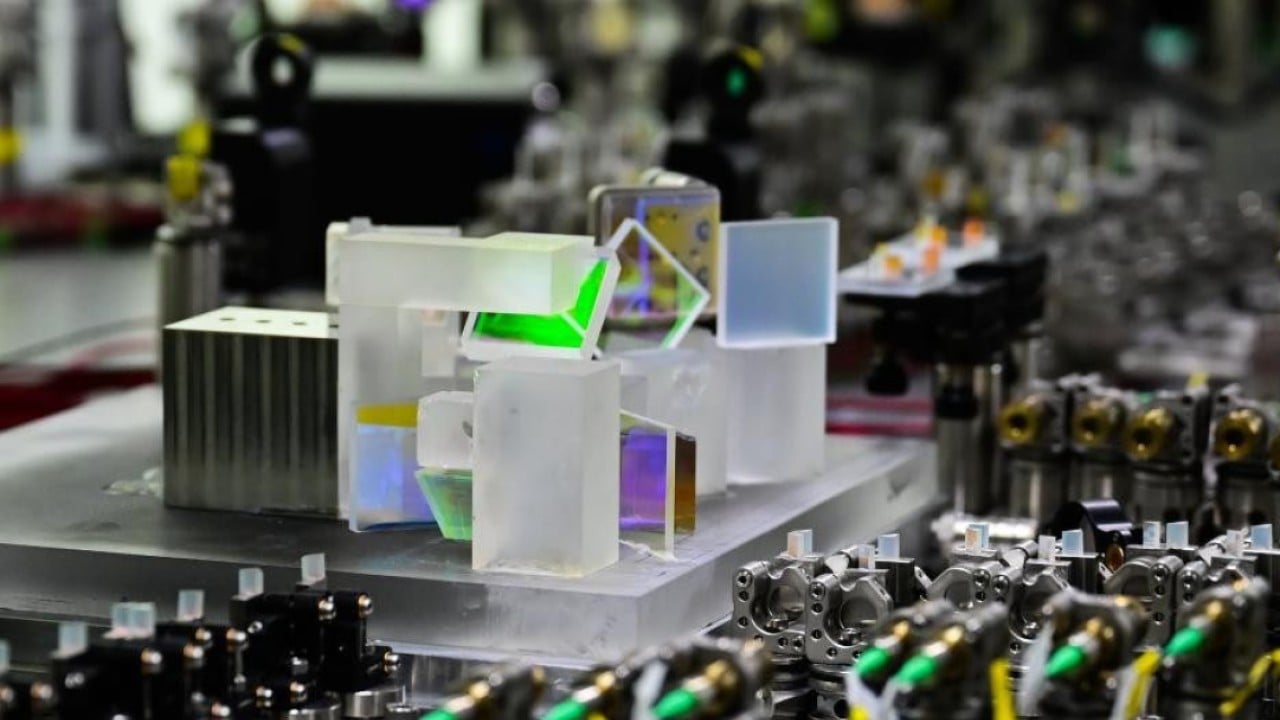
Chinese scientists just dropped a bombshell in the journal Nature, and it’s not just another incremental update. The University of Science and Technology of China (USTC) announced Jiuzhang 4.0, a photonic quantum computer that didn't just beat the world's fastest supercomputer—it practically deleted it from the conversation.
We're talking about a speedup of $10^{54}$ times. To put that in perspective, while the El Capitan supercomputer would need roughly $10^{42}$ years to solve a specific sampling problem, Jiuzhang 4.0 finishes it in 25 microseconds. That’s faster than a camera flash. If you're wondering whether "quantum supremacy" is still a hypothetical goal, the answer is a resounding no. China isn't just in the race; they're lapping the field.
The Massive Leap from 3.0 to 4.0
The technical jump here is staggering. Only a short while ago, Jiuzhang 3.0 was making headlines by manipulating 255 photons. That felt like the peak of optical quantum tech at the time. But the 4.0 version has blown that ceiling off by detecting and manipulating up to 3,050 photons.
This isn't just about adding more "parts." The team, led by Pan Jianwei and Lu Chaoyang, had to completely re-engineer how light is handled. They moved to a spatiotemporally hybrid-coded circuit with over 8,000 modes. In plain English? They found a way to pack more information into the same physical space and time, vastly increasing the complexity of the math the machine can "see."
Why 3,050 Photons Matter
- Scalability: Managing 3,050 photons without them "leaking" or losing their quantum state is an engineering nightmare. Achieving this shows that the loss problems that plague optical systems are being solved.
- Complexity: The "Hilbert space"—basically the map of all possible states the computer can exist in—is now $10^{2461}$. There aren't enough atoms in the observable universe to write that number down.
- Efficiency: Jiuzhang 4.0 reached a system efficiency of 51%, which sounds low until you realize how hard it's to keep a single photon from disappearing in a maze of mirrors.
Programmability is the Real Story
For years, critics have dismissed the Jiuzhang series as "one-trick ponies." The argument was that these machines could only solve one specific math problem—Gaussian Boson Sampling (GBS)—and were useless for anything else. They were effectively high-tech light shows, not "real" computers.
Jiuzhang 4.0 shuts that down. It's programmable.
By integrating 1,024 squeezed-state optical fields into the circuit, researchers can now tweak the parameters. This means we're moving away from fixed-function hardware toward something that looks like a usable platform. While it's still not going to run your Excel spreadsheets or crack Bitcoin tomorrow, it’s a massive step toward fault-tolerant quantum computing.
The Quiet War Between Light and Circuits
Most people know about Google’s Sycamore or IBM’s Osprey. Those machines use superconducting qubits—tiny loops of wire cooled to temperatures colder than deep space. China’s Jiuzhang takes a totally different path using photons (light).
[Image comparing superconducting qubits vs photonic quantum computing]
Photons don't need the massive, expensive "refrigerators" that superconducting qubits do. They can operate at room temperature in many parts of the system. More importantly, photons move fast and don't interfere with each other easily. The downside has always been that they’re hard to "hold" and manipulate. Jiuzhang 4.0 proves that the photonic path might actually be the faster route to large-scale, 3D quantum cluster states.
What This Means for You
Honestly, you won't see a "Quantum iPhone" next year. But the implications of $10^{54}$ speedups are hitting the "back end" of technology first. When a machine can simulate molecular bonds or optimize logistics at this scale, the ripple effects hit medicine, battery tech, and AI.
The most immediate "threat" (or opportunity) is in cryptography. While Jiuzhang 4.0 isn't running Shor's algorithm to break RSA encryption yet, the rate of progress suggests the "Quantum Apocalypse"—the day current encryption becomes useless—is moving closer.
If you’re a developer or a tech strategist, the move is to stop treating quantum as "science fiction."
- Start looking at Post-Quantum Cryptography (PQC). If China has a machine this powerful today, your encrypted data from five years ago is already at risk of being decrypted in the near future.
- Follow the USTC and CAS (Chinese Academy of Sciences) publications. They’re currently the ones setting the benchmark for what’s possible in the photonic space.
- Watch for the "Trillion-Qubit-Mode". The researchers mentioned this as the next milestone. If they hit that, the gap between quantum and classical computers won't just be a gap—it’ll be a canyon.
China’s latest move proves that the era of "quantum advantage" isn't a fluke. It’s a repeatable, scalable reality. We're watching the transition from experimental physics to engineering, and Jiuzhang 4.0 is the clearest sign yet that the old rules of computing are dead.