Beijing is quietly turning Hong Kong and Macau into the financial and academic anchors of its sovereign internet in the sky. While Western analysts focus on the military launchpads of Gobi or Hainan, the real engine of China’s commercial satellite expansion is shifting to the Greater Bay Area. State-backed entities and private firms like GalaxySpace are utilizing these special administrative regions to bypass export controls, capture international capital, and challenge Starlink's global dominance.
This is not a sudden burst of civic pride. It is a calculated geopolitical strategy to build a low-Earth orbit (LEO) megaconstellation that can survive Western sanctions.
The Greater Bay Area Loophole
Commercial space ventures require two things that mainland China struggles to access under current geopolitical strains: unfettered Western capital and advanced foreign electronics. Hong Kong and Macau offer both, wrapped in a distinct legal and economic framework.
By positioning these cities at the center of the commercial space push, Beijing creates a buffer zone.
Under the "One Country, Two Systems" framework, Hong Kong retains its status as a separate customs territory. This status makes it an attractive jurisdiction for sourcing dual-use technologies that might face immediate blocks if shipped directly to Shanghai or Beijing. Furthermore, the lack of capital controls allows satellite manufacturing startups to raise funds from international venture capital, which can then be funneled into mainland research and development.
The strategy relies on a distinct division of labor. The mainland handles heavy industrial manufacturing and launch logistics. The special administrative regions manage the capital architecture, international data routing, and fundamental engineering research.
Moving the Assembly Line to the Financial Hub
The physical manifestation of this strategy is already visible. Look at the recent establishment of satellite manufacturing centers and advanced research labs in the heart of Hong Kong’s high-tech industrial parks.
These are not mere sales offices. They are highly specialized assembly and testing facilities.
+--------------------------------------------------------------+
|               THE GREATER BAY AREA SPACE NETWORK             |
+--------------------------------------------------------------+
| MACAU:                                                       |
| - Satellite data analysis for Portuguese-speaking nations    |
| - Remote sensing for climate and maritime tracking           |
+--------------------------------------------------------------+
| HONG KONG:                                                   |
| - International capital raising and venture financing        |
| - Advanced electronics sourcing and assembly                 |
+--------------------------------------------------------------+
| MAINLAND GUANGDONG:                                          |
| - Mass industrial manufacturing                              |
| - Heavy rocket testing and launch infrastructure             |
+--------------------------------------------------------------+
GalaxySpace and its state-aligned peers are capitalizing on Hong Kong's universities, which rank among the top globally for engineering and material sciences. By funding laboratories in Macau for remote sensing and planetary science, the Chinese aerospace sector gains access to global academic networks that are increasingly closed to mainland institutions.
Macau serves a secondary, equally vital purpose. It acts as a diplomatic bridge to the Lusophone world. Through Macau, China can export its satellite data services, agricultural monitoring, and communication networks to Portuguese-speaking nations in Africa and South America, effectively locking in international customers before American networks can secure the territory.
The Counterweight to Starlink
The urgency behind this regional mobilization is driven by a stark reality. The orbital slots and radio frequencies required for mega-constellations are a finite resource. They operate on a first-come, first-served basis governed by the International Telecommunication Union.
SpaceX’s Starlink already controls thousands of active satellites in LEO. China’s planned Guowang (National Network) and G60 Starlink constellations aim to deploy over 20,000 satellites combined to claim remaining orbital real estate.
"Orbital crowding is the new territorial dispute. Once a layer of LEO is occupied by one nation's infrastructure, it becomes mechanically and politically impossible for another nation to occupy that same space without catastrophic collision risks."
By utilizing Hong Kong as a commercial front, Chinese space companies can pitch their internet services to developing nations without the explicit baggage of a state-run military program. It gives the appearance of a commercial, open-market alternative to Western satellite broadband.
Structural Fault Lines in the SatCom Strategy
The strategy looks flawless on paper, but it contains significant structural risks. The primary vulnerability is the regulatory tightrope these companies must walk.
As Washington tightens definitions of dual-use technologies, Hong Kong’s special status is under constant scrutiny. If the US government decides that a satellite component assembled in a Hong Kong lab is ultimately serving the strategic communication needs of the People's Liberation Army, sanctions will follow. The entire financial pipeline could evaporate overnight.
There is also a deep cultural and bureaucratic mismatch between mainland aerospace planners and the financial elites of Hong Kong. Mainland space programs have historically operated under rigid military command structures. Commercial satellite operators, conversely, must move at the speed of venture capital, pivoting designs and software stacks weekly.
Merging these two worlds inside the Greater Bay Area is causing operational friction. Mainland engineers face strict security clearances to travel to Hong Kong facilities, slowing down collaborative development pipelines that need to move rapidly to compete with American private space companies.
Western Capital Funding Sovereign Constellations
The irony of this space race expansion is the source of the funding. Despite political rhetoric regarding decoupling, global institutional investors remain deeply embedded in the funds backing China's commercial space ecosystem.
Hong Kong acts as the laundering mechanism for this risk.
An international investment bank might hesitate to buy shares directly in a state-owned defense enterprise in Beijing. However, investing in a Hong Kong-registered commercial satellite data entity that promises smart-city solutions for Southeast Asia is an easier sell to compliance boards. This capital flows directly into the component procurement that keeps mainland assembly lines running.
This financial structure means Western retirement funds are indirectly paying for the hardware that will compete directly with Western aerospace infrastructure over the next decade.
The Geographic Reality of Launch Logistics
Even if Hong Kong solves the funding and component issues, the physical geography of rocket launches creates an unavoidable bottleneck. Satellites assembled or financed in the south must still be transported to mainland launch sites.
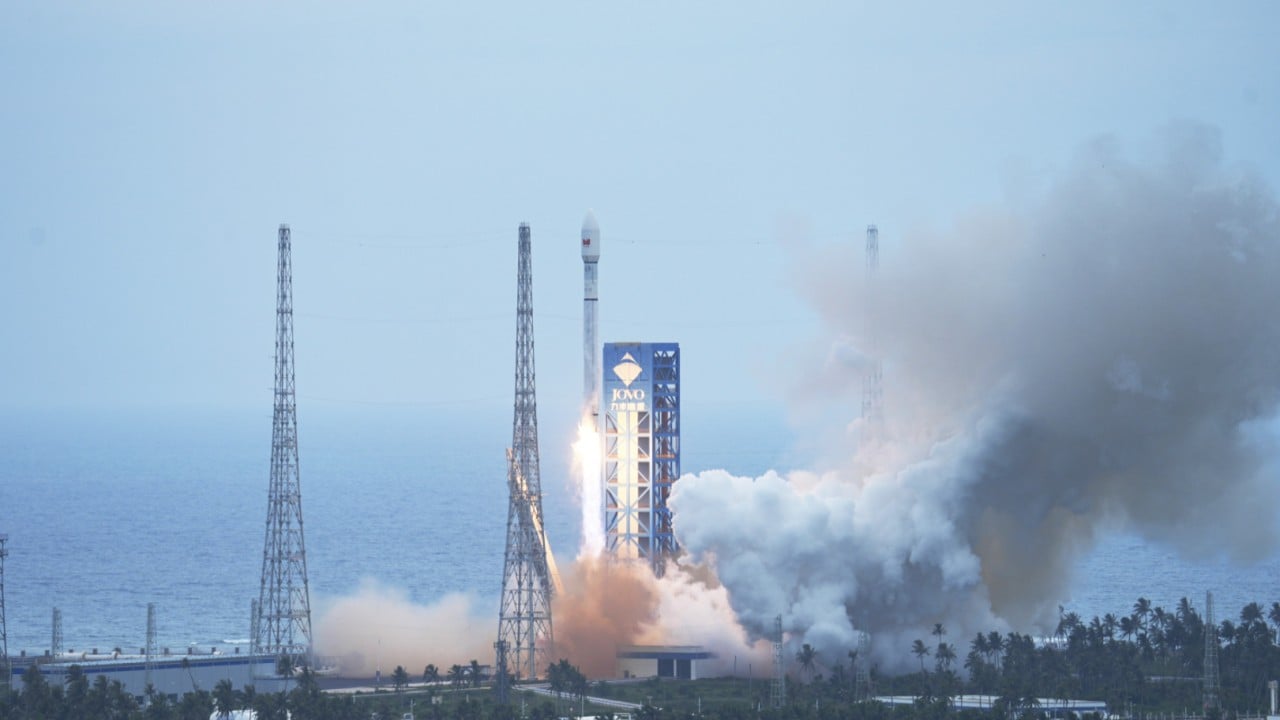
Hainan’s Wenchang Space Launch Site is the closest deep-water port capable of handling these payloads. This creates a supply chain that is highly vulnerable to regional logistics disruptions and political interference.
A breakdown in the domestic transport corridors between the Greater Bay Area manufacturing hubs and the Hainan launch pads immediately stalls the deployment schedule. In the LEO race, a three-month delay can mean losing an entire orbital plane to a competitor.
The assumption that Western nations will sit idly by while Hong Kong acts as a procurement hub for Chinese aerospace is a dangerous gamble. New export control frameworks specifically target entities operating out of the Greater Bay Area, treating them with the same restrictions as mainland defense contractors.
Companies that fail to diversify their supply chains away from restricted Western components will find their hardware grounded, regardless of how much capital they raise in Hong Kong's financial markets. The window for using the city's unique status as a geopolitical shield is closing fast, forcing these entities to either achieve total domestic component independence or face operational paralysis.