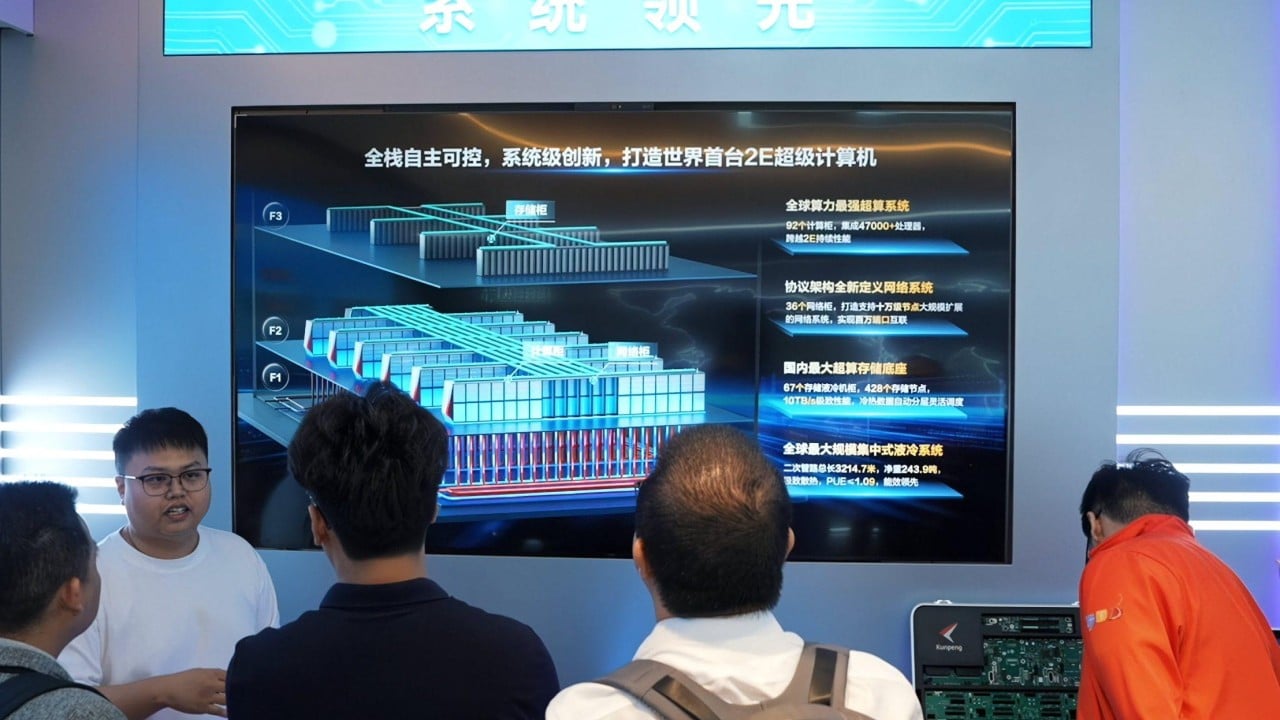
The global supercomputing crown has ostensibly changed hands, but the numbers on the leaderboard do not tell the real story. Industry insiders tracking the Top500 rankings witnessed China’s LineShine system leapfrog the United States’ El Capitan machine to claim the theoretical number-one spot. On paper, it looks like a clean technical victory. In reality, this shift reveals a deeper, more troubling splintering of global technology benchmarking, driven by geopolitical posturing rather than verifiable computational supremacy.
The Top500 list has long served as the definitive scorecard for international bragging rights. But the list is broken. By focusing strictly on Linpack performance—a synthetic benchmark measuring linear equations—the rankings reward architectures optimized for a single, specific math problem. China's LineShine victory is the result of targeted state funding designed specifically to win this exact numbers game, even as the underlying machines remain severely constrained by Western supply-chain sanctions.
The Mirage of the LineShine Victory
To understand how LineShine took the top spot, you have to look at how the machine is built. It isn't a triumph of next-generation commercial silicon. It is an exercise in extreme brute force.
Western trade restrictions have cut off Chinese entities from accessing the latest lithography nodes from TSMC and Intel, as well as the advanced High Bandwidth Memory (HBM) modules produced by SK Hynix and Micron. To circumvent these roadblocks, Chinese design bureaus relied on mature domestic nodes, packing massive arrays of smaller, less efficient custom accelerator cores onto sprawling, power-hungry system boards.
They built a monster. LineShine achieves its massive Linpack score through raw scale, burning through megawatts of electricity at a rate that would make commercial data center operators wince.
Compare this to El Capitan, housed at the Lawrence Livermore National Laboratory. El Capitan relies on AMD’s integrated APU architecture, blending CPU and GPU cores with unified memory access. It is built for real-world workloads: climate modeling, nuclear stockpile simulation, and massive workloads where data must constantly move between memory and processors. LineShine wins the sprint on a flat track. El Capitan is built for the marathon.
The Secretive Split in High Performance Computing
This ranking shift is happening in a vacuum of transparency. For the past several years, the Chinese government has actively discouraged its top-tier laboratories from submitting their true flagship systems to the Top500 organizers. The OceanLight and Tianhe-3 systems, both widely understood by intelligence analysts to operate well into the exascale regime, were kept off the official books to avoid triggering further unilateral US export controls.
Why change strategy now with LineShine?
Domestic politics demanded a public win. With the domestic semiconductor industry facing intense scrutiny over state fund allocation and slowing progress in sub-7nanometer manufacturing, the state needed a high-profile validation of its self-reliance strategy. LineShine was selected as the sacrificial lamb—a system built explicitly to be measured, scrutinized, and publicized, while the truly sensitive national security workloads remain hidden on unlisted clusters.
This bifurcation destroys the utility of the Top500 list. When major state actors selectively hide their best hardware or build custom configurations simply to juice a benchmark, the ranking ceases to be an engineering index. It becomes a theater production.
Memory Bandwidth and the Real Performance Bottleneck
Supercomputing engineers know a fundamental truth that political commentators ignore. Compute nodes are cheap; moving data is expensive.
A supercomputer’s utility is determined by its bytes-to-flops ratio—the amount of memory bandwidth available to feed the processing cores. When a machine runs out of memory bandwidth, the processors sit idle, waiting for data to arrive. This is known as the memory wall.
- Synthetic Benchmarks: The Linpack test fits entirely within local cache memory, largely bypassing the main memory subsystem. It shows how fast a car can go if it never has to turn or stop for fuel.
- Real-World Applications: National security simulations, structural biology modeling, and deep learning training require massive, erratic data transfers across the entire system cluster.
Because of sanctions, LineShine suffers from a severe memory bottleneck. Its domestic packaging options cannot match the dense inter-chip routing of Western equivalents. It has plenty of horsepower, but the fuel lines are narrow. In an actual multi-variable simulation, a system with a lower Linpack score but a superior memory fabric will routinely complete the job faster than a poorly balanced benchmark king.
The High Cost of Purely Sovereign Silicon
Building a supercomputer without access to the global supply chain requires massive capital inefficiency. China’s state-directed investment funds, often referred to as the Big Fund, have poured tens of billions of dollars into domestic foundries like SMIC and packaging firms like JCET.
The results are functional, but the yields are punishingly low. Industry estimates suggest that manufacturing the specialized silicon used in LineShine costs up to four times more per wafer than equivalent commercial chips produced in Taiwan. The power consumption alone creates an enormous operational tax. LineShine requires dedicated electrical substations and specialized liquid-cooling infrastructure that pushes the boundaries of municipal grid capabilities.
The United States faces its own hurdles, primarily bureaucratic inertia and a highly centralized procurement process that relies on a tiny handful of defense contractors and national labs. But the US ecosystem still benefits from a commercial tide. The chips powering El Capitan are direct relatives of the hardware sold to enterprise data centers worldwide. The commercial market subsidizes the R&D. China, conversely, must fund its high-end architectural development entirely through government grants, creating a closed ecosystem that cannot scale organically through market demand.
Moving Beyond Synthetic Metrics
The obsession with who holds the number-one spot on a legacy list obscures the actual battlefield of high-performance computing. The future belongs to the architecture that can most efficiently process sparse matrices and unstructured data workloads typical of modern artificial intelligence pipelines.
The High-Performance Conjugate Gradients (HPCG) benchmark offers a far more accurate reflection of a machine’s capability than Linpack. It forces the supercomputer to handle complex data access patterns that mimic actual scientific research. When viewed through this lens, the Western systems utilizing tightly integrated architecture maintain a commanding lead in operational efficiency.
The LineShine ranking is a political milestone, not an engineering paradigm shift. It proves that with enough state capital and sheer physical space, any nation can build a machine that tops a specific, narrow index. It does not prove technical self-sufficiency, nor does it guarantee an advantage in the strategic applications that supercomputers are actually built to solve. The hardware community must stop treating these rankings as a sports scoreboard and start analyzing the structural realities hidden beneath the data.