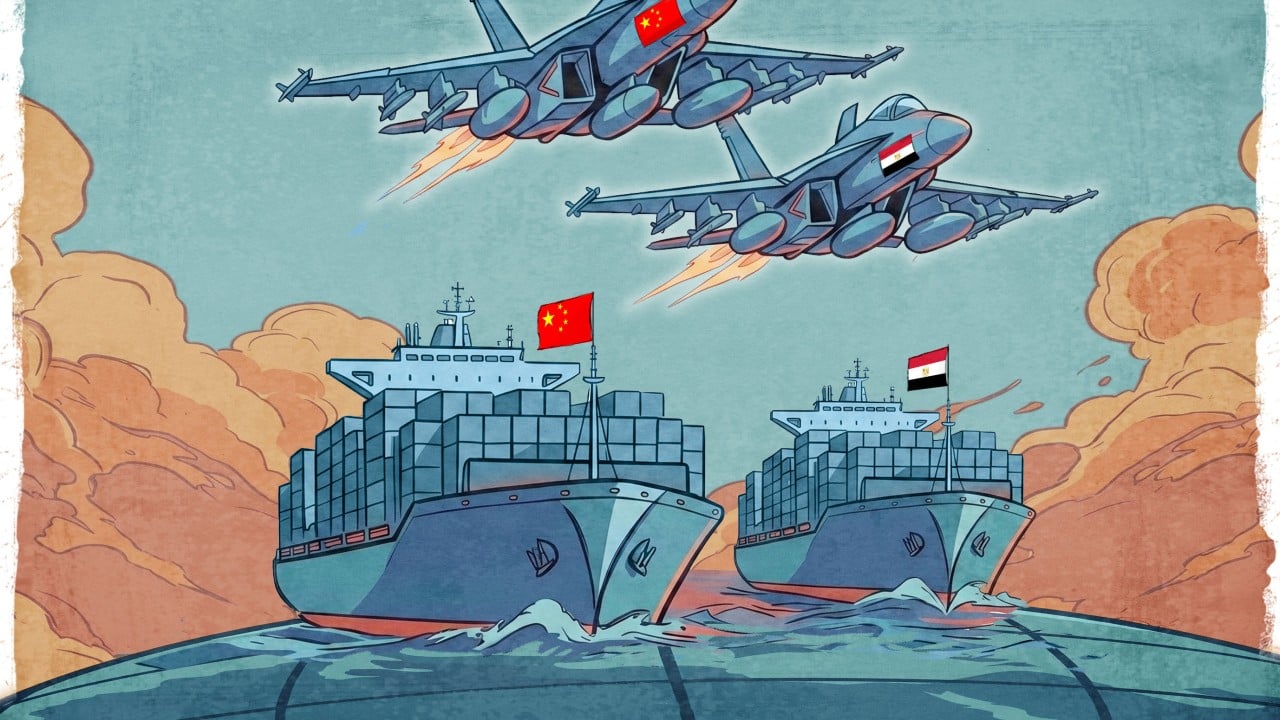
Geographic distance remains the ultimate friction point for any state attempting to project armed influence beyond its immediate periphery. When military units train thousands of kilometers from their home territory, the operational constraint is rarely the capability of the combat platform itself. Rather, it is the logistics chain required to sustain that platform in a theater devoid of organic supply lines. The bilateral training exercises conducted between China and Egypt provide a clear window into how Beijing attempts to solve this distance equation, moving past traditional territorial defense toward trans-regional maneuver capability.
Understanding this dynamic requires stripping away political rhetoric and examining the underlying logistical, strategic, and economic variables. Security cooperation between Beijing and Cairo is frequently framed through the lens of diplomatic signaling or arms sales. A rigorous analysis reveals a more complex calculation: an incremental test of long-range deployment mechanics, fleet sustainability, and interoperability under foreign operational constraints. For a closer look into similar topics, we recommend: this related article.
The Logistics Deficit and the Mechanics of Projection
Military reach is a function of mass multiplied by distance divided by logistical friction. For the People's Liberation Army, extending operational capacity into the Middle East and North Africa encounters a fundamental structural limitation: the absence of a dense, established network of permanent foreign military bases akin to the global footprint maintained by Western powers.
Without a mature network of sovereign logistics hubs, any deployment into the Eastern Mediterranean or the Red Sea relies on alternative mechanisms. These include host-nation support agreements, commercial port access arrangements, and the utilization of specialized auxiliary vessels designed to replenish combatants at sea. Joint exercises with Egypt serve as a practical stress test for these alternative supply lines. For further background on this development, extensive coverage can be read at NBC News.
When combat aircraft or naval surface action groups transit from East Asian waters to the Mediterranean basin, they traverse critical maritime chokepoints, including the Strait of Malacca, the Bab el-Mandeb, and the Suez Canal. Each chokepoint represents a vulnerability point where transit speeds drop, security risks escalate, and the consumption of fuel, spare parts, and operational bandwidth accelerates.
The mechanics of the China-Egypt exercises must be evaluated against this transit penalty. By conducting complex drills alongside the Egyptian Armed Forces, the Chinese military evaluates its capacity to integrate into foreign maintenance ecosystems, test secure communications protocols with non-native command structures, and validate the endurance limits of its power-projection platforms without relying on a permanent regional logistics command.
Structural Drivers of Bilateral Defense Convergence
Bilateral defense arrangements do not emerge from diplomatic goodwill; they are driven by aligned strategic necessities and economic exposure. The convergence between Beijing and Cairo rests on three distinct structural pillars.
First is the protection of economic corridors. The Suez Canal and the surrounding Red Sea approaches constitute a vital artery for global commerce, handling a significant percentage of maritime trade moving between Asia and Europe. Disruptions in this corridor inflict direct economic damage on export-driven economies. For Beijing, participating in security operations and joint training within this geography is a direct extension of economic risk mitigation. The deployment of naval assets to regional anti-piracy escorts over the past decade laid the groundwork for more complex, multi-domain exercises with local partners like Egypt.
Second is the diversification of defense procurement and industrial cooperation. Egypt operates a diversified military inventory, balancing legacy Western systems with acquisitions from secondary suppliers. Engaging in joint exercises allows defense planners to observe how disparate hardware architectures manage tactical data sharing and electronic warfare environments. For the Egyptian military, working with advanced foreign systems provides insights into multi-domain integration. For the Chinese defense sector, participation acts as a live operational demonstration of platform performance in high-temperature, sand-heavy operational environments, generating valuable telemetry and reliability data that feed back into domestic research and development cycles.
Third is the alignment of strategic autonomy objectives. Both capitals share a preference for a multipolar international security architecture that limits unilateral security interventions by traditional Western alliances. Joint military activities signal diplomatic independence and expand the operational options available to regional governments seeking alternative partners for capacity building and counter-terrorism operations.
Operational Realities and Tactical Limitations
Observers frequently misinterpret joint exercises as proof of seamless coalition warfare capability. In practice, exercises are heavily scripted environments designed to test specific, narrow technical thresholds while masking broader systemic friction points.
Command and control presents the most severe barrier to genuine tactical integration. Language differences, distinct doctrine regarding decision-making hierarchies, and incompatible tactical data links prevent real-time, fluid interoperability during high-tempo combat scenarios. While participating forces can execute pre-planned maneuvers, coordinated targeting, and standard maritime interdiction operations, they operate largely in parallel rather than as a unified, cohesive command structure.
Maintenance and supply chain compatibility introduce another hard ceiling. A Chinese frigate operating far from its domestic industrial base cannot easily draw upon Egyptian naval depots for specialized propulsion components, advanced missile guidance spares, or proprietary electronic warfare modules. Consequently, the operational duration of any deployed element remains strictly tethered to the carrying capacity of its accompanying replenishment ships. Until this logistical dependency is resolved through either permanent overseas support facilities or vastly expanded auxiliary fleet sizes, long-range projection remains constrained by a strict time horizon.
Furthermore, regional security dynamics impose political costs on excessive military alignment. Cairo maintains deep strategic and economic ties with Western partners and regional states that view external security presences with caution. Consequently, military cooperation with Beijing is calibrated to avoid triggering secondary sanctions, alienating traditional financiers, or destabilizing delicate regional balances of power. The scope of joint exercises is thus bounded by these diplomatic guardrails, preventing them from evolving into permanent security pacts or mutual defense guarantees.
Strategic Outlook for Long-Range Maneuver
The evolution of these exercises offers a reliable indicator of broader shifts in global military architecture. As defense budgets adapt to changing fiscal realities and technological paradigms, the ability to project credible combat power over vast distances without triggering systemic economic or logistical collapse becomes the defining metric of a major power.
Future iterations of these bilateral engagements will likely pivot away from basic surface maneuvers toward high-end asymmetric domains. Expect increased focus on electronic warfare resilience, cybersecurity coordination, uncrewed maritime and aerial system integration, and advanced air defense tracking in complex littoral environments. These domains allow participating militaries to test future-proof concepts without requiring the massive capital expenditure of deploying entire carrier strike groups or heavy armored divisions.
The constraint moving forward is not political will, but the unyielding mathematics of logistics. Every nautical mile steamed away from sovereign shipyards increases the cost curve and amplifies the vulnerability profile of the deployed force. Strategic assessment must therefore measure capability not by the number of platform types photographed together during a coastal exercise, but by the efficiency of the supply chain sustaining them three thousand miles from home. The operational trajectory points toward a sustained, methodical expansion of out-of-area competency, measured in incremental logistical breakthroughs rather than sudden shifts in the regional balance of power.