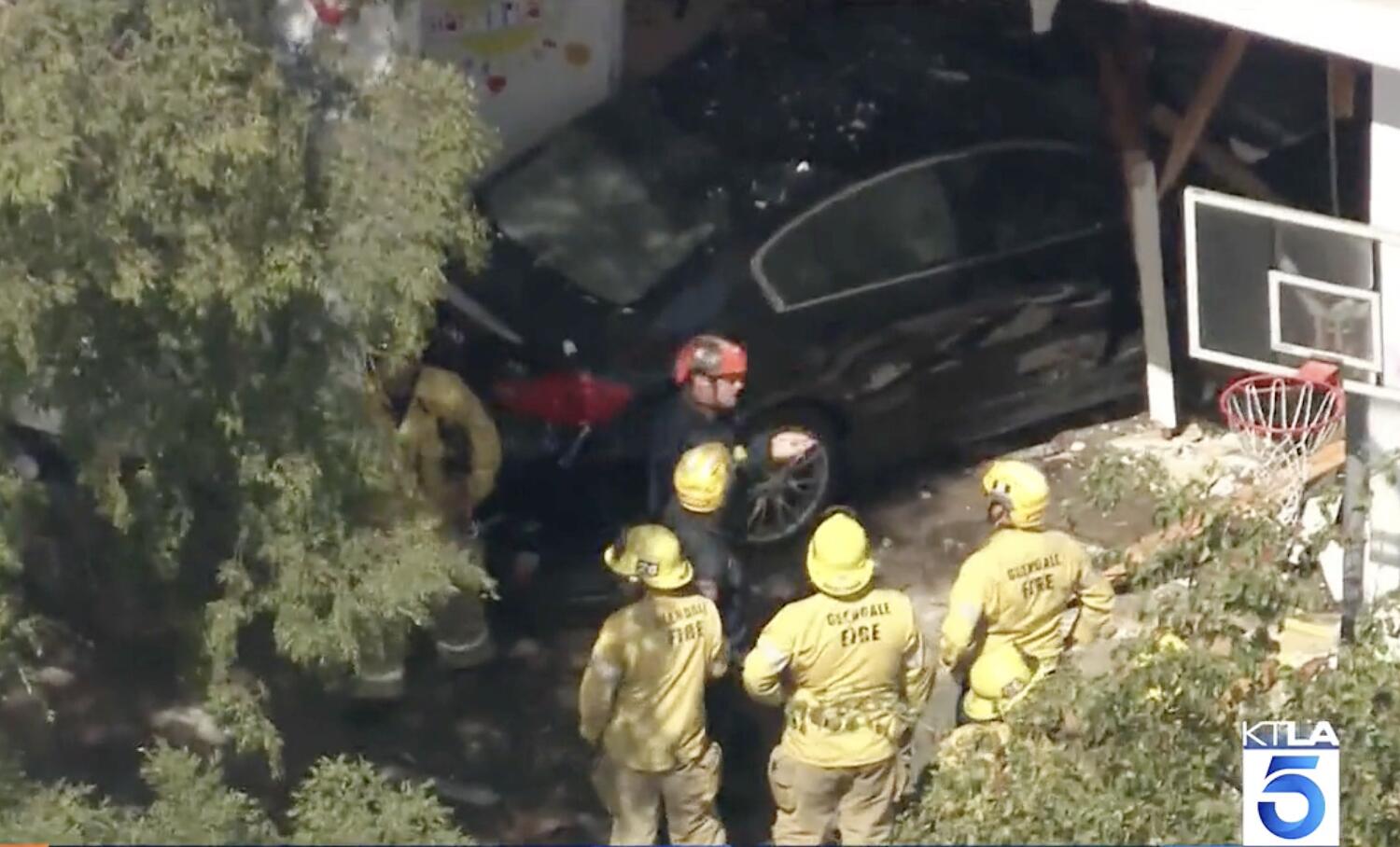
Eight children were rushed to local hospitals on a Friday afternoon after a vehicle smashed directly through the wall of a classroom at Grandview House Preschool in Glendale, California. A 79-year-old motorist, attempting a routine U-turn in the facility's parking lot, accidentally accelerated into a parked car, plowed through a protective security gate, and breached a room filled with resting students. Miraculously, all eight victims sustained only minor injuries and were promptly released to their families. Law enforcement quickly ruled out impairment, pointing instead to a catastrophic pedal confusion error.
Another freak accident. Another miraculous escape from tragedy.
Except calling these incidents "freak accidents" is an intellectual cop-out that allows municipal planners, facility operators, and vehicle manufacturers to ignore a persistent, entirely predictable public safety hazard. Vehicles crash into commercial buildings, storefronts, and schools across the United States with terrifying regularity. When a car breaches a preschool classroom, the narrative almost always defaults to individual driver error, elderly motorists, or a sudden medical emergency. We cluck our tongues at the statistics, offer collective sighs of relief when fatalities are avoided, and wait for the next structural breach to shock us all over again.
The Architecture of Vulnerability
Look closely at the typical suburban or urban preschool parking lot. You will find a thin chain-link fence, a decorative shrub, or a low-slung concrete parking bumper separating multi-ton steel machines from rooms full of toddlers. These design elements offer psychological comfort rather than physical protection. They are ornamental boundaries, not kinetic barriers.
When a driver hits the accelerator instead of the brake—a surprisingly common cognitive lapse often linked to pedal confusion—the car transforms into an unguided projectile. Physics does not care about the driver's age or intent. A sport utility vehicle weighing four thousand pounds possesses enough kinetic energy at five miles per hour to shatter standard drywall, shatter glass, and push aluminum framing inward like foil.
City codes mandate fire sprinklers, smoke detectors, and secure entry buzzers to keep children safe from external threats. Yet, physical fortification against vehicular intrusion remains largely optional or completely overlooked in commercial zoning laws. We build fortresses against hypothetical intruders while leaving the front wall exposed to ordinary parking stalls pointing directly at children's desks.
The Myth of the Accidental Collision
Police reports from Glendale confirmed that the driver was not under the influence. Investigators stated that the operator confused the gas pedal with the brake while executing a tight parking lot turnaround.
This explanation satisfies the legal requirement for closing an investigation, but it fails the test of systemic analysis. Pedal confusion crashes happen tens of thousands of times annually nationwide, disproportionately involving elderly drivers whose spatial awareness or muscle memory falters under tight spatial constraints. Relying entirely on driver licensing renewals or self-reporting to solve this issue is a losing battle.
If human error is an absolute certainty in a population of millions, then environmental design must account for it. We do not place unprotected highway curves next to abysses without guardrails. Why, then, do we place parking spaces perpendicular to classroom windows without heavy-duty bollards?
Engineering the Solution We Refuse to Build
Protecting schools from vehicle intrusion does not require advanced technology or impossible budgets. It requires steel and concrete.
High-impact steel bollards—embedded deep into reinforced concrete foundations—can stop a heavy vehicle dead in its tracks before it ever reaches a building envelope. These architectural barriers are common around federal buildings, airports, and embassies. They are conspicuously absent from the vast majority of neighborhood daycare centers, elementary schools, and community clinics.
Consider a hypothetical commercial strip mall with storefront parking. When a municipality mandates steel-reinforced bollards in front of glass storefronts, vehicle-into-building crashes drop dramatically in severity and frequency. The car sustains heavy mechanical damage, but the building structure remains intact. The human beings inside remain separated from the kinetic force of the machine.
Applying this standard to childcare facilities is an obvious safety imperative. If a preschool occupies a building adjacent to a parking lot or a busy roadway, the exterior walls should be rated to withstand low-speed vehicular impacts, or the parking configuration should be re-oriented entirely. Parking stalls should never face pedestrian walkways, play yards, or classroom windows.
Shifting the Burden of Proof
We cannot continue to treat vehicular breaches of schools as acts of God. Every time a car penetrates a classroom, it represents a failure of zoning, a failure of architecture, and a failure of regulatory foresight.
The children at Grandview House Preschool returned home to their parents this week with minor scrapes and vivid memories of a terrifying afternoon. Next time, the angle might be different. The speed might be higher. The structural wall might collapse completely.
True safety reform begins the moment we stop blaming the driver alone and start questioning why we allowed a multi-ton vehicle to park ten feet away from a room full of children with nothing more than a strip of asphalt and a chain-link fence in its way