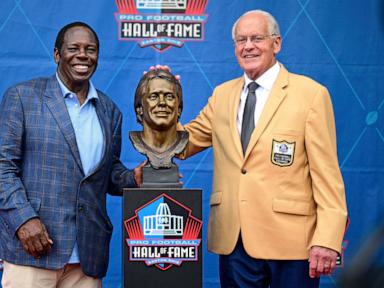
The death of Tom Jackson at 75 closes the ledger on one of the most consequential dual-act careers in modern American sports media. Standard obituaries treat a transition from the National Football League to national sports television as a natural progression, yet the empirical reality is the exact opposite. The vast majority of former players fail to sustain multi-decade careers in national studio broadcasting because the skill sets required for on-field execution and live television analysis operate on fundamentally different mechanics. Jackson’s trajectory offers a clear blueprint for how an athlete converts physical credibility into institutional broadcast authority without relying on shock-jock theatrics or fabricated outrage.
To understand Jackson’s impact, one must separate his career into two distinct operational phases—his fourteen-year tenure as the defensive anchor of the Denver Broncos and his nearly three-decade run as the emotional and analytical counterweight on ESPN’s Sunday NFL Countdown. Analyzing the structural mechanics of both eras reveals why his death marks the end of a specific model of sports journalism that prioritized locker-room authenticity over algorithmic engagement.
The Structural Foundation of the Orange Crush Defense
Before Jackson ever sat behind an ESPN desk, he functioned as the primary processor for one of the most innovative defensive units in professional football history. Drafted by the Denver Broncos out of the University of Louisville in the fourth round of the 1973 NFL Draft, Jackson entered a franchise that had never posted a winning season or reached the playoffs.
At 5 feet 11 inches and approximately 220 pounds, Jackson was undersized by the traditional metrics applied to NFL linebackers in the early 1970s. Conventional defensive architecture of the era favored massive, downhill run-stoppers designed to absorb blocks in a 4-3 alignment. Denver’s defensive coordinator, Joe Collier, solved Jackson’s size deficit by altering the geometry of the defense. Collier installed a 3-4 base scheme—three down linemen and four linebackers—that insulated Jackson from direct engagement with 270-pound offensive guards.
This structural adjustment created a specific cause-and-effect chain on the field:
- Block Absorption: Nose tackle Rubin Carter and defensive ends Barney Chavous and Lyle Alzado occupied multiple offensive linemen at the point of attack, preventing clean releases to the second level.
- Lateral Freedom: Operating behind a three-man front, Jackson utilized superior lateral agility and diagnostic speed rather than brute mass to scrape across the formation and close running lanes.
- Pass Coverage Versatility: The 3-4 alignment allowed Collier to disguise blitz packages and drop Jackson into underneath zone coverages, turning an undersized linebacker into a high-volume turnover generator.
Between 1973 and 1986, Jackson appeared in 191 regular-season games for Denver, recording 20 interceptions—an exceptional figure for a linebacker—alongside 44 unofficial sacks and three consecutive Pro Bowl selections from 1977 to 1979. He served as the defensive captain and emotional thermostat for the "Orange Crush" defense that propelled the Broncos to Super Bowl XII following the 1977 season, the franchise’s first championship appearance. When Jackson retired after the 1986 season—following a second Super Bowl appearance in Super Bowl XXI—he left behind a statistical and cultural baseline that eventually earned him induction into the Denver Broncos Ring of Fame in 1992.
The Mechanics of the Athlete-to-Broadcaster Transition
When Jackson joined ESPN in 1987, the network was less than eight years old and still fighting for institutional legitimacy against legacy broadcast networks like CBS and NBC. ESPN had just acquired its first package of live Sunday night NFL games, and its studio programming required on-air talent capable of translating complex schematic concepts to a mainstream audience without diluting the substance of the game.
Most former athletes fail in this environment due to a specific cognitive trap: they confuse playing experience with communication skill. On the field, processing is instinctive and kinetic. In a television studio, processing must be verbal, concise, and timed to the second by a producer in an earpiece.
Jackson bypassed this failure mode by applying the exact same diagnostic discipline he used in Joe Collier’s 3-4 defense to the broadcast booth. He treated television production as a team sport with defined positional responsibilities. Rather than competing with play-by-play voices or studio hosts for airtime, Jackson established a clear operational division of labor—most notably alongside longtime Sunday NFL Countdown host Chris Berman.
The Berman-Jackson dynamic functioned because of strict structural contrast:
- The Setup Engine: Berman operated as the rhythmic, high-energy narrator, using catchphrases, historical callbacks, and rapid-fire highlight framing to maintain broadcast momentum across multi-hour pregame windows.
- The Analytical Anchor: Jackson served as the gravity in the room. When Berman escalated the energy, Jackson grounded the segment with measured cadence, moral clarity, and tactical specificity.
This pairing avoided the primary flaw of contemporary sports studio shows, where four to six panelists shout over one another to generate ten-second social media clips. Jackson understood that silence, vocal modulation, and direct eye contact carried more authority than volume.
The Three Pillars of Jackson’s Broadcast Authority
Across twenty-nine seasons at ESPN, culminating in his retirement from the network in 2016, Jackson’s on-air credibility rested on three distinct operational pillars.
1. Tactical Translation Without Jargon
Many former players alienate viewers by hiding behind impenetrable coaching terminology, while others oversimplify the sport into clichés about "wanting it more." Jackson operated in the middle space. He broke down offensive and defensive failures into observable mechanical breakdowns—leverage at the line of scrimmage, blown coverage assignments, or quarterback footwork under pressure—using plain English. He respected the intelligence of the casual fan while satisfying the scrutiny of active coaches and players watching from team facilities.
2. Moral Accountability and Locker-Room Credibility
Because Jackson had played fourteen seasons in the NFL and endured the physical toll of the sport, active players granted him a level of deference rarely extended to career journalists. When Jackson criticized a player’s effort or a coach’s decision-making, the critique carried institutional weight because it originated from a peer who had survived the same environment. Conversely, when Jackson defended players against unfair media narratives, he framed his arguments around the realities of locker-room dynamics and organizational accountability rather than blind loyalty.
3. Controlled Emotional Resonance
The defining moments of Jackson’s broadcast career occurred when the boundaries between sports and broader human events collapsed. Following the September 11 terrorist attacks in 2001, and during the subsequent NFL seasons shaped by war and national grief, Jackson articulated the emotional reality of players and fans without descending into performative sentimentality. His tears on air—most famously after the Broncos won Super Bowl XXXII in January 1998, giving Jackson’s former teammate John Elway and the franchise its first championship—never read as theatrical because Jackson spent the other 99 percent of his broadcast hours exercising strict emotional restraint.
The Limits of the Traditional Studio Model
While Jackson’s tenure represents the gold standard for studio analysis, his retirement in 2016 coincided with a structural shift in sports media economics that exposed the limitations of the classic pregame format.
The traditional studio model—anchored by a two-hour Sunday morning broadcast leading into a 1:00 PM Eastern kickoff—relied on appointment viewing and scarcity of information. In 1995, fans watched Sunday NFL Countdown because it was the primary aggregator of injury reports, weather updates, and film breakdowns before kickoff. By the mid-2010s, real-time social media feeds, fantasy football data streams, and legal sports betting platforms fragmented that audience. Viewers no longer needed a studio panel to deliver news; they wanted immediate statistical edges or polarizing debate.
ESPN and competing networks responded by compressing analytical segments, expanding panel sizes, and incentivizing hot-take theater designed to trigger algorithmic engagement on digital platforms. Under these modern incentives, a measured, thoughtful analyst who takes forty-five seconds to build a nuanced point risks losing the audience to a second screen. Jackson’s departure marked not merely a personnel change, but the quiet retirement of a broadcast pacing model that modern television executives rarely have the patience to fund.
What Sports Media Organizations Must Retain From Jackson’s Blueprint
The passing of Tom Jackson at 75—an event that immediately prompts reflection across both the Denver Broncos organization and the broader sports broadcasting industry—forces media executives and aspiring athlete-analysts to confront a basic strategic reality: authenticity cannot be manufactured by a production meeting.
As networks continue to hand record-setting contracts to recently retired superstars, the failure rate remains high because organizations prioritize name recognition over communication mechanics. A Hall of Fame resume does not guarantee an ability to diagnose a game in real time under studio pressure.
To build durable broadcast properties in an increasingly fragmented media environment, network executives and talent evaluators should enforce three operational standards derived directly from Jackson’s career:
- Select for Diagnostic Empathy Over Fame: Hire former players who demonstrated a capacity to understand systems beyond their own position group—linebackers, quarterbacks, centers, and safeties who had to align teammates on the field—rather than pure physical outliers who relied solely on athletic dominance.
- Pair Contrasting Rhythms Intentionally: Resist the urge to stack panels with identical high-volume personalities. Every broadcast desk requires a structural counterweight capable of slowing the tempo, validating the stakes, and anchoring the viewer’s trust.
- Protect Long-Form Credibility: Even within digital-first ecosystems, networks must preserve protected segments where analysts are permitted to explain why a play failed rather than simply assigning blame. Trust is a lagging indicator; it accumulates over years of disciplined accuracy and evaporates the moment an analyst prioritizes volume over truth.
Tom Jackson proved that an undersized linebacker could anchor a championship defense through superior positioning, and that a soft-spoken retired player could anchor the most powerful sports network in the world through preparation and integrity. For any athlete stepping behind a microphone today, his career remains the definitive operational manual.