Call it a "first" if you want clicks. Call it accurate if you want respect.
Every time a crew turns over dirt near Beijing and finds a stretch of rammed earth or stone that predates the Ming dynasty, the headline machine wakes up with the same tired script. First Great Wall. Missing link. Ancient wonder. Another brick added to a single, unbroken dragon stretching across millennia.
That story makes great copy. It is terrible history.
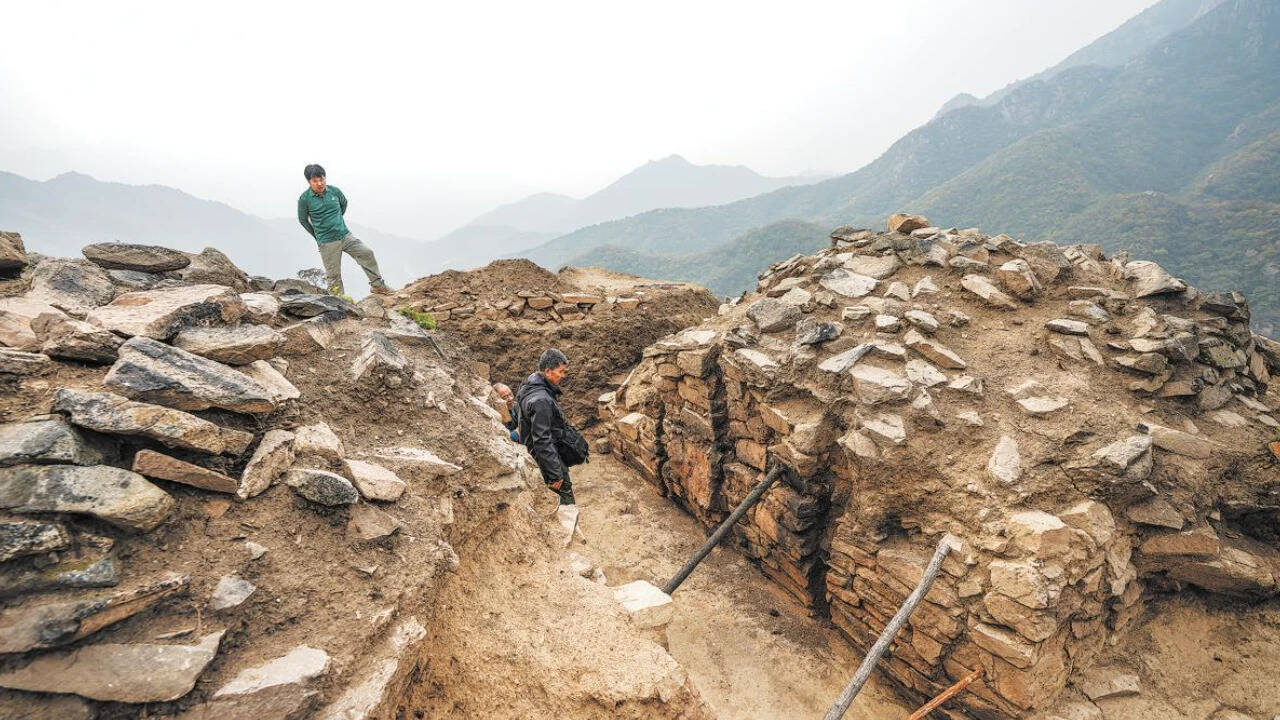
When headlines celebrate Sui dynasty fortification remains in Beijing as the "first Great Wall" discoveries, they bake a modern myth straight into the soil. There was no single, continuous Great Wall running from the Bohai Sea to the desert during the Sui dynasty. Calling a newly excavated Sui wall section the "first Great Wall" flattens centuries of shifting borders, regional wars, and political emergencies into one neat poster image.
I have spent years watching heritage projects, cultural campaigns, and popular media treat ancient fortifications like a single software version with neat release dates. People love clean timelines. History rarely gives them one. Walls in northern China were built, abandoned, repaired, bypassed, and built again by different states for wildly different reasons. Slapping the "Great Wall" label onto every early frontier line erases the real mechanics of how power worked along the northern steppe.
The Lazy Consensus Around "First" Walls
Here is the lazy consensus you see every time a dig in Beijing makes international news:
- A newly uncovered wall section near the capital is framed as a foundational piece of the Great Wall.
- Readers assume earlier walls were simply smaller, rougher prototypes of the famous Ming stone ramparts north of Beijing.
- Every new excavation is treated as proof that ancient rulers pursued one grand, continuous barrier strategy.
That consensus confuses two separate things: frontier fortification systems and the modern cultural concept of the Great Wall.
Archaeologists and historians of East Asia have spent decades pushing back against treating the Great Wall as a single monument built on a single blueprint. Scholars such as Arthur Waldron, in his influential work The Great Wall of China: From History to Myth, showed how the popular image of one unified, continuous wall was heavily shaped later in history rather than serving as a constant reality across every dynasty. Early walls were often discontinuous networks of earthworks, watchtowers, passes, and garrison lines tailored to local terrain and immediate threats.
Even the word Changcheng ("Long Wall") shifted in meaning over time. What one era called a long wall or frontier barrier did not match the scale, purpose, or geography of the Ming dynasty's iconic stone-and-brick fortifications that tourists photograph today. Treating Sui remains as the "first Great Wall" takes a modern umbrella term and projects it backward like a spotlight.
Imagine a scenario where a city council builds three separate flood levees over two hundred years—one made of packed clay, one of timber and earth, one of reinforced concrete—in different neighborhoods to stop different rivers. Two centuries later, someone calls the oldest clay bank "the first concrete dam." The material is wrong. The geography is wrong. The engineering logic is wrong. Yet that is how casual wall headlines treat Sui fortifications near Beijing.
What the Sui Dynasty Was Actually Doing
To understand why Sui remains in the Beijing area matter, you have to look at the actual pressure cooker the Sui dynasty sat in.
The Sui dynasty was brief—running from 581 to 618 CE—and intense. After centuries of division following the fall of the Han dynasty, Sui rulers reunified northern and southern China through military force, administrative overhaul, and massive state mobilization. Think of the Sui as a high-speed, high-friction rebuilding project. They dug the Grand Canal, reorganized government exams and law codes, rebuilt capitals, and fought grueling campaigns on the northern frontier and in Korea.
Northern defense was not a side hobby for the Sui. It was survival.
Along the northern borderlands, Sui emperors faced powerful nomadic polities, above all the Göktürks (Turks). Northern China's political center had long been tied to the steppes through trade, marriage alliances, military recruitment, and warfare. Controlling the approaches to the capital region meant watching mountain passes, river valleys, and corridor routes where cavalry could move fast and supply lines could snap.
Why Beijing Was Never Just a Quiet Backwater
People sometimes picture ancient Beijing as a sleepy northern outpost waiting around for the Ming or Qing dynasties to turn it into a grand capital. That is backwards.
The plain around modern Beijing—historically linked to the Youzhou region—has sat at a strategic crossroads for thousands of years. It connects the North China Plain with the northeast and the passes leading up toward the Mongolian plateau. Control that corridor, and you shape who moves between settled farming regions and mobile pastoral zones.
When archaeologists uncover Sui-era defensive remains in the Beijing area, what they are really looking at is a snapshot of a short-lived, hyper-ambitious state trying to lock down a volatile frontier while stretching its treasury and manpower to the breaking point.
That is a far more interesting story than "first Great Wall." The Sui story is about urgency, overreach, and adaptation. Sui emperors pushed conscript labor and resources hard across multiple fronts at once, and the dynasty collapsed rapidly under the weight of internal rebellions and costly external campaigns before giving way to the Tang. Finding Sui remains in Beijing does not give us a neat origin story for a tourist icon. It gives us physical evidence of a state scrambling to hold a strategic hinge together.
Stop Asking the Wrong Questions About Wall Discoveries
When a new archaeological find hits the feed, most readers ask the same three questions. Every single one of them misses the mark.
1. "Is this the oldest part of the Great Wall?"
Wrong question. "Oldest" only makes sense if you define the boundary of what counts, and historians already debate how separate early walls relate to later ones. Early states like Chu, Qi, Wei, Yan, Zhao, and Qin built walls long before the Sui. Asking "is this the oldest?" turns archaeology into a horse race where the winner gets a catchy label and the loser gets ignored.
Ask instead: What specific threat, terrain, or route was this wall built to control in this exact century?
2. "Why didn't walls stop invaders if they kept rebuilding them?"
Here is a blunt truth: a wall is a friction machine, not an impenetrable glass dome.
If you treat a fortification like a force field, every breach looks like a failure. Military historians who study frontier warfare look at walls differently. A fortification line can:
- Slow down raiding parties and force them to leave heavy loot behind.
- Channel movement into chokepoints where garrisons can observe and intercept forces.
- Signal authority and mark administrative control over a zone.
- Protect roads, beacons, and supply routes used by your own troops.
Walls worked best when paired with mobile troops, intelligence networks, diplomacy, and logistics—and they failed when states ran out of money, morale, or political cohesion. Blaming a wall for not stopping an empire is like blaming a lock because someone kicked through a rotten door frame.
3. "Does finding older walls change how we view Chinese history?"
Only if you let it break your habits. If you just add another pin to a map and keep repeating clichés about an "eternal wall," nothing changes.
It shifts your view when you realize how discontinuous frontier strategy actually was. Some dynasties leaned heavily on walls and garrisons. Others, like the Tang at its height or the Yuan, operated across vast spaces where imperial reach, alliances, or steppe-settled integration mattered more than building static ramparts along one line. Even the Ming walls—the ones most people picture—reflect the specific anxieties and resources of the Ming state rather than a timeless master plan passed down unchanged from antiquity.
How to Read Archaeological Headlines Without Getting Played
You do not need a PhD in archaeology to spot hype in heritage reporting. You just need a sharper filter.
- Watch out for "first" and "only" in headlines. In archaeology, "first" usually means "first found in this spot," "first dated to this period in this district," or "first mentioned in this local report." Read past the headline to see what was actually excavated—rammed earth, stone foundations, beacon towers, pottery shards—and how archaeologists dated it.
- Separate physical remains from modern branding. Rammed earth from the Sui period is real. Calling it "the Great Wall" is a modern framing choice. Notice who is doing the framing: the excavation team, a local cultural bureau, or a news editor chasing clicks.
- Look at the landscape, not just the wall. A wall rarely sits alone in the wilderness. Ask what was nearby: a mountain pass, a river crossing, an old road, a garrison site, or farmland. Walls make sense when you see what they connected or guarded.
- Respect uncertainty in dating and function. Ancient earthworks get reused. A bank of earth might be built in one era, repaired in another, and repurposed centuries later. Good archaeologists talk in probabilities, stratigraphy, and phases—not fairy-tale certainty.
The Catch With Pushing Back on the "Great Wall" Narrative
Let's be honest about the downside of taking a strict, anti-myth approach to wall archaeology.
If you strip away the neat "Great Wall" shorthand and insist on talking about discontinuous regional fortifications, shifting frontier zones, and dynasty-specific military logistics, things get complicated fast. Ordinary readers do not always want a lecture on frontier historiography when they open their morning news. Nuance loses clicks to big, simple nouns.
There is also a real risk of swinging too far in the opposite direction. Saying "don't call Sui remains the first Great Wall" does not mean early walls were trivial or unimportant. Rammed-earth walls in tough terrain required serious labor, organization, and engineering skill. Dismissing the label should never mean dismissing the work of the people who built those defenses or the archaeologists carefully uncovering them today.
Precision takes more effort than hype. That is the cost of being right.
What Serious Readers Should Do Next
If you care about history—or if you run media, content, or cultural programs that cover it—stop feeding people convenient myths just because they are easy to package.
Read the excavation details. Look up the actual historical context of the dynasty involved. Teach your audience to see borders as living, contested spaces shaped by geography, politics, and human limits rather than straight lines drawn in stone for eternity.
The dirt in Beijing does not owe anyone a neat headline. It owes us the truth.