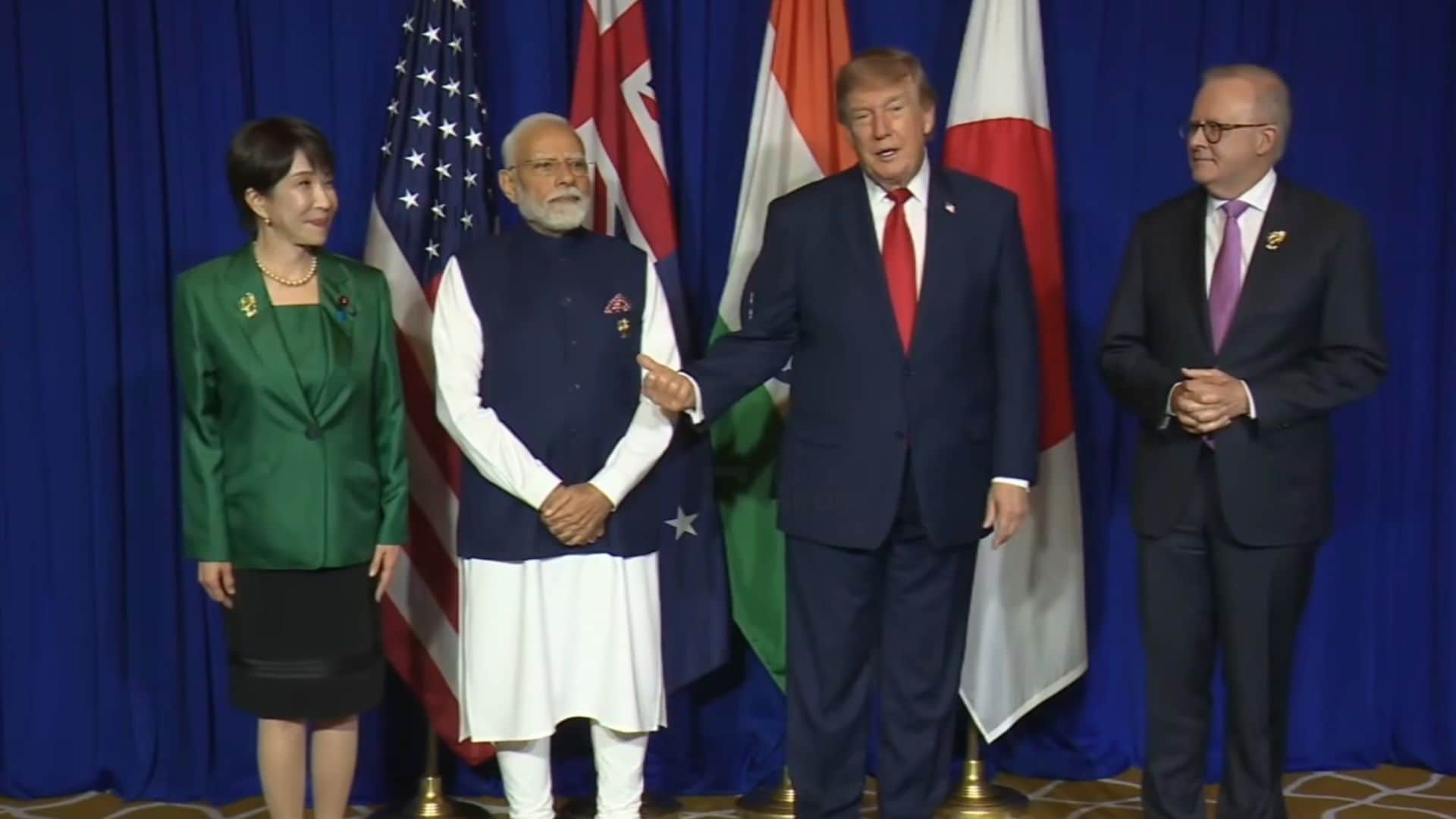
Political analysts love a simple headline. When Donald Trump stood beside Narendra Modi at the Quad Summit in Wilmington, Delaware, in September 2024 and called the Indian Prime Minister a "tough man," the media immediately packaged the soundbite as proof of an unbreakable personal bromance and a unified front against China.
That framing is lazy. It mistakes theatrical flattery for strategic alignment.
In diplomacy, public praise between leaders often masks deep, unresolved friction over trade, security commitments, and competing national interests. Looking closely at the actual mechanics of U.S.-India relations reveals that the "tough man" label is not a badge of seamless partnership—it is a polite acknowledgment that New Delhi refuses to be a compliant junior partner in Washington's Indo-Pacific strategy.
The Myth of Personal Chemistry Driving Foreign Policy
Mainstream coverage frequently reduces complex international summits to interpersonal dynamics. Commentators point to past rallies like "Howdy, Modi!" in Houston or "Namaste Trump" in Ahmedabad as evidence that personal rapport overrides structural disagreements.
Experienced diplomats view this differently. Realist international relations theorists, such as John Mearsheimer and Kenneth Waltz, have long argued that states act according to their structural incentives and national security needs, not the personal friendships of their leaders.
When Trump called Modi "tough" during the 2024 summit—and similarly praised him during campaign appearances—he was referring directly to Modi's hardline stance in trade negotiations. During the first Trump administration, Washington revoked India's preferential trade status under the Generalized System of Preferences (GSP) and imposed tariffs on Indian steel and aluminum. New Delhi retaliated with tariffs on 28 American products, including almonds, apples, and walnuts.
Calling a counterpart "tough" in that context is not an endorsement of shared goals. It is an admission that the other side will not yield concessions easily.
What the Quad Actually Is and What It Is Not
To understand why the media narrative falls short, you have to look at the Quadrilateral Security Dialogue—the Quad—itself. Comprising the United States, India, Japan, and Australia, the grouping is routinely described in press reports as an "Asian NATO."
That characterization is factually wrong.
- No mutual defense treaty: Unlike NATO, the Quad has no Article 5 equivalent. Neither Washington, Tokyo, Canberra, nor New Delhi is legally bound to defend the others in an armed conflict.
- Divergent threat perceptions: While the United States, Japan, and Australia are formal treaty allies with shared military interoperability, India maintains a strict doctrine of strategic autonomy.
- Non-military focus: Official Quad joint statements, including the Wilmington Declaration, emphasize maritime domain awareness, semiconductor supply chains, clean energy, and health security rather than joint combat operations.
India shares a contested, 2,100-mile Himalayan border with China, where deadly clashes occurred in the Galwan Valley in 2020. Because India faces a direct land threat from Beijing—unlike the maritime geography separating the U.S., Japan, and Australia from the Chinese mainland—New Delhi has to calibrate its posture carefully. Provoking Beijing into a two-front crisis without guaranteed American military intervention on the Himalayan border is a risk Indian planners will not take.
The Structural Friction Beneath the Handshakes
Behind the photo opportunities at the Quad Summit, three major policy divergences continue to test the U.S.-India relationship.
1. Trade Protectionism vs. Market Access
Both Washington and New Delhi have leaned heavily into economic nationalism. India's "Make in India" initiative relies on high import tariffs to shield domestic manufacturing and attract local assembly, which frustrates American exporters seeking access to India's consumer market. Conversely, Washington's reshoring subsidies and tariff threats create uncertainty for Indian pharmaceutical, IT, and manufacturing sectors. Neither government is prepared to sign a comprehensive free trade agreement because domestic political constituencies in both countries oppose the required concessions.
2. Russia and Defense Diversification
While the United States views Moscow as an adversary following the invasion of Ukraine, India maintains decades-old defense and energy ties with Russia. According to data from the Stockholm International Peace Research Institute (SIPRI), Russia remained India's largest arms supplier between 2019 and 2023, accounting for 36% of Indian arms imports—down from 76% a decade earlier, yet still substantial. Furthermore, India became a major buyer of discounted Russian crude oil after 2022, resisting Western pressure to join sanctions regimes. For New Delhi, maintaining ties with Moscow is a strategic hedge to prevent Russia from becoming entirely dependent on China.
3. Sovereignty and Domestic Politics
Diplomatic friction also arises when domestic political issues cross borders. Allegations raised by U.S. federal prosecutors regarding a foiled assassination plot targeting a Sikh separatist on American soil introduced quiet tension into bilateral intelligence and law enforcement cooperation. While both governments compartmentalized the issue to preserve broader strategic ties, it demonstrated that shared democratic labels do not eliminate friction over sovereignty and extraterritorial actions.
Why Analysts Misread Diplomatic Language
When observers ask whether Trump and Modi's rapport guarantees a stronger Quad, they are asking the wrong question. Personal warmth between leaders can grease the wheels of communication during a crisis, and it signals to domestic audiences in both countries that the relationship carries high-level attention.
However, equating a complimentary remark at a summit with strategic convergence ignores how foreign policy actually operates.
- Transactional alignment: The U.S. and India cooperate where their interests overlap—specifically in balancing Chinese influence in the Indian Ocean and diversifying supply chains away from single-source dependencies.
- Persistent autonomy: India will continue to participate in multilateral forums like BRICS and the Shanghai Cooperation Organisation alongside Russia and China, even while participating in Quad initiatives.
- Issue-by-issue bargaining: Every trade dispute, visa cap, and technology transfer agreement will be negotiated on hard transactional terms regardless of how leaders describe each other in front of cameras.
The Trade-Off of Strategic Autonomy
There is a clear downside to India's refusal to enter formal alliances, just as there is a downside to Washington's expectation of alignment. By preserving strategic autonomy, India avoids being drawn into American military conflicts in the Middle East or Eastern Europe, but it also forfeits the ironclad security guarantees and top-tier defense technology transfers that treaty allies like the United Kingdom or Australia receive under frameworks like AUKUS.
Similarly, if Washington treats India like a conventional treaty ally and demands uniform alignment on sanctions or trade rules, it risks alienating a partner whose primary value lies in being an independent regional counterweight in Asia.
The Quad functions precisely because it does not require total ideological or military uniformity. It is a flexible coalition built around overlapping interests rather than identical worldviews.
When a leader calls his counterpart a "tough man" on an international stage, take the words at face value. It is not a declaration of unconditional harmony—it is a recognition that the negotiation at the table is going to be hard.