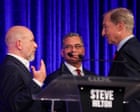
The political press is currently obsessing over a mathematical hallucination. Turn on any cable network or open any major news site, and you will see breathless coverage of the California jungle primary. They call it a "nail-biter." They claim the race to replace Gavin Newsom remains "too close to call" as late-arriving mail ballots crawl into county registrar offices.
They are fundamentally misreading the board.
The early June data shows Republican Steve Hilton and Democrat Xavier Becerra hovering at roughly 27% and 26% of the vote respectively, with billionaire Tom Steyer trailing around 19%. Because the Associated Press refuses to plant a flag while mail-in drops continue, pundits treat this like a volatile three-way cliffhanger.
It is not. The primary is functionally over, and more importantly, the general election in November is already decided. The media is selling a false narrative of suspense to maintain reader engagement, completely ignoring the structural reality of California’s electorate and the mechanics of its top-two system.
The Myth of the Three-Way Cliffhanger
Every election cycle, mainstream reporters fall into the same trap: they treat the slow speed of California’s ballot tallying as a proxy for political volatility. It is a fundamental misunderstanding of the process. California’s universal vote-by-mail system means ballots postmarked by Election Day can arrive days later. This does not mean the race is changing; it just means the data entry is slow.
Look at the actual spread. Hilton and Becerra have held a consistent lead outside the margin of error needed for Steyer to close a multi-point gap with the remaining uncounted pool. Steyer poured over $130 million of his own wealth into this primary, buying up airwaves and running a textbook outsider campaign. It failed. The data shows his spending peaked early, and when Eric Swalwell imploded and dropped out in mid-April, those votes did not go to Steyer or Katie Porter as the donor class expected. They consolidated directly behind Becerra.
Imagine a scenario where a corporate brand spends its entire annual runway on a hyper-aggressive customer acquisition campaign, only to watch its conversion rate flatline while a legacy competitor grabs the market share for free. That is what happened to Steyer. The remaining uncounted ballots—disproportionately late mail-in drops from urban centers—do not favor a self-funded billionaire tracker or a consolidated conservative base. They favor a traditional Democratic infrastructure candidate like Becerra. The math for a third-place surge simply does not exist.
Why a Hilton Victory in November Is Statistically Impossible
The second, more egregious narrative floating around is that Steve Hilton’s strong primary showing—buoyed by a late April endorsement from Donald Trump—means California is suddenly a live battlefield for Republicans in the general election.
This is dangerous statistical illiteracy.
I have watched political consultancies torch millions of dollars of donor cash trying to manufacture "purple" trends in deep blue states. They look at a primary where a Republican tops the ticket with 27% or 28% of the vote and convince gullible national super PACs that the state is in play.
They ignore the denominator. In a California jungle primary, the total Republican vote is capped by a hard ceiling. Between Hilton and Riverside County Sheriff Chad Bianco, the total conservative turnout in this primary accounts for roughly 38% to 40% of the electorate. The remaining 60% is an absolute firewall of Democratic and left-leaning independent voters distributed among Becerra, Steyer, Porter, and a dozen minor candidates.
When the field condenses to a binary choice in November, the math recalibrates brutally.
- Registration Deficit: Registered Democrats outnumber Republicans in California by nearly two to one.
- The Independent Fallacy: Pundits assume independent voters are centrist wildcards. In California, independent voters break heavily toward Democrats on statewide executive races, typically by a 15- to 20-point margin.
- The Trump Tax: While a Trump endorsement is a golden ticket to survive a Republican primary split, it operates as a lead weight in a California general election. It completely alienates the suburban voters in Orange County and the Bay Area that a Republican would need to build a winning coalition.
To believe Hilton can win the governorship in November requires you to believe that a substantial portion of Tom Steyer and Katie Porter voters will either stay home or cross the aisle to vote for a former Fox News host and right-wing commentator. It is a fantasy.
The Flawed Premise of the "Change" Candidate
The media’s favorite question right now is: Can a political outsider fix California's systemic crises? By framing the election around the state’s very real problems—homelessness, skyrocketing housing costs, a massive budget deficit, and infrastructure decay—reporters imply that voters will penalize the ruling party. They assume that because a voter is furious about the cost of living, they will vote for a structural overhaul.
This premise is completely broken. Electorates do not vote like rational economic actors in a textbook; they vote based on tribal alignment and risk aversion.
Xavier Becerra is the ultimate insider candidate. His resume reads like a checklist of the California Democratic establishment: more than two decades in Congress, State Attorney General, and federal Health Secretary. To an independent observer, his record is deeply tied to the very status quo that voters claim to detest. Yet, he is the safest bet on the ballot for the state's dominant voting blocs.
The reality of California politics is that the institutional machinery—public sector unions, environmental lobbies, and tech-sector donors—exerts a gravity that no primary upset can break. A contrarian analysis requires acknowledging a uncomfortable truth: a broken system can remain politically stable for a long time if the opposition party refuses to offer a viable, culturally palatable alternative. By running on a platform of suspending environmental regulations and slashing taxes, the Republican options ran a campaign tailored for a national cable audience, not the median voter in Los Angeles or Santa Clara County.
The Actionable Reality for Donors and Strategists
If you are a political donor, a corporate government affairs officer, or a strategy executive looking at California, the advice is straightforward: ignore the horse-race coverage completely.
Stop funding the general election apparatus for the top-two race. Every dollar sent to Hilton’s general election campaign is a total write-off that would be better spent on competitive congressional house seats in the Central Valley or competitive legislative races where local dynamics actually matter.
The gubernatorial race is effectively locked. Xavier Becerra will be the next governor of California. The only variable left to determine is the exact margin of his victory in November, and whether the institutional left uses his inevitable platform to push further toward progressive fiscal policy, or if his corporate backers hold him to a moderate business-as-usual line.
The media will keep telling you the vote-counting delay is a sign of a vibrant, unpredictable democracy. Do not buy the hype. The numbers are clear, the electorate is segmented, and the script for November has already been written.