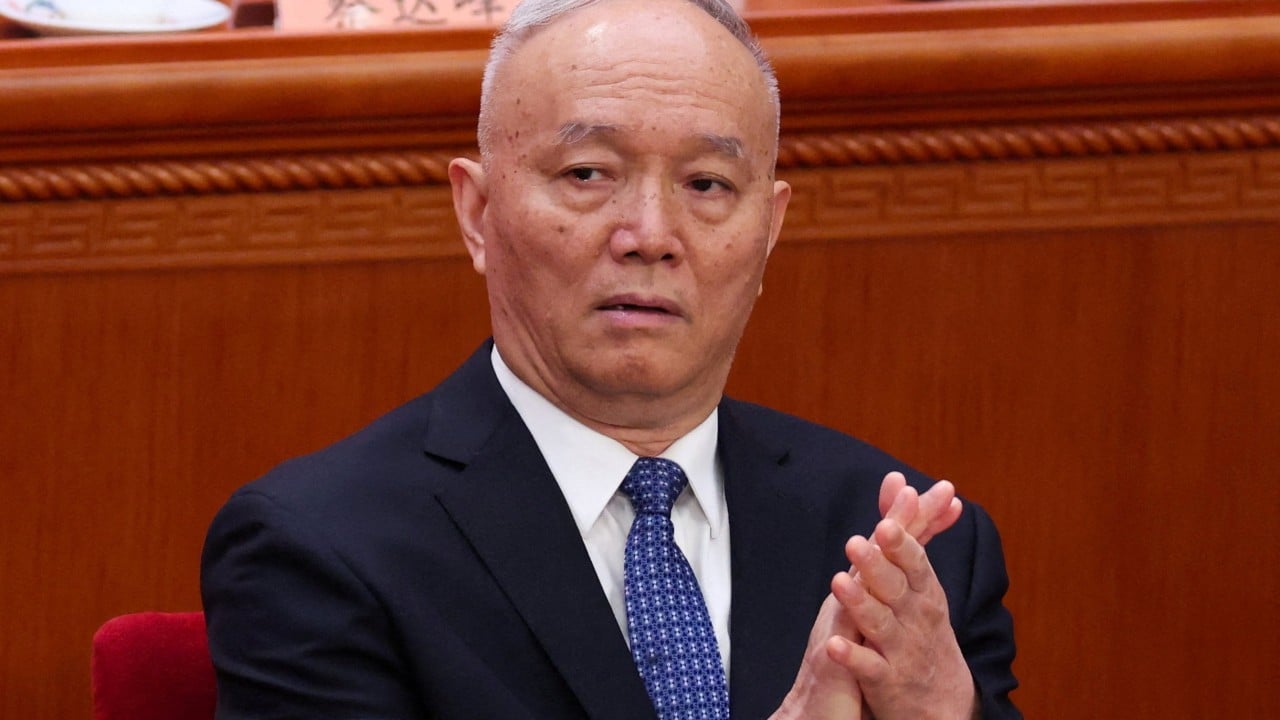
Western observers usually look at China's official ranking lists to figure out who holds the power. They see Cai Qi listed as number five on the seven-member Politburo Standing Committee. They figure he is important, but not right at the top.
That is a major misunderstanding of how Beijing actually works.
Cai Qi is effectively Xi Jinping's chief of staff. He handles everything from daily scheduling to national security coordination. Now, his portfolio just got even bigger. State media broadcasts confirmed his new role as the president of the Central Party School.
This isn't just another title for a busy bureaucrat. It consolidates unprecedented administrative, organizational, and ideological control under one single official. To understand where China is heading, you have to understand why this specific school matters so much, and why Cai Qi taking the wheel is a massive structural shift.
The Incubator of Power
The Central Party School in Beijing isn't a normal university. It is the premier training ground for the rising stars of the Chinese Communist Party. If you want to climb into the upper echelons of provincial or national government, you spend time here.
It serves as the core incubator for the party's ruling ideology. This is where rising cadres learn how to speak the policy language of the era. They don't just study history; they are trained to execute the top leader's vision with total compliance.
Historically, this seat has been a stepping stone for the very top job. Both Xi Jinping and his predecessor, Hu Jintao, ran the Central Party School right before they took over the country. Serving as its head allowed a rising leader to build a personal network of loyal subordinates across different provinces. It was a way to cultivate a future faction.
Lately, that pattern changed. Xi broke the tradition by appointing Chen Xi, a trusted ally who ran the party's Organization Department. Chen kept the job even after retiring from his main political posts.
By replacing a retired elder with Cai Qi, Xi is doing something completely different. He is putting an active, hyper-powerful insider in charge of the classroom.
The Man Who Monopolizes the Backroom
To see why this appointment matters, look at the other hats Cai Qi wears. He is the director of the party's General Office. That makes him the gatekeeper. He controls who gets to see Xi Jinping, which documents reach the top desk, and how security details are managed around the leadership.
He also leads the Secretariat, the body that manages the day-to-day operations of the party. He oversees the Working Committee for Central and State Organs, giving him direct supervision over the bureaucracy in Beijing. He even handles major pieces of the national security apparatus.
No single Standing Committee member has held this specific combination of administrative and doctrinal power in decades.
"With this appointment, he combines the Party's organizational, doctrinal, and administrative functions under one Standing Committee member," notes Jean-Christian Mittelstaedt, a professor of modern Chinese studies at the University of Zurich. "I don't think there's a precedent for that."
Basically, Cai controls the paper flow, the security, the daily execution of policy, and now, the ideological training of every future leader in the country. He isn't just a chief of staff anymore. He is the manager of the party's future.
What This Tells Us About Xi's Circle
This appointment tells us two things about the current state of Chinese politics.
First, it shows total trust. Xi is comfortable handing the keys of the ideological kingdom to one man. Cai's history with Xi goes back decades to their time working together in Fujian and Zhejiang provinces. He proved his willingness to execute tough policies when he cleared out migrant neighborhoods in Beijing as the city's party boss in 2017. He does not hesitate.
Second, it signals that ideological enforcement is a permanent priority. During the recent spring graduation ceremony where Cai made his debut as president, state media reported that the 531 graduates focused heavily on "Xi Jinping Thought" and the decisions of the Fourth Plenary Session of the 20th Central Committee. They were reminded to defend the core leader's authority above all else.
By putting his closest enforcer in charge of the school, Xi ensures there is zero gap between top-level policy and grassroots party training. The goal is complete alignment.
How to Read Beijing's Next Moves
If you are trying to track where China's domestic policy is going, stop looking only at the state premier or the official diplomatic ranks. Watch what Cai Qi does with the party's internal structure.
Keep an eye on upcoming provincial leadership shuffles. The cadres graduating from the Central Party School over the next year are being molded directly under Cai's watch. When these officials move into regional governorships or ministerial roles, they will carry a specific brand of absolute loyalty that Cai is paid to enforce.
Pay attention to the language coming out of party journals like Qiushi. The ideological directives published there will directly reflect the curriculum being taught at the school. If the school shifts its focus toward harsher economic security measures or tighter internet controls, expect those policies to hit the ground nationwide within months. The school is the leading indicator; the country is the lagging one.