The headlines are screaming about "unprecedented" force. They want you to marvel at the sheer tonnage of the GBU-28. They want you to believe that a 2,200-kg hunk of steel and high explosives falling from a B-2 Spirit is the final word in Persian Gulf diplomacy.
It isn't. It’s a loud, expensive admission that traditional air power is reaching its expiration date.
Media outlets are salivating over the "bunker buster" narrative because it’s easy to digest. Big bomb hits ground; ground goes boom; bad guys lose. But anyone who has spent time analyzing hardened target defeat knows that the GBU-28 is a relic of a 1990s mindset being applied to a 2026 problem. We are watching the military-industrial complex try to solve a decentralized, subterranean network problem with a sledgehammer when the enemy is a liquid.
The obsession with these strikes near the Strait of Hormuz misses the most glaring reality of modern warfare: If you have to use a 5,000-pound gravity bomb to hit a missile site, you’ve already lost the intelligence war.
The Physics of Failure: Why Depth Doesn't Equal Defeat
Let’s talk about the math that the "shock and awe" crowd ignores. The GBU-28 is designed to penetrate roughly 30 meters of earth or 6 meters of reinforced concrete. That sounds impressive until you look at the geological reality of Iran’s "missile cities."
The IRGC (Islamic Revolutionary Guard Corps) hasn't been sitting idle since the Gulf War. They have been digging into the Zagros Mountains. We aren't talking about basement bunkers. We are talking about facilities buried under 100 to 500 meters of solid limestone and granite.
Physics dictates a hard limit on kinetic penetration.
$$d = \frac{1.1 \cdot W}{A} \cdot \sqrt{V}$$
Where $d$ is penetration depth, $W$ is weight, $A$ is cross-sectional area, and $V$ is impact velocity. Even if you optimize every variable, a gravity-fed bomb is never going to reach the heart of a mountain-based facility.
When the US drops a GBU-28 on a site near Hormuz, they aren't destroying the "missile city." They are collapsing an entrance. They are "mission-killing" the site for 48 to 72 hours while the IRGC clears the debris with a few bulldozers. Calling this a "destruction of Iranian missile capabilities" is like saying you destroyed a subway system by putting a padlock on one station entrance.
The Cost-Exchange Ratio is Broken
Every time a B-2 drops a GBU-28, the taxpayer is out roughly $200,000 per munition, not counting the $150,000 per flight hour for the stealth bomber.
The IRGC’s response? A $20,000 Shahed-style drone or a mobile launcher hidden in a civilian garage five miles away. We are using "exquisite" weaponry to fight a ghost. The 2,200-kg bomb is a PR tool designed to reassure domestic audiences and nervous allies, but tactically, it’s an inefficient use of mass.
The Myth of the Strait of Hormuz Chokepoint
The competitor narrative suggests that hitting these sites secures the Strait. This is a fundamental misunderstanding of "Anti-Access/Area Denial" (A2/AD).
The threat to the Strait of Hormuz isn't just fixed missile silos. If it were, the war would be over in a weekend. The real threat is the "swarm and disappear" doctrine.
- Mobile TELs (Transporter Erector Launchers): These move every 20 minutes. A bunker buster hitting a fixed site is hitting a target the Iranians wanted us to see. It’s a decoy.
- Semi-Submersibles: Small, low-profile craft that can’t be seen from the altitude a B-2 operates at.
- Smart Mines: They don’t need a bunker. They sit on the sea floor for six months until a specific acoustic signature passes by.
By focusing on the "big boom" of a bunker buster, the US military is playing into a choreographed performance. The Iranians build deep, visible tunnels specifically to draw fire, knowing that the most dangerous assets are actually stored in the back of unmarked refrigerated trucks in Bandar Abbas.
Cyber is the Real Bunker Buster
If you want to neutralize a missile site, you don't drop a 2,200-kg bomb. You drop a logic bomb.
I’ve seen how these "hardened" facilities operate. They rely on closed-circuit industrial control systems (ICS). They have power grids, ventilation systems, and cooling loops for the liquid-fueled rockets. If you kill the air filtration system in a facility 100 meters underground, the "missile city" becomes a tomb without a single gram of TNT being detonated.
Yet, we continue to see this fetishization of kinetic force. Why? Because you can’t put a photo of a successful cyber-intrusion on the front page of India Today. You can’t show "data corruption" to a congressional committee to justify a $800 billion defense budget. You need the plume of smoke. You need the video of the concrete shattering.
The persistence of the bunker-buster narrative is a symptom of Intellectual Inertia. We are comfortable with the GBU-28 because it fits our 20th-century mental model of what "winning" looks like.
The Collateral Damage Trap
There is another nuance the "pro-strike" analysts ignore: The geological shockwave.
When you drop 2,200 kg of explosives on a coastal missile site, you aren't just hitting a military target. You are risking the structural integrity of local desalination plants or energy infrastructure that the civilian population relies on. In the Middle East, "surgical strikes" are a myth sold to the public to make war feel palatable. Every bunker buster dropped is a recruitment poster for the next generation of insurgents. It’s a self-perpetuating cycle of violence fueled by a love for heavy ordnance.
People Also Ask (and Get Wrong)
Can the US actually stop Iran from closing the Strait?
Not with bombs. You can't "bomb" a sea lane open. If Iran sinks two VLCCs (Very Large Crude Carriers) in the narrowest part of the channel, no amount of bunker busters will clear that wreckage. The only way to keep the Strait open is through diplomatic de-escalation or a massive, sustained ground presence—neither of which is achieved by dropping 5,000-pound bombs from 30,000 feet.
Is the GBU-28 the most powerful conventional weapon?
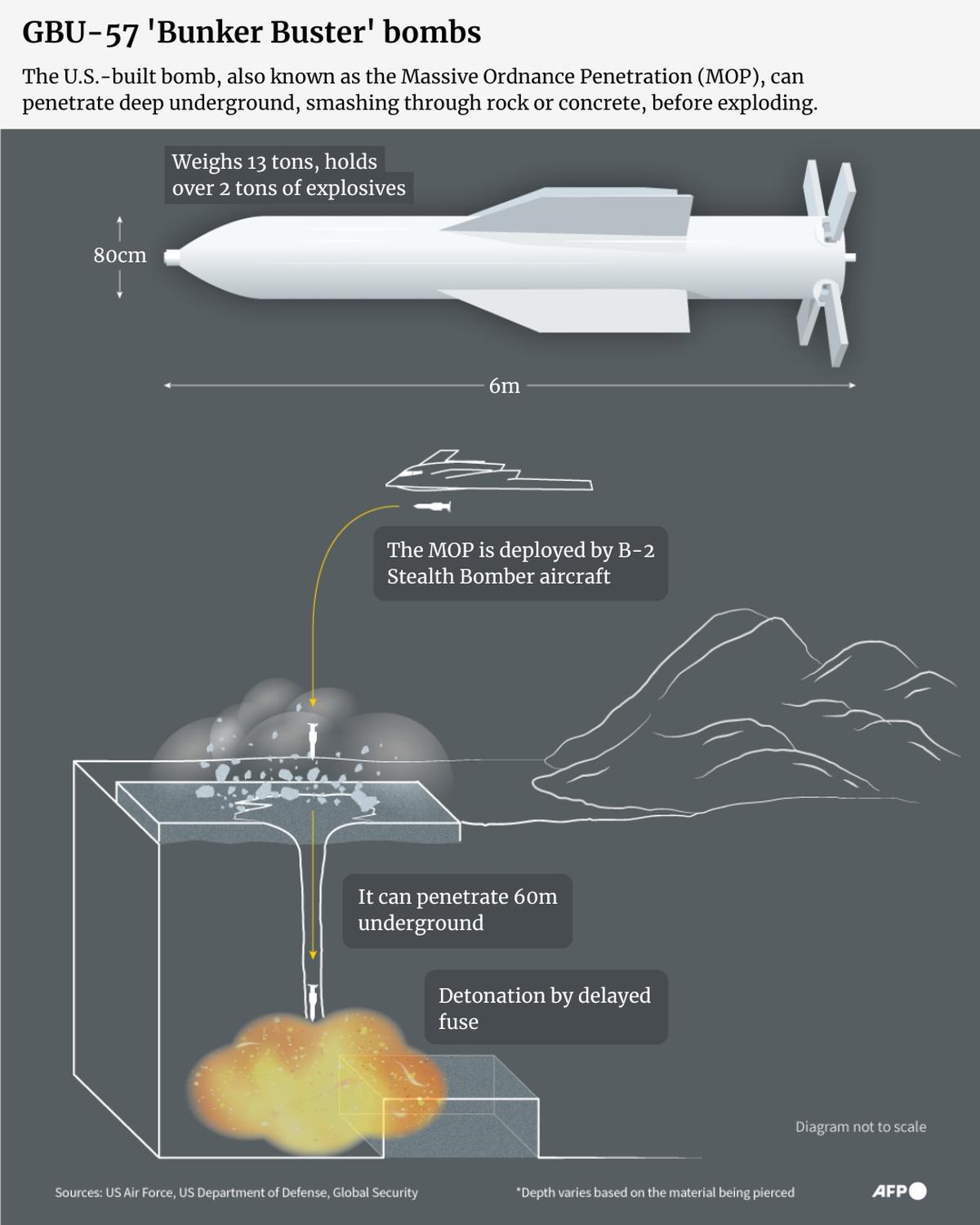
No. That would be the GBU-57 Massive Ordnance Penetrator (MOP), weighing in at 13,600 kg. But even the MOP has its limits. The more weight you add, the fewer planes can carry it. You trade volume for impact. If you only have two planes capable of carrying the "big one," the enemy only has to track two planes. Predictability is the death of strategy.
Why is the media reporting this as a "game-changer"?
Because the media doesn't understand the difference between destruction and denial. They see a hole in the ground and report a victory. They don't see the five other mobile launchers that just pulled out of a civilian tunnel three miles away.
The Strategic Pivot: What No One Is Admitting
The era of the "Bunker Buster" is a sunset period. We are witnessing the final gasps of the "Big Bomb" doctrine.
The future isn't a 2,200-kg bomb. It’s 2,200 one-kilogram drones acting in coordination. It's high-powered microwave (HPM) weapons that fry the electronics inside the mountain without scratching the rock. It's the total subversion of the enemy's command and control (C2) through electronic warfare.
But those solutions are quiet. They are "boring" to the general public. They don't provide the visceral thrill of a B-2 banking into the sunset after an explosion.
If the US continues to rely on the GBU-28 to project power in the Persian Gulf, it is signaling weakness, not strength. It is telling the world that it has no answer for subterranean proliferation other than trying to punch the Earth until it gives up.
The IRGC isn't afraid of the GBU-28. They have more dirt than we have bombs. They know that for every million-dollar strike we conduct, they can dig another tunnel for the price of a few dozen laborers and a boring machine.
Stop looking at the craters. Start looking at the logistics. The "bunker buster" is a tactical distraction from a strategic stalemate. We are playing checkers with 5,000-pound pieces while the opponent is playing a different game entirely.
The bunker isn't the target. The mindset that thinks we need to bust it is the real problem.