The stone underfoot is polished to a mirror shine, slick with the residual moisture of ten thousand damp overcoats and the relentless scuff of shoe leather. If you stand in the center of the Galleria Vittorio Emanuele II—Milan’s towering, glass-domed cathedral to commerce—and look down, you will eventually see someone spin. They will plant their right heel firmly into a specific, hollowed-out groove in the pavement, close their eyes, and rotate backward three times.
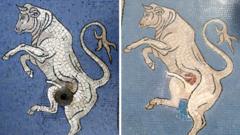
Tradition dictates it brings good luck. Specifically, the ritual requires pivoting on the testicles of a mosaic bull, the heraldic symbol of rival Turin, embedded in the floor.
For decades, this act of superstitious vandalism has been a collective, joyful rite. Milanese executives in tailored Zegna suits, backpack-wearing students from the polite suburbs, and dazed tourists fresh from the Duomo steps have all partaken. The mosaic was never an untouchable museum piece. It was a living, breathing part of the city’s concrete identity, worn down by millions of human desires.
But a recent restoration has changed the conversation entirely. What was meant to fix the damage has instead sparked a quiet fury among locals, exposing a deep rift in how we treat the soul of historic cities.
The Day the Magic Vanished
Consider the craftsman who arrived with his tools, tasked with erasing the indentation of millions of human heels. The goal was noble on paper: repair the deep crater worn into the bull’s midsection and restore the nineteenth-century mosaic to its original, pristine glory. The municipality wanted to patch the wound.
Instead, they altered the geometry of a ritual.
When the barricades came down, the collective reaction from the Milanese was not gratitude. It was bemusement, quickly souring into irritation. The restored bull looked bright, sharp, and fundamentally wrong. The deep, familiar dip where a heel naturally locked into place was gone, replaced by a flat, uniform surface of brand-new tesserae. The tiles looked less like historical conservation and more like a rushed bathroom renovation.
To understand why this matters, you have to look past the stone itself and focus on the people who interact with it. A city is not merely a collection of preserved monuments; it is an ecosystem of habits. When a piece of public art is polished so thoroughly that it loses its relationship with the public, it ceases to be alive. It becomes a taxidermied version of itself.
The Illusion of the Untouched Past
We suffer from a modern obsession with pristine beginnings. We want our ancient ruins to look exactly as they did the day the mortar dried, forgetting that history is a process of accumulation, not a static freeze-frame.
Imagine a hypothetical watchmaker inheriting a grandfather clock. The wood is nicked from decades of vacuum cleaners bumping against the base; the brass dial is tarnished where three generations of hands have wound the spring. If the watchmaker strips the patina, replaces the weathered gears with factory-fresh silicone components, and sands away the dents, he hasn’t preserved the clock. He has murdered its story.
The bull in the Galleria was beautiful precisely because it was broken. The cavity in the floor was a physical manifestation of human hope, a testament to the strange, irrational things people do when they want a little bit of luck. It was a monument to human presence. By smoothing it over, the restorers didn't protect history; they erased the evidence that we were ever there.
Logistical arguments always favor the preservationists. They will point out that the structural integrity of the floor was at risk, that the sub-flooring was exposed, and that water from wet umbrellas could seep into the foundations of the Galleria. These are reasonable, logical points. But architecture must accommodate the human animal, not just the weather.
When Conservation Feels Like Eviction
This tension isn't unique to Milan. Walk through Venice, Florence, or Paris, and you will see the same quiet war being waged between authenticity and sanitization. Cities are increasingly treated like open-air museums where the locals are merely background extras in a corporate film.
When you alter a landmark to make it impervious to the people who love it, you change the contract between the citizen and the street. The message is subtle but clear: Look, but do not touch. Admire, but do not participate.
The true tragedy of the new mosaic bull isn't that the tiles are too bright—they will eventually fade under the grey Milanese winter light. The tragedy is that the physical memory of the city has been reset to zero. The groove that took decades to carve through sheer, collective repetition was a democratic masterpiece. It belonged to everyone and no one.
Now, the spinning has resumed, but it feels performative rather than habitual. The heel slips on the flat, slick surface. The natural anchor point is missing. People look down, confused by the lack of resistance, before executing an awkward turn and moving on toward the luxury boutiques that line the arcade.
The restorers achieved their objective. The floor is flat. The bull is intact. The damage has been repaired. Yet, standing under the great glass vault of the Galleria as the evening crowd swells, it is hard to shake the feeling that in saving the stone, they forgot to save the magic that made us care about the stone in the first place.