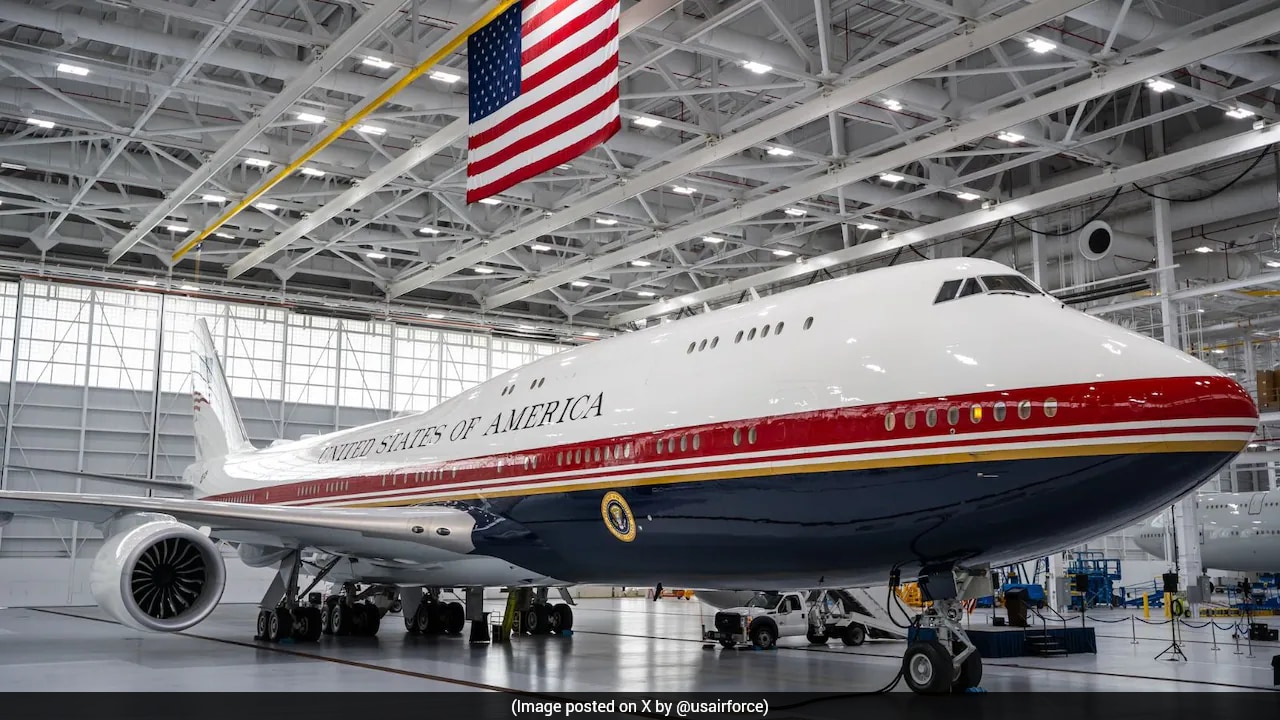
The newly unveiled Air Force One—a modified Boeing 747-8 gifted by Qatar—fundamentally redefines presidential travel by replacing the spartan, office-like utility of the old 1990-era fleet with a sovereign royal transport. Unlike the retiring VC-25A, which functioned as a flying military command center, this interim "bridge" aircraft preserves the lavish lounge-and-flatbed interior built for Gulf royalty. The plane mirrors Donald Trump’s private Boeing 757 in its dark navy, red, and gold paint scheme, yet it dwarfs his personal jet in size, range, and operational expense, presenting a complex mix of diplomatic, ethical, and logistical challenges.
The arrival of the aircraft at Joint Base Andrews marks a striking departure from historical precedent. Never before has the United States commander-in-chief flown in a major piece of military infrastructure donated by a foreign state. While Washington spent decades viewing the presidential aircraft as an unassailable symbol of American industrial might, the new reality is far messier. The jet represents a temporary fix for a broken domestic defense procurement system.
A Sovereign Compromise in the Hangar
The official designation is the VC-25B Bridge aircraft. To the public, it is the new Air Force One, sporting a massive American flag on the tail and the presidential seal on the fuselage. To national security experts and ethics lawyers, it is a $400 million question mark.
Accepting a luxury jumbo jet from the emir of Qatar, Sheikh Tamim bin Hamad al-Thani, shatters traditional norms surrounding federal gifts. The administration bypassed standard restrictions by having the Department of Defense formally accept the aircraft as a military asset. Critics call it a glaring conflict of interest, especially given the Trump Organization’s ongoing real estate partnerships with state-backed entities in the Gulf. The White House counters that rejecting a free, modern commercial airliner during an active procurement crisis would be fiscally irresponsible.
The security implications are equally profound. The Air Force spent ten months modifying the Qatari plane to bring its communication and defensive suites up to presidential standards. Officials claim the retrofitting process cost less than $400 million and adhered to rigid engineering protocols. However, defense analysts note that integrating highly classified American electronic warfare systems into an airframe originally built for foreign operations is inherently difficult. The military had to skip several deep-tier modifications planned for the permanent fleet just to get this interim version into the air.
Luxury Over Duty Inside the Royal Flight
To understand how much the presidential environment has shifted, one must look at the layout of the cabin. The previous Air Force One, a heavily modified Boeing 747-200B that served five presidents over 36 years, was structured like a secure government office building. It featured cramped staff seating, functional conference rooms, and a spartan medical suite. It smelled of stale coffee and old upholstery.
The Qatari-gifted 747-8 feels like a flying estate. The Air Force opted to leave the interior layout minimally changed to save time and money. The cabin boasts warm tan walls, high-gloss wood paneling, gold trim, and multi-room lounge areas outfitted with plush couches.
Unlike the old plane, where staff and journalists spent long overseas flights upright in rigid seats, the new aircraft features modern lay-flat seats that convert fully into beds. The press section alone has expanded to nearly three times its original size. Even the seatbelts have been updated, now stamped with the presidential seal over top-tier leather.
This environment aligns perfectly with Trump’s personal aviation preferences. His private jet, a Boeing 757 affectionately dubbed Trump Force One, is famous for its 24-karat gold-plated fixtures, silk-lined ceilings, and deep mahogany accents. The new Air Force One brings that exact aesthetic to the state fleet, replacing the institutional, Kennedy-era robin's egg blue with a dark, commanding interior that feels less like a branch of government and more like a private club.
The Tactical Reality of Flight Operations
The physical scale of the new aircraft introduces massive logistical hurdles. The Boeing 747-8 is the longest operational passenger airliner in the world, measuring 250 feet from nose to tail.
Presidential Fleet Specifications
| Feature | Retiring Air Force One (VC-25A) | New Bridge Air Force One (747-8) | Trump Private Jet (757-200) |
|---|---|---|---|
| Aircraft Model | Boeing 747-200B | Boeing 747-8 | Boeing 757-200 |
| Length | 231 feet | 250 feet | 155 feet |
| Wingspan | 195 feet | 224 feet | 124 feet |
| Flight Hour Cost | $180,000 | $210,000 | $15,000 |
| Primary Interior Focus | Military Command/Office | Royal Luxury/Lounges | Personal Luxury |
The increased wingspan and fuselage length meant the military had to build an entirely new, specialized hangar at Joint Base Andrews simply to park the plane.
Operationally, the 747-8 outclasses the older VC-25A in speed, fuel efficiency, and range. It can fly faster and further without needing the complex in-flight refueling maneuvers that the aging 1990 models required. Yet, its sheer size limits where the president can land. Many smaller regional airports that could accommodate Trump's personal 757, or even the older 747, cannot handle the runway thickness or taxiway clearance required by a fully loaded 747-8.
The defense infrastructure of the new plane includes advanced missile-warning sensors, radar-jamming chaff dispensers, and shielded wiring to protect against electromagnetic pulses. Trump’s private 757 possesses none of these features, relying entirely on standard commercial radar and civilian air traffic control. The administration has even equipped the new bridge plane with Starlink terminals to guarantee high-bandwidth internet connectivity anywhere on earth.
Boeing's Billion Dollar Delay Drama
The reliance on a foreign gift highlights a broader systemic failure within the American aerospace sector. The government originally contracted Boeing in 2017 to build two brand-new, highly customized VC-25B aircraft to replace the aging presidential fleet. That program has collapsed into a logistical nightmare.
Plagued by severe labor shortages, design disputes, and the bankruptcy of a major interior subcontractor, Boeing's presidential aircraft program has seen its timeline slip by four years. Costs have ballooned from an initial estimate of $3.9 billion to well over $5.3 billion. The manufacturing giant has been forced to absorb billions of dollars in fixed-price losses on the project.
The two custom planes are trapped in a factory floor logjam, with delivery pushed back to 2028. This left the Air Force in a dangerous position. The existing VC-25A fleet was suffering from acute mechanical fatigue. Just months ago, one of the older planes was forced to abort a trip to a summit in Europe due to a critical technical fault, exposing the vulnerability of relying on 30-year-old electronics. The Qatari gift provided an escape hatch from an embarrassing operational shortage, allowing the military to retire the most exhausted airframe before a catastrophic failure occurred.
The Hidden Operating Costs Taxpayers Will Face
While the acquisition cost of the Qatari airframe was technically zero, keeping the mammoth jet in the air will drain public funds at an unprecedented rate. Flying a Boeing 747-8 is a staggeringly expensive endeavor.
Fuel consumption alone represents a massive financial burden. The four General Electric GEnx engines burn thousands of gallons of aviation fuel per hour. When factoring in specialized military maintenance crews, secure supply chains for parts, and the constant security details required at every destination, the cost to operate the new bridge aircraft hovers around $210,000 per flight hour.
Compare this to Trump’s personal Boeing 757, which runs on a fraction of the infrastructure and costs roughly $15,000 per hour to operate. The enormous fiscal footprint of the new Air Force One means every official trip, campaign travel arrangement, and international summit will carry a record-breaking price tag for the American public.
The White House has already announced that the new aircraft will make its public debut leading a massive military flyover in Washington for the upcoming July 4th celebrations. Critics point out that using a nuclear-hardened command ship as a ceremonial party piece is an unnecessary strain on both the airframe and the budget.
The administration insists the plane will eventually be donated to a future presidential library rather than returning to private hands. Until then, the United States will fly its leader around the globe in a gold-plated symbol of foreign generosity, a stark reminder that even the world’s most powerful military superpower occasionally has to accept charity when its own industrial base fails to deliver.