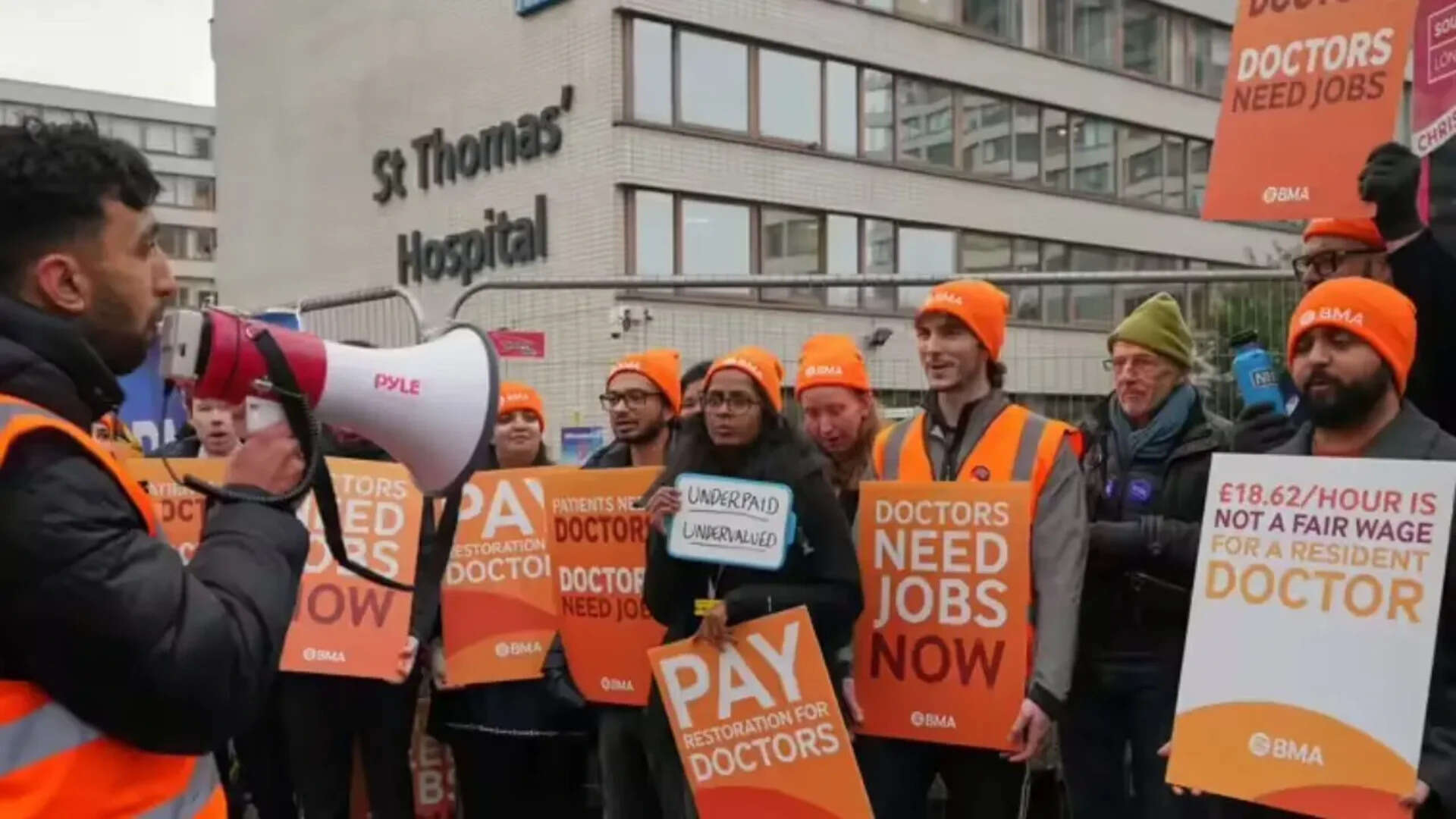
Resident doctors in England have abruptly suspended a highly disruptive four-day walkout following an unexpected, eleventh-hour proposal from the government. The British Medical Association agreed to freeze the industrial action, which was scheduled to cripple frontline hospital services, to allow its tens of thousands of members to vote on the new package. While health officials breathe a temporary sigh of relief, this sudden halt is not an absolute victory for the state. It is a tactical pause in a bitter, multi-year conflict over workforce depletion and economic erosion that remains far from resolved.
The proposed deal offers an average 6.6% pay uplift to be fully implemented by April 2027, alongside standardized contract terms for locally employed physicians. For a health service facing massive patient backlogs, the suspension prevents immediate chaos. Yet beneath the official optimism lies a much darker reality about the state of medical employment in Britain today. Don't miss our earlier post on this related article.
The Illusion of Peace
Whitehall is quick to frame this development as the dawn of a permanent truce. Health Secretary James Murray publicly insisted that the country cannot afford further baseline salary increases beyond what has already been delivered, signaling that the treasury has hit a hard ceiling. By shifting the focus to training places and working conditions, the government managed to pull the British Medical Association back from the brink of its 16th distinct round of walkouts.
But this is an incredibly fragile consensus. The union leadership, spearheaded by resident doctors committee chair Dr. Jack Fletcher, did not accept the deal; they merely agreed to let the rank-and-file vote on it. The language coming from the frontline is defiant, not triumphant. If the membership rejects the terms in the upcoming referendum, the mandate for escalated strike action remains completely valid until August. If you want more about the background here, WebMD provides an excellent summary.
A central driver of this dispute is an issue that rarely makes the nightly news headlines. It is the growing, paradoxical crisis of doctor unemployment.
While hospitals complain of chronic staff shortages, hundreds of fully qualified, locally employed medical graduates cannot secure stable training slots or permanent posts. Highly trained professionals find themselves adrift in bureaucratic limbo because local trusts lack the ring-fenced budgets to hire them permanently. The new deal attempts to resolve this by standardizing the 2016 contract terms for these precarious roles, but standardizing a contract does not automatically create a vacancy.
The Math of Attrition
To understand why the medical workforce remains deeply skeptical, one must look at the long-term trajectory of public sector pay rather than the short-term percentages offered in late-night negotiations.
The state frequently cites a cumulative 28.9% increase over the past three years to argue that medics have been treated generously. From the perspective of a junior or resident doctor, that number is misleading. It represents a partial correction of a steep fifteen-year decline in real-term purchasing power.
Consider a simplified financial trajectory of a standard medical officer over the last decade. If real wages drop consistently due to inflation while workload doubles because of an aging population, a sudden nominal bump does not restore the original baseline. It merely stops the bleeding.
Year      Real-Term Pay Value (Hypothetical Index)
2010      100
2015      91
2020      84
2023      74 (Peak Discontent)
2026      88 (Post-Negotiation Estimate)
This structural deficit explains why recruitment retention numbers are flashing red. Frontline staff are not looking at these figures in isolation. They see their peers leaving for Australia, New Zealand, or the private sector, where the remuneration matches the intense pressure of the job.
Cross-Border Fractures and Senior Discontent
The suspension of the walkout in England does not mean the wider National Health Service is stable. The medical ecosystem is experiencing severe geographic and hierarchical fragmentation.
- Northern Ireland: Doctors have rejected identical baseline offers, with resident physicians preparing for a 24-hour stoppage and senior consultants threatening to reduce services to emergency-only cover.
- Senior Consultants in England: Senior staff and specialist doctors are currently balloting for their own industrial action after rejecting a flat 3.5% upgrade, proving that institutional anger is not confined to entry-level practitioners.
- General Practice: Local family doctors are facing severe financial strain, with modern contract stipulations forcing small clinics to the verge of closure.
This regional and professional variance creates a chaotic environment for patients. A hospital cannot function effectively if the resident doctors return to work but the supervising consultants or the local GPs walk out. The system relies on a seamless continuum of care that is currently fractured at every level.
The Pressure Point
The timing of the government's concession was entirely strategic. Had the walkout proceeded, it would have intersected with an unusually high period of summer hospital admissions and major international public events. National medical directors explicitly warned of a catastrophic convergence of operational pressures.
By waiting until the absolute final moment to alter its position, the Ministry of Health engaged in a high-stakes game of political chicken. It forced the union to make a rapid decision, betting that public pressure would make a prolonged summer strike unpalatable.
This contract dispute is a symptom of a deeper structural failure. The state has treated medical labor as a captive market for decades, assuming that professional duty would always override economic self-interest. That assumption is officially dead. The modern workforce is highly mobile, politically organized, and increasingly unwilling to subsidize a crumbling infrastructure with their own financial wellbeing.
The ballots are now being distributed to tens of thousands of hospital workers across the country. Their decision will determine whether the health service gets a genuine reprieve or enters a winter of unprecedented industrial confrontation. The government has bought itself a few weeks of quiet, but the underlying systemic crisis cannot be negotiated away with a temporary percentage patch.