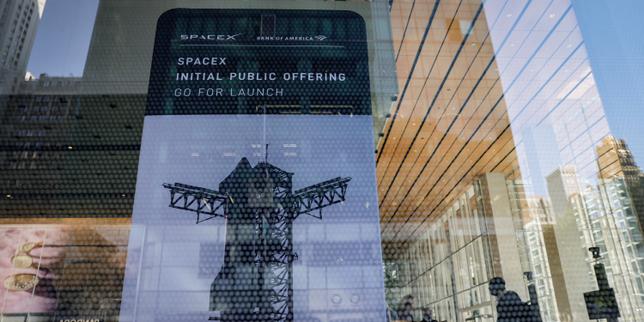
Wall Street is preparing for the largest public market debut in history, and it has almost nothing to do with rockets. While space enthusiasts focus on Mars trajectories and reusable boosters, the imminent SpaceX initial public offering is fundamentally a story about financial hegemony. European regulators and global competitors are watching in real time as American capital markets absorb the world's most critical aerospace infrastructure. This listing does not just create a mega-cap stock. It permanently locks Western commercial space dominance into a single postal code in Lower Manhattan.
The competitor narrative suggests this IPO is a simple victory lap for American finance. That is a superficial reading of a much more aggressive economic reality. This public listing is a defensive moat designed to starve international competitors of capital while tying the retirement funds of millions of everyday investors to the strategic defense priorities of the United States government. If you enjoyed this article, you might want to look at: this related article.
The Subsidized Moat Behind the Valuation
To understand why this IPO is happening now, look at the balance sheet, not the launchpad. SpaceX has achieved a near-monopoly on commercial launch services through a brutal cycle of price compression and state-backed revenue guaranteed by the Pentagon and NASA. This is not pure free-market capitalism. It is a highly coordinated public-private partnership.
International rivals, particularly in Europe, are trapped. Arianespace cannot compete on price because it lacks the massive, recurring national security launch contracts that fund American aerospace development. When SpaceX goes public, it unlocks a pool of liquidity that no sovereign government in Europe can match. The capital influx allows for immediate, aggressive capital expenditure that ensures no foreign competitor can catch up. For another angle on this development, check out the latest update from Reuters Business.
Consider the mechanics of the Falcon 9 and Starship development pipelines. The technology is capital-intensive. By transitioning from private venture funding to public equity markets, the company shifts its financial burden from high-risk venture capitalists to institutional index funds. If you own an S&P 500 tracker, you will soon own a piece of the American military-industrial complex's primary orbital logistics provider.
The Myth of the Global Space Economy
Every major investment bank pitch deck describes outer space as a multi-trillion-dollar frontier waiting for democratization. This is a mirage. The space economy is currently an insular ecosystem where the U.S. government is the primary buyer, the primary regulator, and the ultimate arbiter of success.
Export control laws, specifically ITAR (International Traffic in Arms Regulations), ensure that the technology driving this valuation cannot easily leave American soil. This creates a closed loop. Foreign capital can flow into Wall Street to buy the stock, but the intellectual property, the high-paying engineering jobs, and the strategic capabilities remain fiercely guarded domestic assets.
Europe's response has been marked by bureaucratic hesitation. While the European Space Agency relies on consensus-driven funding models across dozens of member states, the American model concentrates capital rapidly behind a single winner. The upcoming public listing is the final stage of this concentration. It turns a private monopoly into a public institution that is effectively too big to fail.
The Sovereign Risk for Global Telecommunications
The real prize of the public listing is Starlink, the satellite internet constellation. Starlink already controls the majority of active satellites in low Earth orbit. This is no longer a commercial telecom network. It is critical geopolitical infrastructure.
Governments worldwide are realizing that their national communication networks depend on a constellation controlled by a single private entity subject to U.S. jurisdiction. By taking this entity public, the financial upside is shared with the markets, but the operational control remains tightly centralized. Foreign nations face a stark choice. They can build their own multi-billion-dollar constellations—a prospect that is economically unviable for most—or they can accept permanent digital dependence on an American corporate giant.
Wall Street Strategy Explains the Timing
Why go public now? The private markets are running out of room. When a company's valuation crosses the threshold of major sovereign wealth funds, the only remaining buyers with enough liquidity to provide an exit for early investors are public retail and institutional markets.
+--------------------------+--------------------------+
| Funding Stage            | Capital Access Limit     |
+--------------------------+--------------------------+
| Venture Capital          | Millions to Low Billions |
| Sovereign Wealth Funds   | Mid-Billions             |
| Public Equity Markets    | Unlimited Liquidity      |
+--------------------------+--------------------------+
This transition creates a unique risk profile for new shareholders. Early-stage venture investors captured the massive growth phase during the transition from experimental rocket firm to dominant launch provider. Public investors are buying in at the top of the cycle, where the company must execute flawless operational performance across thousands of launches just to justify its baseline valuation.
The pressure of quarterly earnings reports changes corporate behavior. The frantic pace of innovation that defined the private era will inevitably collide with the risk aversion of institutional asset managers. Wall Street demands predictable margins. Aerospace development demands spectacular, expensive failures to achieve breakthroughs. Something will have to give.
The Illusion of Liquidity for Retail Investors
The marketing surrounding this IPO focuses on the democratization of finance, suggesting that retail investors can finally participate in the commercialization of the cosmos. This ignores the structural realities of modern equity listings. The allocations will be dominated by massive institutional players—the BlackRocks and Vanguards of the world—who will hold the stock in passive index funds.
Retail buyers will likely buy at a premium on the secondary market once trading opens, absorption occurring at the precise moment early insiders are looking for liquidity. The valuation assumes perfect execution of the Starship program and the rapid deployment of direct-to-cell satellite technology. Any delay in regulatory approval or a single catastrophic hardware failure will result in billions of dollars of market value evaporating in minutes.
The true beneficiaries are the investment banks underwriting the deal. The fees generated from a transaction of this magnitude will fund Wall Street bonuses for a generation, further cementing New York as the undisputed capital of global finance. This concentration of financial power leaves traditional aerospace hubs in Europe and Asia increasingly marginalized. They are unable to match the sheer volume of capital available in the American market.
Security Assets in a Commercial Wrapper
The most overlooked aspect of this financial transition is the weaponization of commercial equity. When a company becomes an integral part of national defense infrastructure, its stock price becomes a matter of national security. The U.S. government has a vested interest in ensuring this entity remains financially stable and dominant.
This creates an implicit state guarantee. It is an advantage that no international competitor can counter. If a European launch provider faces bankruptcy, it undergoes restructuring or liquidation. If the primary American orbital logistics provider faces a financial crisis, it receives a strategic defense contract to stabilize its balance sheet.
This reality distorts the global market entirely. True price discovery becomes impossible when one player has the full backing of the world's largest military budget and its most liquid capital market. The public listing does not open up competition. It codifies a permanent imbalance.
International regulators are powerless to stop this consolidation. Anti-trust laws are designed for domestic consumer markets, not strategic global infrastructure. By the time foreign competition commissions realize the implications of an orbital monopoly, the capital will already be deployed, the satellites will be in orbit, and the market will be closed.