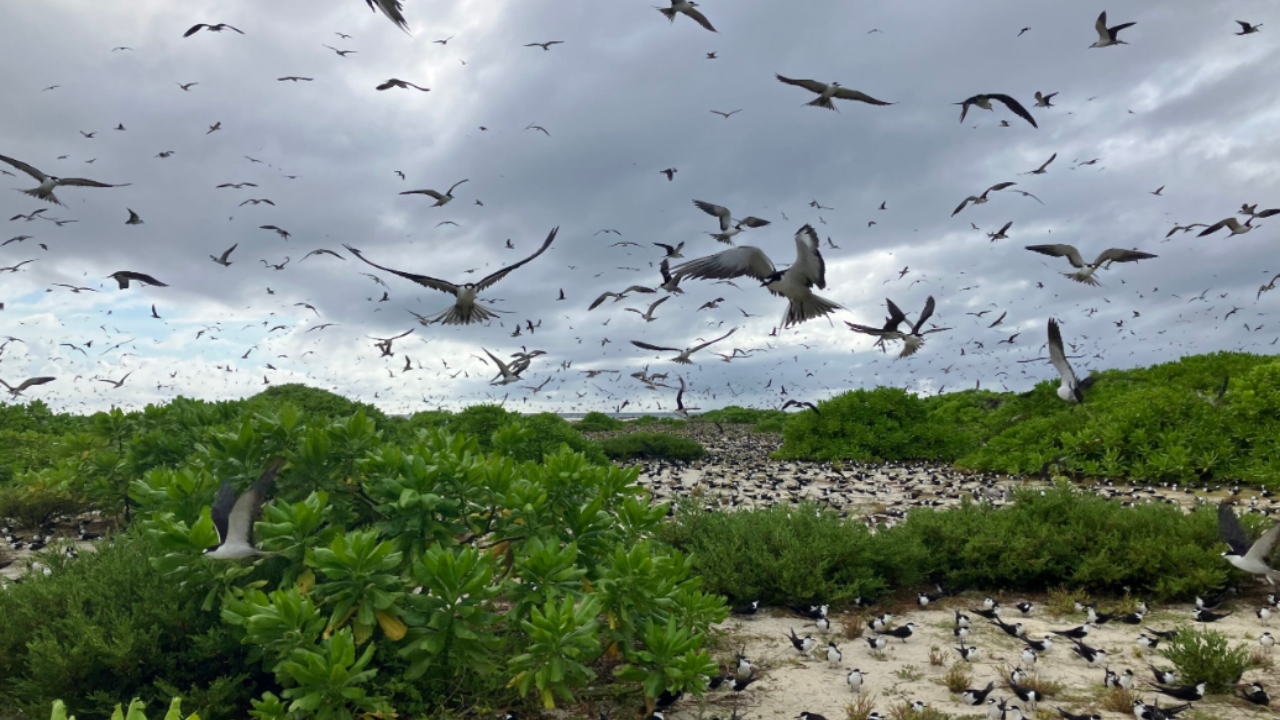
In 1967, a Seychellois accountant named Guy Savy purchased a battered coral scrap on the northern edge of the Seychelles Bank with a simple, high-stakes gamble: that a ruined ecosystem could be clawed back from the brink through sheer force of private will. Decades of commercial coconut farming, invasive pest introduction, and industrial guano scraping had reduced Bird Island into an ecological ghost town. Its once-massive sooty tern population, historically numbering over a million breeding pairs, had crashed to fewer than 20,000. Today, that colony sits near 700,000 pairs. Yet this famous conservation triumph masks a fragile, complicated reality about modern wildlife management that mainstream narratives consistently ignore.
The Industrial Blueprint of Ruin
To understand how Bird Island recovered, you must first understand the absolute thoroughness of its destruction. Early explorers found an environment teeming with life, but human arrival treated nature as a balance sheet to be liquidated. Between 1896 and 1906, commercial miners stripped roughly 17,000 tons of nitrogen-rich guano off the coral bedrock.
What the miners missed, the agriculturalists cleared. Native scrub was ripped out to make way for commercial plantations of cotton, papaya, and dense coconut palms. Those coconut trees proved catastrophic for ground-nesting seabirds. Sooty terns require open, sandy expanses to establish their scrapes and lay eggs. The encroaching palm canopy choked off their habitat, while introduced rats and rabbits feasted on eggs and chicks.
Human exploitation was systematic. Egg harvesting wasn't just a byproduct of settlement; it was a commercial industry. By the time Savy and his partners acquired the land, the ecosystem was functioning on life support.
Rewriting the Ecological Baseline
Savy did not practice passive preservation. He practiced aggressive ecological surgery.
The strategy required radical physical intervention. Workers systematically chainsawed and cleared dense swathes of coconut palms, deliberately manufacturing the open landscape the sooty terns needed to return. Pest eradication campaigns hunted down every last invasive rat and rabbit. Without this brutal pruning of introduced species, native flora and fauna never would have found the breathing room required to rebound.
[Commercial Exploitation Era]
       │
       ▼ (1967 Acquisition)
[Aggressive Habitat Surgery] ──> Palm Removal & Pest Eradication
       │
       ▼ (Sustainable Funding Model)
[Low-Impact Eco-Tourism]    ──> 700,000 Sooty Tern Pairs
To fund this ongoing labor without state subsidies, the ownership turned to a mechanism conservation purists often view with suspicion. They built a tiny, low-impact eco-tourism operation. Opening a handful of small chalets created a self-sustaining financial loop. Every paying visitor directly underwrote the cost of wardens, habitat maintenance, and scientific monitoring.
The Hidden Vulnerabilities of Success
Numbers like 700,000 breeding pairs look magnificent on paper, but field researchers know better than to confuse a protected sanctuary with an invulnerable fortress. Terrestrial protection stops at the high-water mark.
Once the sooty terns depart their nesting grounds in October, they vanish into the open ocean for months at a time. Modern satellite tracking and geolocator studies reveal that these birds travel thousands of miles across the Indian Ocean, concentrating heavily in regions like the Bay of Bengal and the waters surrounding Sri Lanka.
These distant foraging zones expose the colony to entirely unmanaged perils. Plastic microparticle pollution contaminates the very waters where the birds hunt for small fish and squid. Industrial overfishing depletes pelagic predators like tuna, which naturally drive baitballs to the surface. Without those predatory fish forcing food upward, the terns lose their primary feeding mechanism.
A seabird can find absolute safety on a managed coral cay for six months of the year, only to starve in a heavily industrialized, overfished international ocean during the other six.
The Private Ownership Paradox
The story of Bird Island highlights a profound structural truth about global conservation. Bureaucratic state management frequently fails due to shifting political tides, underfunding, and administrative inertia. Private ownership, when driven by long-term stewardship rather than short-term real estate extraction, can achieve remarkable turnarounds.
Yet relying on private enterprise creates its own systemic risks. The financial survival of the ecosystem remains tied to the economic viability of high-cost eco-tourism and the personal ethics of whoever holds the title deed. Conservation should not have to depend on benevolent landlords.
The terns continue to arrive every March with the south-east trade winds, banking over sands that humans nearly ruined forever. Their survival is real, but it remains an ongoing negotiation against an increasingly hostile marine world