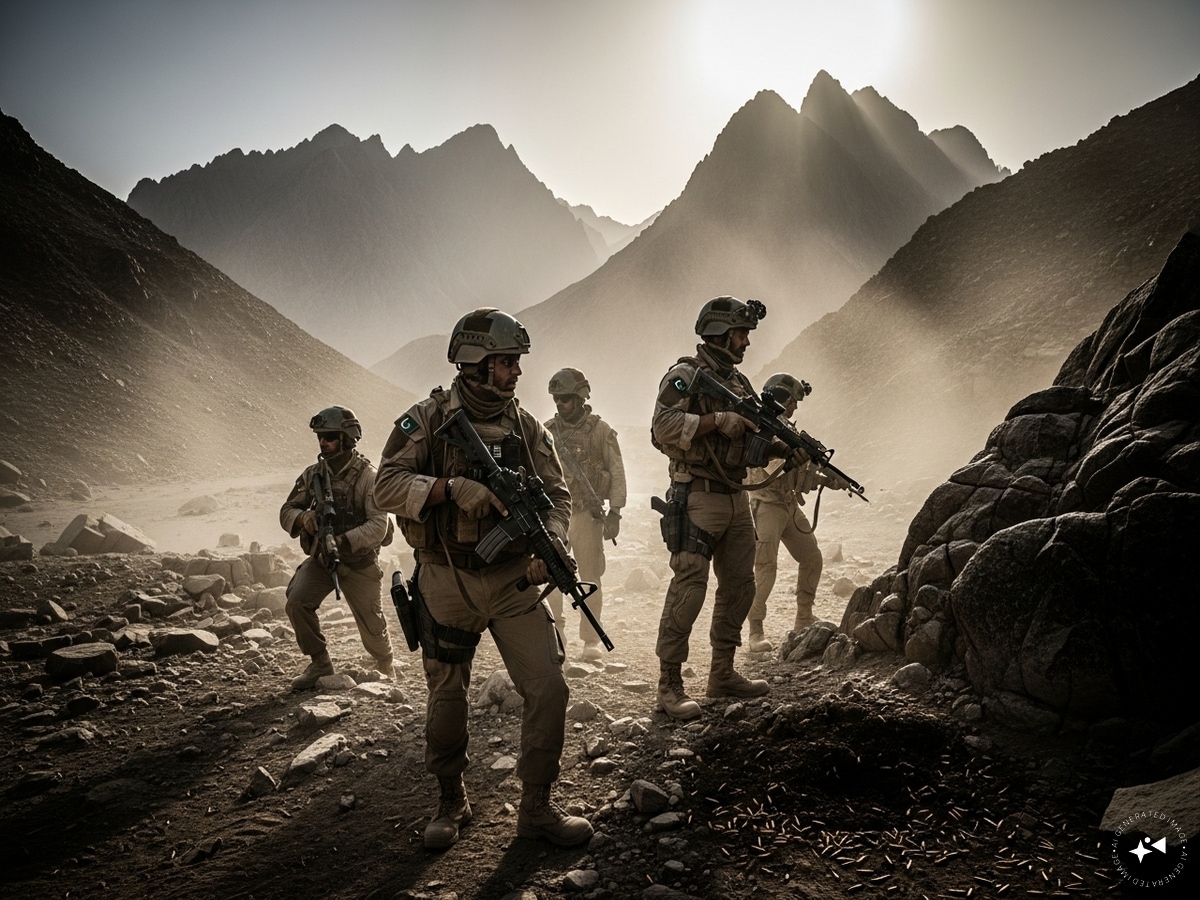
Pakistan security forces recently launched another tactical operation against militants in the country’s northwest Khyber Pakhtunkhwa province. Government press releases framed the raid as a clean, decisive blow against regional instability. They reported weapons seized, hideouts neutralized, and terrorists eliminated. Yet, this localized skirmish is merely a symptom of a much larger, systemic security breakdown that Islamabad is failing to contain. The cycle of violence in the northwest is accelerating because Pakistan's counterterrorism strategy relies on fleeting tactical victories while completely ignoring the shifting geopolitical realities on its border.
For decades, the standard playbook for the Pakistani military has involved periodic sweeps through the rugged terrain of the former Federally Administered Tribal Areas (FATA). These operations are highly publicized, designed to project strength and reassure a weary public. But the ground reality tells a different story. The infrastructure of militancy is not being dismantled. It is adapting.
The Illusion of Containment in Khyber Pakhtunkhwa
Every few months, a familiar pattern emerges. Intelligence-based operations target specific cells of the Tehrik-i-Taliban Pakistan (TTP) or its splinter groups. The state claims victory. Then, weeks later, a devastating suicide bombing or an ambush on a military convoy proves that the network remains intact.
This is not a failure of raw military might. It is a failure of strategic imagination. The Pakistani security apparatus continues to treat the northwest as a domestic policing problem with a military edge. It is far more dangerous than that. The region has become the frontline of a transnational guerrilla war that Islamabad can no longer control through occasional raids.
The TTP has undergone a significant transformation. No longer just a loose coalition of disgruntled tribal factions, the group has streamlined its command structure, modernized its media apparatus, and acquired sophisticated weaponry left behind by Western forces during the 2021 withdrawal from Afghanistan. When security forces launch an operation in valleys like Swat or North Waziristan, they are fighting an enemy that possesses night-vision gear, thermal imaging technology, and American-made M4 rifles.
The Kabul Connection and the Border Problem
The elephant in the room is Afghanistan.
When the Taliban seized power in Kabul, sections of the Pakistani establishment celebrated what they perceived as a victory for "strategic depth." That celebration was incredibly short-sighted. Instead of securing Pakistan's western flank, the fall of Kabul provided the TTP with something invaluable: a safe haven.
- Cross-Border Sanctuary: Militants launch attacks in Pakistan, then retreat across the Durand Line into Afghan provinces like Khost, Paktika, or Kunar.
- Diplomatic Dead Ends: Islamabad regularly demands that the Afghan Taliban rein in these groups. Kabul responds with denials, counter-accusations, or empty promises of mediation.
- The Border Fencing Myth: Pakistan spent years and millions of dollars constructing a chain-link fence along the 2,600-kilometer border. Militants simply cut through it, use sophisticated smuggling tunnels, or exploit the corrupt networks operating at official crossing points.
The ideological bond between the Afghan Taliban and the TTP is unbreakable. Expecting Kabul to turn on its wartime allies to please Islamabad is a fundamental misreading of religious and tribal dynamics. Consequently, local operations inside Pakistan are like trying to empty an ocean with a thimble while the faucet in Afghanistan remains wide open.
The Human Cost and Local Alienation
Military operations do not happen in a vacuum. They happen in villages, towns, and markets where ordinary citizens are trying to survive. The collateral damage of this endless conflict has created a profound crisis of trust between the local Pashtun population and the central state.
Consider a hypothetical scenario that mirrors hundreds of real accounts from the region. A local shopkeeper in South Waziristan receives a late-night visit from armed militants demanding taxes. If he refuses, he is executed. If he complies, the military discovers the transaction during a subsequent sweep, labels him a facilitator, and detains him.
This impossible position has fueled deep resentment. The rise of grassroots movements like the Pashtun Tahafuz Movement (PTM) highlights this anger. Instead of addressing these legitimate grievances, the state has frequently chosen to crack down on peaceful protesters, further alienating the very population needed to win an insurgency.
Without the active cooperation of the local populace, intelligence-based operations become incredibly difficult. Information dries up. Troops operate in a hostile environment where every civilian looks at them with suspicion, if not outright hostility.
The Failure of Civilian Governance
The military can clear an area, but it cannot hold it forever. That requires civilian administration, courts, police, and economic development.
When FATA was officially merged with Khyber Pakhtunkhwa province in 2018, the state promised a massive influx of funds to build schools, hospitals, and infrastructure. Most of those promises remain unfulfilled. The police force in the merged districts is chronically underfunded, undertrained, and outgunned by militants.
| Security Element | Current Status in Border Districts |
|---|---|
| Military Units | High combat readiness but stretched thin across multiple sectors. |
| Local Police | Lacking armored vehicles, modern communication gear, and adequate training. |
| Judicial System | Virtually non-existent in remote areas, leading locals to rely on traditional Jirgas or shadow Taliban courts. |
| Economic Programs | Stalled due to corruption and the volatile security environment. |
When the state fails to provide justice and security, a power vacuum forms. The TTP fills that vacuum by establishing shadow governance, settling land disputes, and enforcing their version of law.
The Economic Drain on a Fractured State
Pakistan is currently grappling with one of the worst economic crises in its history. Inflation is high, foreign exchange reserves are perpetually low, and the country relies on constant bailouts from international lenders.
Running continuous, high-tempo military operations in the northwest is an expensive endeavor. Fuel, ammunition, logistics, and intelligence operations cost billions of rupees. This reality forces a brutal trade-off. Every rupee spent on a localized military operation is a rupee taken away from education, healthcare, or industrial development.
Militants understand this math perfectly. Their strategy is one of attrition. By launching low-cost attacks—using improvised explosive devices (IEDs) or sniper fire—they force the Pakistani military into expensive, large-scale deployments. It is an unsustainable financial burden for a state that is economically fragile.
The Geopolitical Fallout
The instability in Pakistan's northwest does not stay contained within its borders. It directly impacts the country’s crucial international relationships, most notably with China.
Beijing has invested tens of billions of dollars into the China-Pakistan Economic Corridor (CPEC), a cornerstone of its Belt and Road Initiative. These projects require thousands of Chinese engineers and technicians to live and work in Pakistan. Militant groups, recognizing the strategic value of this relationship, have increasingly targeted Chinese nationals.
A major attack on a convoy of Chinese engineers in Khyber Pakhtunkhwa earlier this year sent shockwaves through Beijing. The Chinese government has grown increasingly impatient with Pakistan’s inability to guarantee security. They have demanded direct Chinese security involvement on Pakistani soil—a request that wounds Islamabad’s national sovereignty but is difficult to refuse given Pakistan's financial dependence on Beijing.
If Islamabad cannot secure its northwest, it risks losing its most important economic benefactor.
Moving Beyond the Kinetic Fix
The definition of insanity is doing the same thing over and over again and expecting different results. Decades of launching localized military operations, declaring victory, and watching the militancy return prove that the current approach is broken.
Pakistan cannot shoot its way out of this crisis. A purely kinetic approach will only continue to yield temporary lulls in violence followed by bloodier resurgences.
To break the cycle, the state must shift toward a comprehensive strategy that prioritizes regional diplomacy and civilian empowerment over endless military sweeps.
First, the government must abandon its submissive posture toward the regime in Kabul. Islamabad needs to use its considerable economic leverage over landlocked Afghanistan—including transit trade routes and border closures—to force the Afghan Taliban to deny the TTP operational space. Border management must move away from ineffective fencing toward high-tech surveillance and strict biometric tracking of everyone crossing the frontier.
Domestically, the priority must shift from killing militants to preventing their recruitment. This means fulfilling the financial promises made during the tribal merger. The provincial police force must be transformed into a modern, heavily armed counter-insurgency unit capable of holding territory after the military leaves. Most importantly, the state must stop treating peaceful political dissent in the northwest as treason. Alienating the local population creates the very environment where militancy thrives.
The current strategy of relying on sporadic tactical operations is not a solution. It is an expensive way to buy time while the foundations of regional security crumble.