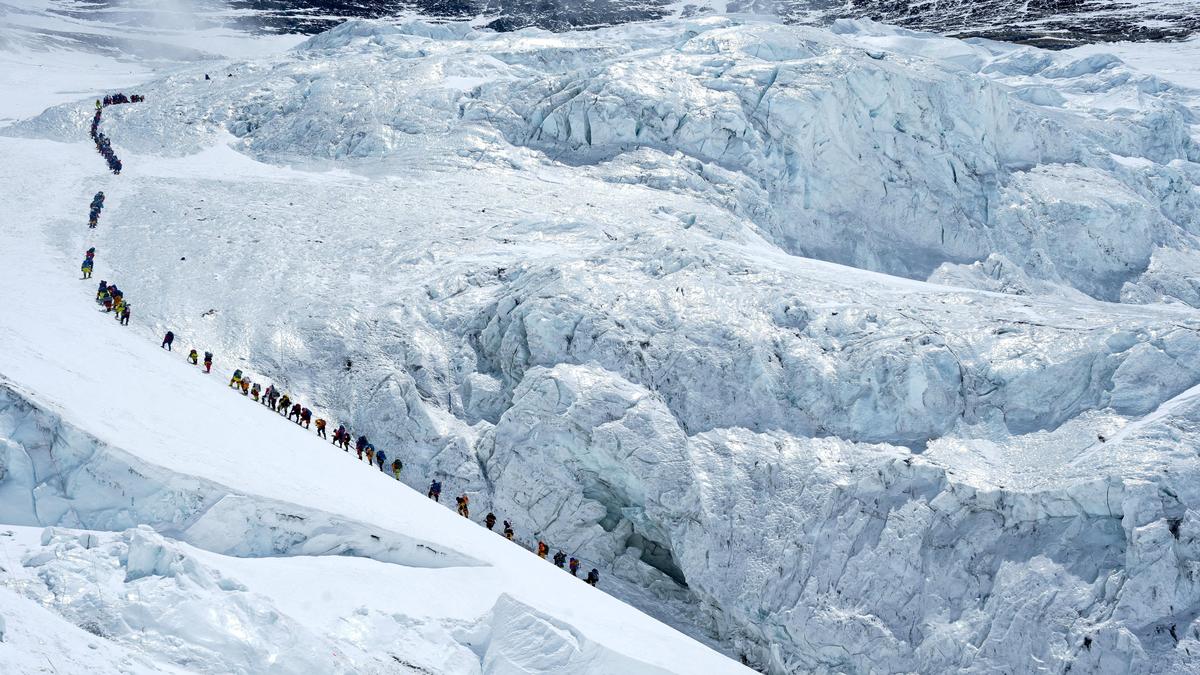
A staggering 274 climbers stood on the summit of Mount Everest on Wednesday. This unprecedented single-day rush from the Nepali side smashed the previous single-day record of 223 ascents set in May 2019. Among the crowd were three Indian mountaineers—Tulasi Reddi Palpunoori, Sandeep Are, and Ajay Pal Singh Dhaliwal—who successfully navigated the bottlenecked southern route. While commercial operators celebrate this logistically complex achievement as a triumph of modern guiding, the sheer density of human traffic at 8,848.86 meters exposes an escalating, systemic crisis in high-altitude mountaineering. The pursuit of records has commodified the world's highest peak to a dangerous extreme.
This mass convergence was not a spontaneous event. It was the direct result of a compressed climbing window and a regulatory vacuum. Read more on a connected subject: this related article.
A massive serac—a precarious cliff of glacial ice—hung over the standard route through the Khumbu Icefall earlier this spring, delaying the fixing of safety lines and halting the initial progression of teams. When a brief window of stable, low-wind weather finally arrived on Wednesday, expedition operators launched their clients from the high camps simultaneously. The situation was compounded by a geopolitical shift. Chinese authorities refused to issue permits for the northern, Tibetan face of the mountain this season. Consequently, the global demand for Everest was funneled entirely into Nepal, choking the classic Southeast Ridge.
The Illusion of Everest Mountaineering
The modern commercialization of Everest has fundamentally altered the definition of high-altitude success. Climbing the mountain is no longer an elite athletic pursuit reserved for seasoned alpinists. It has become an industrialized tourism product. Additional reporting by NBC Sports highlights comparable views on this issue.
Out of the 274 individuals who summited on Wednesday, 150 were Nepalese Sherpas. This ratio reveals the reality of modern high-altitude tourism. The vast majority of clients are heavily reliant on an infrastructure of support that begins months before they even arrive in Kathmandu. Sherpa guides carry the heavy loads, pitch the tents, cook the meals, and lay down miles of fixed ropes from Base Camp to the summit.
More crucially, almost every climber on that record-breaking day relied on supplementary bottled oxygen. Only one person, Ecuadorian climber Marcelo Segovia, reached the top independently without the use of gas. The use of bottled oxygen effectively lowers the perceived altitude of the mountain by thousands of meters. It reduces the physical barrier of entry, allowing wealthy hobbyists to buy their way into the Death Zone—the region above 8,000 meters where the human body cannot acclimatize and slowly consumes itself.
This commercial infrastructure creates a false sense of security. Clients with minimal technical mountaineering experience assume that paying an entry fee of $15,000 for a permit, and upwards of $50,000 for a guided expedition, guarantees a safe passage. It does not. When hundreds of climbers move at the pace of the slowest individual on a single fixed rope, the risk vectors multiply exponentially.
The Logistics of a High Altitude Gridlock
The Southeast Ridge of Everest is a narrow, unforgiving spine of rock and ice. It cannot accommodate two-way traffic smoothly, let alone a crowd larger than the capacity of many passenger airplanes.
When a bottleneck forms at critical junctures like the Hillary Step or the South Summit, climbers are forced to stand still in freezing temperatures. In the Death Zone, stationary waiting is a silent killer.
- Oxygen Depletion: Bottled oxygen is a finite resource. Guides calculate the number of canisters needed based on a standard ascent and descent timeline. A three-hour delay caused by a human traffic jam can deplete a climber's reserve tanks, forcing them to survive on ambient air that contains only a third of the oxygen found at sea level.
- Frostbite and Hypothermia: Metabolic heat drops rapidly when physical motion stops. Standing in a queue at -30 degrees Celsius, exposed to high-altitude winds, accelerates severe tissue freezing.
- Cognitive Decline: Prolonged exposure to extreme hypoxia clouds judgment. Climbers trapped in long lines lose the situational awareness required to monitor their own physical deterioration, making catastrophic errors during the descent.
The record-setting crowd on Wednesday was a logistical gamble that paid off solely because the weather held. Had a sudden storm or a high-altitude jet stream shifted over the peak while 274 people were strung along the upper ridges, the outcome would have been a humanitarian disaster.
Institutional Incapacity and the Cash Cow
The government of Nepal face constant international criticism for their management of the mountain. Despite the clear perils of overcrowding, the Department of Tourism issued 494 permits to foreign climbers this spring. When paired with an equal number of required local guides, nearly a thousand individuals were cleared to attempt the peak in a brief two-month window.
The explanation for this regulatory leniency is straightforward economic dependency. Permit fees alone generated millions of dollars for the Nepalese treasury this season. The wider expedition industry supports thousands of local jobs, from porters and lodge owners in the Khumbu region to helicopter charter companies and Kathmandu hoteliers. For a developing nation, Everest is a premium natural asset that is incredibly difficult to restrict.
The Department of Tourism has repeatedly promised tighter controls, higher permit fees, and stricter vetting of a climber's past experience. Yet, year after year, the numbers remain high. The shift toward low-cost, local expedition agencies has further democratized the mountain, driving down prices but also raising concerns about the experience level of the guides being deployed into high-stakes scenarios.
Shattered Records vs True Alpinism
Amid the structural chaos, genuine human athletic achievements still occur on the mountain, though they are increasingly overshadowed by the crowd. This same week, Kami Rita Sherpa extended his own world record by summiting Everest for the 32nd time. Lhakpa Sherpa secured her 11th summit, extending her record for the most ascents by a female climber.
These elite mountain workers possess an extraordinary physiology and a deep, multi-generational understanding of the terrain. Their achievements, however, are fundamentally different from those of the paying clients they shepherd to the top. The Sherpa community takes the brunt of the risk in this industrialized system, fixing the routes and rescue operations when things go wrong.
The celebration of 274 summits in a single day as a milestone of human progress is a deep misunderstanding of the reality on the ground. It is a metric of industrial capacity, not mountaineering prowess. The commercial model has pushed the mountain to its absolute physical limit, transforming an iconic wilderness adventure into an overcrowded, high-altitude assembly line.