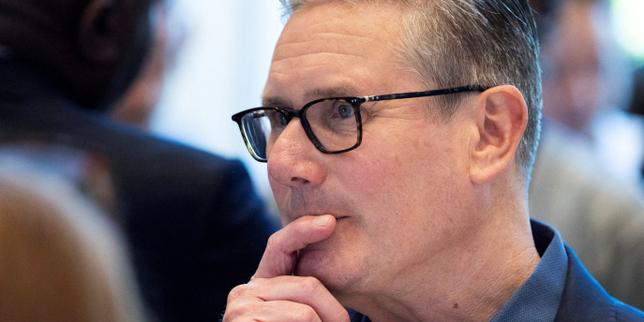
Prime Minister Keir Starmer faces an internal power struggle that threatens to fracture Downing Street. The return of his long-time rival, Andy Burnham, to Westminster has catalyzed a quiet mutiny among Labour backbenchers. For months, Westminster insiders watched Starmer try to solidify his mandate amid slipping poll numbers and deep-seated economic anxieties. Now, Burnham’s re-entry into parliamentary politics changes the calculus entirely. This isn't just a clash of personalities. It is a fundamental battle over the soul and direction of the Labour Party, exposing deep ideological rifts that Starmer’s team has desperately tried to hide behind a facade of managerial competence.
The Quiet Coup Brewing in the Backbenches
Political longevity relies entirely on the perception of inevitability. When a leader begins to look vulnerable, the vultures circle. Starmer’s current vulnerability stems from a series of unforced errors, policy u-turns, and a general sense that his administration lacks a clear narrative. Meanwhile, you can find similar developments here: Why Emergency Medical Aid Packages Always Fail Conflict Zones.
Rank-and-file MPs are anxious. They look at their majorities and see them eroding under the weight of voter disillusionment. In this environment, Burnham represents an alternative path. The former Mayor of Greater Manchester brings a distinct brand of northern devolutionary populism that contrasts sharply with Starmer’s cautious, technocratic approach.
Burnham's return to parliament was carefully timed. He did not arrive as a humble backbencher looking to learn the ropes. He arrived with a ready-made power base and a reputation as the "King in the North." This immediately creates a secondary court in Westminster, a rival node of gravity that dissatisfied MPs can orbit. To explore the full picture, we recommend the detailed report by Associated Press.
The Regional Divide That Could Break the Party
The tension between Starmer and Burnham reflects a deeper structural fault line within the United Kingdom itself. London-centric policymaking has alienated large swathes of the country for decades. Starmer’s inner circle is dominated by figures who view the world through the lens of the capital's financial and political elite.
Burnham built his entire modern political identity on defying this consensus. As mayor, he routinely took on Whitehall, demanding more funding, more autonomy, and more respect for regional economies. By bringing that fight directly into the House of Commons, he forces a confrontation that Starmer is ill-equipped to handle.
Consider the mechanics of party discipline. The whips can threaten MPs with the removal of the party line, but that leverage fails when backbenchers believe the current leadership will lose them their seats anyway. If Burnham can convince a critical mass of northern and midland MPs that his vision is their only hope for survival, Starmer’s legislative agenda stalls. Every major bill will become a negotiation, with Burnham acting as a de facto power broker.
The Fiscal Trap Snapping Shut
Starmer's primary defense has been a strict adherence to fiscal rules. His Chancellor has consistently argued that the government cannot spend its way out of the current economic stagnation. They argue that stability must precede growth.
This argument is wearing thin. Communities that voted for change want to see tangible improvements in their lives, not spreadsheets showing a reduction in the public sector net debt. Burnham understands this frustration perfectly. He advocates for a more aggressive state-led investment strategy, particularly in infrastructure and green energy.
This economic debate is where the real damage will be done. If Burnham can frame Starmer’s fiscal caution as mere timidity, he wins the argument among the party's activist base. It is a potent narrative that pits a supposedly cold, uncaring treasury elite against the lived reality of struggling towns.
Strategic Paralysis inside Downing Street
How does a prime minister respond to a threat from within their own ranks? The classic playbook dictates that you either co-opt the rival by offering them a cabinet position, or you isolate them completely. Starmer can do neither cleanly.
Offering Burnham a high-profile shadow or actual cabinet post would be seen as a sign of weakness, effectively inviting a wolf into the fold. It would give Burnham a massive platform to shape policy from within, making a future leadership challenge even easier to execute.
Conversely, attempting to freeze Burnham out is equally dangerous. He is too popular with the public and too influential with regional leaders to be ignored. An overt attempt to marginalize him would only validate his narrative that London elites are actively suppressing regional voices. This leaves Downing Street in a state of strategic paralysis, watching their rival build momentum while they remain frozen in place.
The Real Timeline of the Leadership Threat
This crisis will not erupt overnight. Westminster plots move slowly, then all at once. The true danger zone for Starmer lies in the upcoming local elections and the subsequent party conference.
The Incubation Period
Over the next few months, expect to see a coordinated series of policy interventions from Burnham and his allies. These will not be direct attacks on Starmer. Instead, they will be framed as constructive contributions to national debate.
- Alternative budgets focusing on regional investment.
- Joint statements with powerful regional mayors.
- Media appearances emphasizing a vision of national renewal that contrasts with Downing Street's austerity-adjacent rhetoric.
This strategy allows Burnham to build his profile and test the waters without technically violating party rules or appearing disloyal. It is a slow squeeze designed to make Starmer look increasingly out of touch.
The Trigger Points
The real test comes when voters head to the polls. If Labour suffers significant losses in local government, the blame will be laid squarely at Starmer’s feet. That is the moment the whispers will turn into open rebellion.
Letters of no confidence could begin accumulating. The threshold required to trigger a leadership vote is lower than many realize, and a panicking parliamentary party can move with terrifying speed when their own livelihoods are on the line. Burnham will be positioned as the unifying candidate, ready to step in and save the party from electoral disaster.
The Structural Weakness of Starmerism
The core flaw in Starmer’s political project is its lack of a defining ideology. It was built entirely on being "not the other guy." While that strategy was effective for winning an election against a collapsing opposition, it is utterly useless for governing a nation in crisis.
Without a deeply held set of principles to anchor the administration, policy becomes reactive. Decisions are made based on focus groups and media cycles rather than long-term vision. This creates an intellectual vacuum that Burnham is more than happy to fill.
Burnhamism offers a coherent, easily understood story about the country. It says that power has been hoarded by a small group of people in London, and that the solution is to distribute that power and wealth back to the regions. It is a simple message, it is a powerful message, and right now, it is a message that Starmer has no answer for.
The coming months will determine whether Starmer can find a way to articulate a compelling vision of his own, or if he will simply be a caretaker prime minister, holding the keys until his rival decides the time is right to take them. The battle lines are drawn, the players are in position, and the fight for control of the government has begun in earnest. Starmer is running out of time to prove he can lead, not just manage.