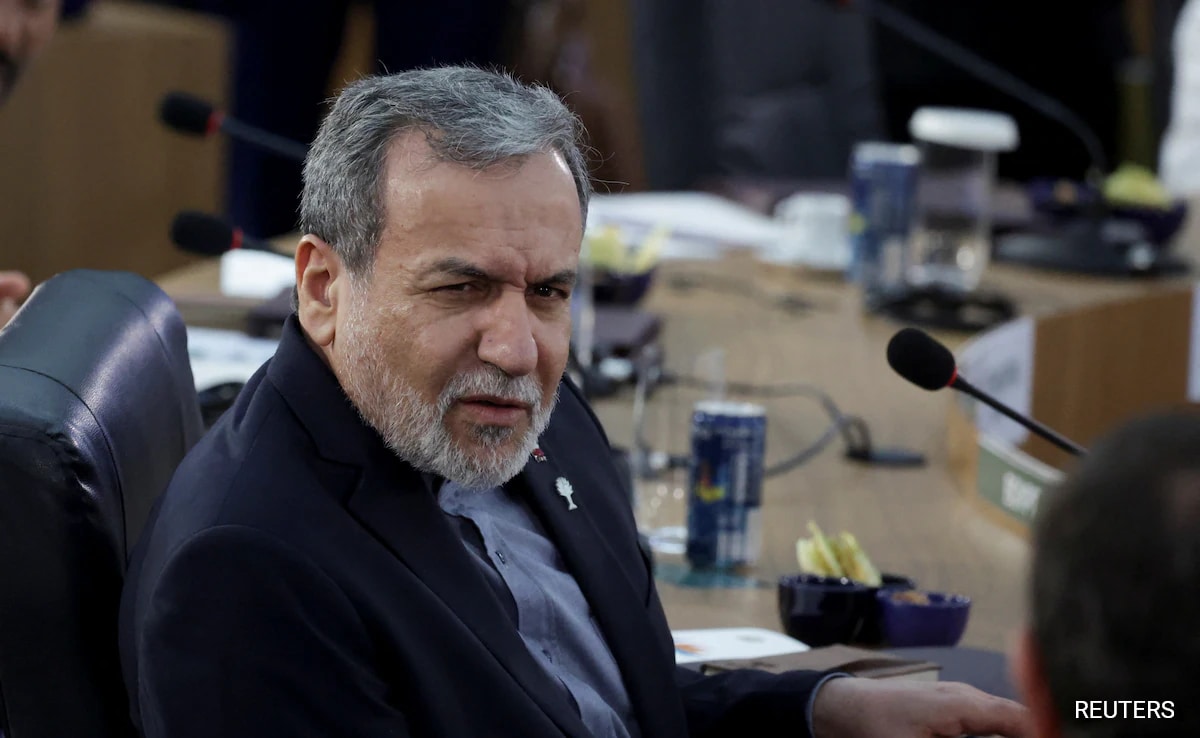
Abbas Araghchi is a man operating without a safety net. As the Iranian Foreign Minister navigates the wreckage of a collapsed diplomatic track, his recent declaration that Tehran will take the current war "as far as necessary" is not mere bluster for a domestic audience. It is a cold admission that the Islamic Republic has run out of traditional leverage. With the death of Supreme Leader Ali Khamenei on February 28, 2026, and the subsequent Israeli-American strikes that have neutralized nearly 85% of Iran’s air defense capabilities, the "no red lines" policy is the final, desperate gamble of a regime facing an existential abyss.
The primary objective of Araghchi’s rhetoric is to convince Washington and Jerusalem that the cost of total victory exceeds the benefit of regime change. By threatening to strike U.S. company assets across the Middle East and effectively choking the Strait of Hormuz for Western-linked vessels, Iran is attempting to weaponize global energy markets to force a ceasefire. However, the reality on the ground suggests a massive disconnect between Tehran’s diplomatic threats and its actual military capacity.
The Mirage of Resistance
For decades, Tehran relied on its "Axis of Resistance" to provide strategic depth. That depth has evaporated. The downfall of the Assad regime in Syria and the systematic dismantling of Hezbollah’s senior leadership have left Iran isolated. Araghchi’s insistence that Iran is "waiting" for a U.S. ground invasion ignores the strategic shift in Western doctrine. The United States and Israel are not seeking a repeat of the 2003 Iraq occupation; they are conducting a high-intensity, remote-access dismantling of the state’s central nervous system.
The numbers are staggering. Since the start of the current campaign, more than 7,600 strikes have hit Iranian soil. While Araghchi claims that everything damaged in the "Twelve-Day War" of June 2025 has been reconstructed, intelligence reports indicate otherwise. The precision strikes on missile production facilities and the aircraft of the Supreme Leader at Mehrabad Airport demonstrate a level of penetration that the Islamic Revolutionary Guard Corps (IRGC) cannot counter.
A Divided House
Behind the unified facade presented by Araghchi, the Iranian political establishment is fracturing. On one side, the pragmatists within the foreign ministry, led by Araghchi, have attempted to keep the door open for Omani-mediated talks with U.S. envoy Steve Witkoff. On the other, the IRGC continues to launch retaliatory strikes against Gulf Cooperation Council (GCC) states like Saudi Arabia and the UAE, directly undermining Araghchi’s diplomatic assurances.
This internal friction became painfully evident in early March 2026. Hours after Araghchi suggested a "joint investigative committee" to manage regional tensions, the IRGC launched another wave of ballistic missiles at energy infrastructure in the Gulf. This lack of command and control means that even if a diplomatic "off-ramp" were offered, the Iranian state might no longer be able to take it.
The Economic Death Spiral
The "no red lines" stance is as much about domestic survival as it is about foreign policy. The Iranian rial has entered a freefall, halving in value within a matter of months. Food price inflation is hovering near 70%. When Araghchi speaks of taking the war as far as necessary, he is also speaking to a population that has been in the streets since December 2025.
The regime is trapped. To stop the war without a significant lifting of sanctions—an unlikely prospect given the current U.S. administration’s "maximum pressure" 2.0—would be to admit total defeat to a restless public. To continue the war is to watch the slow-motion destruction of the nation's remaining industrial and military assets.
The Nuclear Gamble
The most dangerous element of Araghchi’s "as far as necessary" doctrine lies in the nuclear program. With conventional air defenses gutted, the temptation to move toward a "breakout" capability as a final deterrent has never been higher. Araghchi has consistently warned that triggering "snapback" sanctions by European powers would lead to the expulsion of IAEA inspectors.
Yet, even this leverage is waning. The 2025 strikes proved that Iranian nuclear sites are not invulnerable. If Tehran moves toward weaponization, it will almost certainly trigger the very ground invasion Araghchi claims to welcome but which the Iranian military is ill-equipped to survive.
The current conflict has moved beyond the "shadow war" of the 2010s. It is now a direct, kinetic confrontation where the old rules of engagement no longer apply. Araghchi is playing a high-stakes game of chicken with an opponent that has already started the engine and removed the steering wheel.
Watch for the next 48 hours of diplomatic traffic through Muscat. If the Omani mediators go silent, it will be a clear signal that the time for "no red lines" rhetoric has passed and the era of total regional realignment has begun.