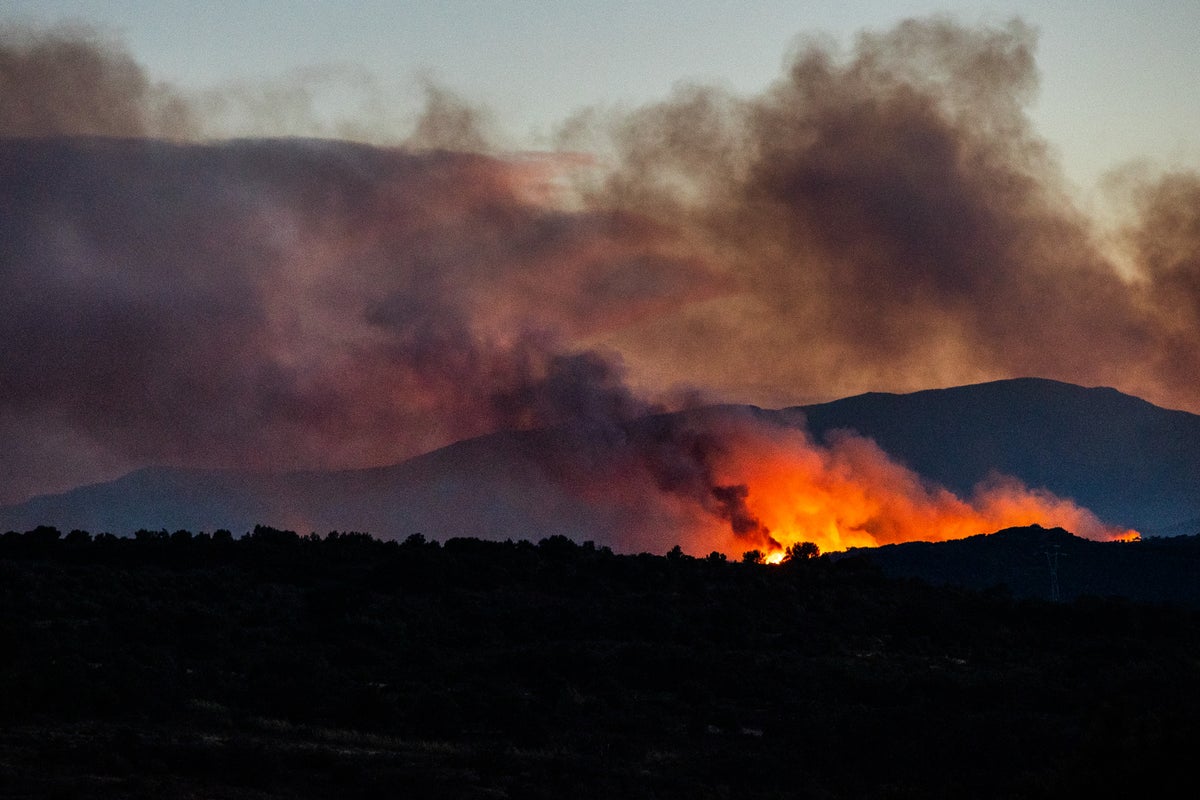
A catastrophic wildfire in southern France has forced the emergency evacuation of over 10,000 residents and tourists, triggering an unprecedented security lockdown that has directly collided with the world’s most prestigious cycling event. As infrastructure buckles under extreme heat, authorities have banned spectators from critical mountain stages of the Tour de France to keep emergency corridors open. This is no longer just an environmental crisis. It is an operational reckoning for global sports. When raging infernos begin dictating the terms of multi-million-dollar athletic properties, the traditional summer sporting calendar faces an existential threat that organizers are fundamentally unprepared to handle.
The Fire at the Gates of the Tour
The immediate trigger for the chaos was a fast-moving wildfire that ignited in the heavily forested regions bordering the Mediterranean coast, fueled by months of severe drought and sudden, unpredictable Mistral winds. Within hours, standard containment strategies failed. Local prefectures initiated mass evacuations across campsites, residential suburbs, and hotels, converting public sports complexes into makeshift emergency shelters.
With the Tour de France route scheduled to cut directly through the adjacent departments, a nightmare scenario emerged for logistical planners.
The primary threat was not just the smoke or the advancing flames, but the fans themselves. The Tour de France thrives on its lack of barriers. Millions of spectators line narrow mountain passes, parking campervans days in advance and choking roads that serve as the only viable evacuation routes for rural communities.
Faced with the prospect of thousands of stranded vehicles blocking fire engines, the French Ministry of the Interior made a swift, painful calculation. They banned spectators from the upcoming mountain stages entirely.
The Anatomy of an Operational Nightmare
To understand how a sporting event becomes a liability during a natural disaster, one must look at the sheer scale of the Tour's daily footprint. The race is a traveling city. It moves 4,500 people every single day, including riders, mechanics, media, sponsors, and medical staff, supported by an escort of hundreds of police motorcycles and logistical vehicles.
When this massive caravan intersects with an active disaster zone, the strain on local resources becomes unsustainable.
- Emergency Resource Diversion: Every local gendarme stationed at a race barricade is a gendarme taken away from evacuation checkpoints or looting prevention in abandoned villages.
- Aero-Logistical Gridlock: Water-bombing aircraft and emergency helicopters require clear, predictable airspace. The presence of broadcast helicopters and civilian drones filming a bicycle race creates an unacceptable risk of mid-air collision.
- Infrastructure Degradation: Extreme heat does not just spark fires; it melts the very asphalt the athletes ride on. Road crews have resorted to dousing mountain descents with thousands of gallons of water just to keep the tar from liquefying under the pelting sun.
This creates a profound contradiction. Organizers want to project normalcy and continuity, celebrating the grueling beauty of the landscape. Meanwhile, just over the ridge, that same landscape is actively burning, and the resources used to protect the race are being stripped from communities fighting for survival.
The Myth of the Fixed Summer Calendar
For over a century, the global sports industry has operated on a rigid, highly lucrative summer calendar. Broadcasters rely on July and August to fill the dead zones between major domestic football leagues. Sponsors tie their biggest marketing campaigns to these sun-drenched spectacles. But this entire financial model is built on an assumption that is rapidly dissolving: the stability of the summer climate.
We are witnessing the limits of human and institutional adaptation.
Sporting bodies have historically treated extreme weather as an anomaly—a freak thunderstorm, a temporary heatwave, a bizarre stroke of bad luck. They respond with minor tweaks. They introduce hydration breaks, push start times back by an hour, or hand out ice vests to athletes.
These are band-aids on a compounding fracture.
When an event requires the evacuation of 10,000 citizens and the total exclusion of fans, it ceases to be a sporting event and becomes a managed hazard. The economic fallout for local host towns is immediate. Municipalities pay hundreds of thousands of Euros for the privilege of hosting a Tour stage, expecting a massive influx of tourism revenue. When fans are banned, the hotels empty out, the restaurants sit vacant, and the local tax base absorbs a crushing deficit while still footing the bill for the cleanup.
The Failed Logic of Sports Washing the Climate Crisis
There is a growing, uncomfortable friction between the commercial messaging of major sporting events and the reality on the ground. Corporate sponsors plaster their logos across green-energy initiatives and sustainability pledges, yet the events themselves continue to demand massive carbon footprints to transport thousands of personnel around the globe.
The industry cannot marketing-maneuver its way out of an unridable road.
Critics argue that continuing the race in such close proximity to a humanitarian emergency is a form of institutional denial. It sends a message that global entertainment takes precedence over regional safety. Conversely, pulling the plug entirely carries devastating financial penalties, legal liabilities with broadcasters, and a blow to national prestige that European governments are desperate to avoid.
So, the race goes on, captured by television cameras that carefully frame the cyclists to exclude the plumes of black smoke rising on the horizon. It is a surreal, dystopian visual: elite athletes pushing their bodies to the absolute limit of human endurance, breathing air thick with particulate matter, while the hills around them are slowly reduced to ash.
The Inevitable Shift Nightward
If the traditional format is broken, what does the future look like? The reality is that sports organizers will be forced to abandon the concept of the European summer afternoon.
We are rapidly approaching a tipping point where major outdoor competitions will have to undergo radical structural changes to survive. This does not mean minor adjustments. It means a fundamental dismantling of how events are scheduled and consumed.
The Midnight Stage Split
Events like the Tour de France may be forced to shift their entire schedule to the middle of the night, concluding before the midday heat spikes and the risk of fire peak electricity grid failures intensifies. This presents a massive blow to live viewership numbers in primary European markets, forcing a complete renegotiation of broadcast rights values.
The Seasonal Migration
The entire sporting calendar will eventually have to shift. The concept of a July Tour de France or an August Grand Slam tournament will become obsolete, pushed into the shoulder months of May or October when temperatures are manageable and the landscape is not a tinderbox.
Geographically Displaced Hubs
Instead of traversing vast, unpredictable rural terrains that are vulnerable to environmental disruptions, events may be forced to consolidate into highly controlled, heavily fortified loops. The romantic notion of the open-road epic is dying, replaced by the logistical necessity of a closed-circuit perimeter that can be easily monitored, defended, and evacuated.
None of these solutions are appealing to traditionalists. They disrupt billions of dollars in historical media rights and alienate core fan bases who view these events as sacred seasonal rituals. But the environment does not negotiate with broadcast schedules or nostalgia. The total exclusion of fans from the mountain stages of France is not an isolated incident or a temporary inconvenience. It is a stark, undeniable preview of the new operational baseline for global sports—one where the main event is no longer the competition on the field, but the desperate struggle to maintain control over a changing world.