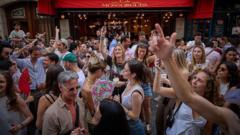
A punishing June heatwave pushing temperatures past 41 degrees Celsius has forced the French government to execute an unprecedented public safety intervention, banning alcohol consumption across more than a third of the country during its most celebrated national street music festival. The emergency decree, issued by Prime Minister Sébastien Lecornu following a weekend crisis meeting, effectively enforces localized prohibition across 35 administrative departments under a red heatwave alert. The immediate objective is clear. By restricting alcohol during the annual Fête de la Musique, authorities aim to prevent a catastrophic convergence of mass intoxication and extreme thermal stress that would instantly overwhelm an already strained healthcare infrastructure.
This is no longer a temporary seasonal inconvenience. It is a fundamental shift in how modern states must manage public assemblies under the weight of an escalating climate reality.
The Breakdown of Public Infrastructure
The timing of the government intervention could not be more disruptive. Held every year on the summer solstice, the Fête de la Musique routinely draws millions of citizens into the streets of Paris, Lyon, and Bordeaux for free, late-night musical performances. In Paris alone, historical attendance records show upwards of two million participants flooding public squares, narrow alleyways, and the banks of the Seine.
When a red alert is triggered by Météo-France, it signifies a threat to the entire population, not just vulnerable demographics. The 2026 heatwave has trapped roughly 26 million people under this maximum warning tier. Central and southwestern regions are bearing the brunt of a high-pressure system pumping scorching air straight from the North African desert across the European continent.
The physical environment of French cities compounds the danger. Urban centers operate as massive heat sinks due to the urban heat island effect, where concrete, asphalt, and stone structures absorb solar radiation during the day and radiate it back into the atmosphere at night. Ambient evening temperatures in central Paris now frequently fail to drop below 25 degrees Celsius, denying the human body any opportunity to naturally cool down and recover.
Public systems are already fracturing under the thermal load.
- National rail operator SNCF has canceled dozens of regional and intercity train lines due to the imminent threat of track buckling, a phenomenon where steel rails expand and warp under extreme heat.
- Educational institutions across central regions have suspended all mandatory examinations and indoor classes.
- Municipal electrical grids are experiencing severe voltage drops as commercial and residential cooling systems strain local substations to their limits.
By opening public parks and gardens through the night, municipal authorities are attempting to give dense apartment dwellers access to cooler patches of shaded grass. Yet, these measures are mere band-aids on a deeper systemic vulnerability.
The Lethal Chemistry of Heat and Alcohol
To understand the necessity of the ban, one must look at how ethanol interacts with a body struggling against extreme external temperatures. The human mechanism for shedding heat relies almost entirely on the evaporation of sweat and the dilation of peripheral blood vessels. Alcohol completely upends this regulatory framework.
When an individual consumes alcohol, it acts as a potent vasodilator, widening blood vessels near the skin's surface. While this initially creates a false sensation of cooling, it actually accelerates internal heat absorption when ambient air temperatures exceed normal body temperature. Simultaneously, alcohol suppresses the production of vasopressin, an antidiuretic hormone. Without this hormone, the kidneys fail to reabsorb water, triggering rapid, severe dehydration through accelerated fluid loss.
Consider a person standing in a crowded, unshaded public square at 40 degrees Celsius. The body is already losing up to 1.5 liters of fluid per hour through perspiration to maintain its core temperature. Introducing alcohol fast-tracks this fluid depletion while masking the cognitive warning signs of heat exhaustion. Dizziness, confusion, and muscle cramps are easily misattributed to a standard state of intoxication. By the time an individual collapses from heat stroke, their internal core temperature can surpass 40.5 degrees Celsius, initiating rapid cellular breakdown and organ failure.
The government’s decision to halt alcohol distribution at state-supported venues and ban public consumption on streets is a direct attempt to alter this physiological equation. Emergency medical services, particularly the Service d'Aide Médicale Urgente (SAMU), operate on razor-thin margins during weekend festivals. A sudden influx of thousands of acute alcohol poisonings mixed with severe heat stroke would inevitably cause a triage crisis, leaving paramedics unable to reach elderly residents trapped in top-floor apartments without air conditioning.
The Economic Cascades of Thermal Shock
The economic fallout of this climate-induced prohibition is radiating through the service and hospitality industries. For thousands of independent bars, bistros, and brasseries across France, the Fête de la Musique represents one of the highest-grossing fiscal days of the calendar year, frequently matching or exceeding New Year's Eve revenue.
Establishments that invested heavily in stocking outdoor kegs, pop-up bars, and extra security are now facing severe losses. While indoor dining and alcohol service remain legal under specific regional rules, the traditional model of selling drinks over the counter to crowds on the pavement has been outlawed under threat of heavy municipal fines.
The wider economic indicators are equally sobering. Bank of France Governor Emmanuel Moulin warned that these recurring, prolonged heatwaves are no longer isolated seasonal shocks but structural drags on macroeconomic activity.
- Construction and outdoor manufacturing sectors experience immediate productivity drops ranging between 15% and 25% when temperatures breach the 38-degree threshold.
- Agricultural outputs across the southwestern wine and grain belts face shifting maturation cycles and increased irrigation costs.
- Supply chain logistics slow down substantially as freight vehicles face mandatory speed restrictions to prevent tire blowouts on melting asphalt.
The long-term fiscal reality is that the cost of climate adaptation is beginning to eat into basic commerce. When a state must choose between preserving public healthcare stability and allowing local businesses to maximize seasonal profits, the economy loses every single time.
The Growing Friction Over Civil Liberties
The implementation of the alcohol ban has also exposed a growing political rift regarding the boundaries of state authority during environmental crises. Critics from both ends of the political spectrum argue that using emergency decrees to micro-manage public behavior sets a dangerous precedent.
The primary point of contention rests on the localized nature of enforcement. Because the decrees are enacted by regional prefects rather than through legislative debate, the rules can vary wildly across administrative borders. A citizen crossing a street between an orange-alert department and a red-alert department can instantly transition from a legal public gathering to an illicit assembly subject to police intervention.
Interior Ministry officials defend the strategy as an absolute necessity for civil defense. They point to the historical lessons of the 2003 European heatwave, which claimed over 15,000 lives in France alone, primarily because institutional responses were slow, bureaucratic, and reactive. The current doctrine prioritizes pre-emptive disruption over afterthought management.
The enforcement mechanism relies on heavy deployments of national police and gendarmerie forces to patrol designated festival zones. Officers are tasked with confiscating open containers and dispersing large, stationary crowds gathering in unshaded concrete plazas. This shift transforms police forces from standard event security into environmental health enforcers, a role that introduces friction between youth subcultures and state authorities.
The Redefined Mediterranean Climate
What is unfolding in France is part of a broader, systemic transformation across Southern and Western Europe. The traditional concept of the continental European summer is effectively dead, replaced by a climate regime that mirrors northern arid zones.
Across the Pyrenees, the Spanish football federation was forced to dismantle massive public fan zones in Madrid due to unsafe thermal conditions during international fixtures. In Italy, historical monuments like the Colosseum are implementing emergency cooling stations and diverting tour groups into underground chambers to prevent mass fainting incidents among tourists. Germany is experiencing unprecedented humidity spikes that threaten to unleash violent, destructive convective storms across its industrial heartland.
The traditional infrastructure of European cities, built centuries ago to retain heat during long winters, is fundamentally unsuited for this new reality. Thick stone walls, minimal cross-ventilation, and a historic aversion to widespread residential air conditioning have transformed traditional housing stock into potential thermal traps.
The Structural Realignment of Public Events
Organizers of mass cultural events must now reckon with a future where traditional summer scheduling is no longer viable. The concept of gathering hundreds of thousands of people in open, paved public spaces during the high summer months is becoming an unacceptable liability.
A structural realignment is inevitable. Industry analysts are already predicting a permanent shift toward shoulder-season scheduling, moving major outdoor festivals to April, May, or late September. Events that choose to remain in the traditional summer slots will face escalating compliance costs, including mandatory water-distribution infrastructure, shaded cooling tents equipped with industrial misters, and dedicated medical triage teams.
The era of the spontaneous, unregulated street festival is drawing to a close. As governments find themselves forced to deploy public health prohibitions to survive the summer months, the very nature of urban celebration, public liberty, and community assembly will continue to be rewritten by an unforgiving thermometer.