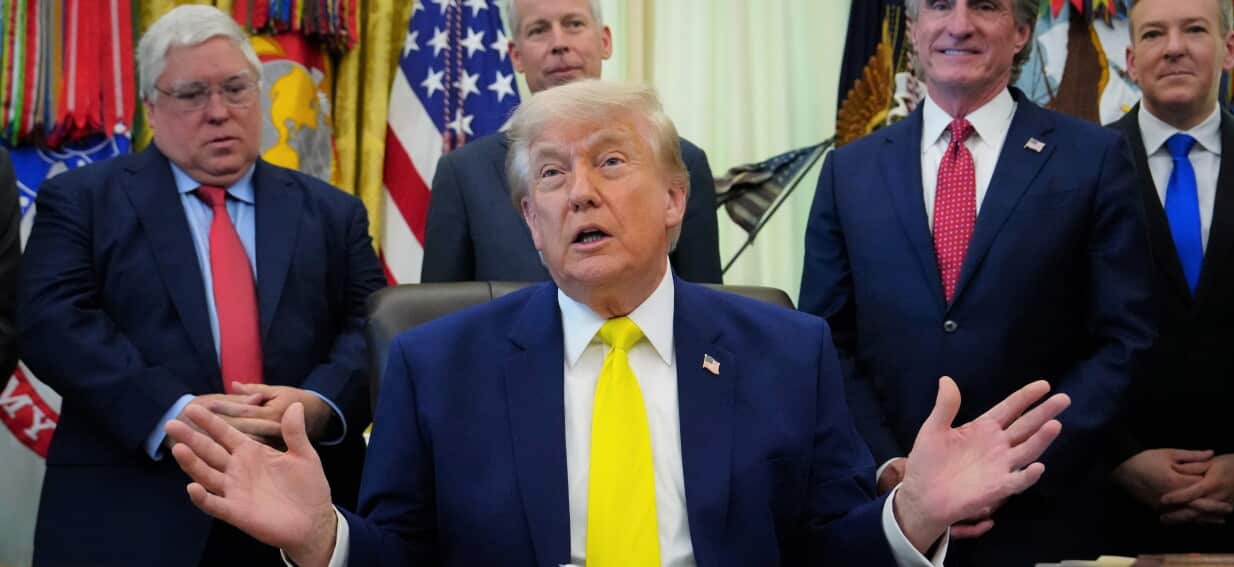
The John F. Kennedy Center for the Performing Arts is purging Donald Trump from its letterhead, email signatures, and marble facade. This rapid scrub follows a sweeping 94-page ruling by U.S. District Judge Christopher Cooper, who declared that the institution's board violated federal law by unilaterally renaming the national monument. The court also halted a planned two-year shutdown of the facility. By attempting to bypass Congress, the administration exposed the limits of executive branding, turning a landmark dedicated to America's 35th president into a fierce battlefield over constitutional authority and cultural legacy.
A memo from the center's Office of General Counsel gave staff a strict deadline of June 12 to eliminate references to the "Trump Kennedy Center" or the "Donald J. Trump and John F. Kennedy Memorial Center for the Performing Arts." The institutional retreat was swift. It signaled a profound operational pause for a venue caught between a president determined to reshape the capital and a legal framework designed to protect national monuments from political whim.
The Illusion of Board Omnipotence
National monuments are not corporate entities subject to sudden rebranding campaigns. The legal dispute turned on a simple question of statutory boundaries. When the Kennedy Center board, packed with recent executive appointees and chaired by the president himself, voted to alter the name, they treated the federal charter as a mere corporate bylaw.
Judge Cooper dismantled this assumption by analyzing the 1964 statute that established the living memorial. The law explicitly names the facility for President Kennedy. It grants no authority to any subsequent board to dilute or alter that designation.
"Congress gave the Kennedy Center its name, and only Congress can change it," Cooper wrote.
The administration argued that adding a name did not constitute removing the original. This distinction was quickly rejected in court. To argue that a board can append names to a national memorial without legislative approval opens the door to arbitrary alterations of any monument on the National Mall.
The rush to install the new marble lettering also created its own legal vulnerabilities. Justice Department lawyers conceded in court filings that preparation for the installation began before the board ever cast its official vote on March 16. This timeline undermined the defense that the board engaged in a deliberative, independent process. Instead, it pointed toward a preordained outcome designed to fulfill an executive mandate rather than serve the institution's statutory mission.
The Architecture of Erasure
The dispute extended far beyond public relations. The conflict involved physical changes to the structure itself. The administration had planned a total operational shutdown to begin in July, aimed at a major structural overhaul funded by $257 million in congressional appropriations.
The scale of the proposed intervention alarmed preservationists and certain board members, including Representative Joyce Beatty, who filed the initial lawsuit. The administration proposed exposing the building's underlying steel skeleton. These plans triggered concerns that the structural integrity and historical fabric of Edward Durell Stone's mid-century modern design would be permanently compromised.
Planned Capital Transformations
The administration's efforts at the Kennedy Center were part of a broader plan to redesign Washington's monumental core.
| Project | Location | Status Following Ruling |
|---|---|---|
| Ballroom Expansion | White House East Wing | Construction proceeding via appeals court allowance |
| Ceremonial Arch | Potomac River Overlook | Pending further legal and environmental review |
| Reflecting Pool Resurfacing | Lincoln Memorial | Completed |
| Facility Rebranding | Kennedy Center Facade | Ordered removed by June 12 deadline |
The court found that the board's vote to close the facility for two years was fundamentally flawed. Trustees are legally obligated to maintain regular programming and public access to the memorial. The judge ruled that the board relied on a one-sided presentation, failing to evaluate how a total shutdown would affect its legislative mandate. The decision to halt the closure does not prevent necessary maintenance, but it requires the board to balance repairs with its obligation to keep the venue open to the public.
Institutional Backlash and Executive Retreat
The aggressive effort to reshape the center fractured its relationship with the broader cultural community. The renaming sparked immediate resistance from performing groups and high-profile artists. A scheduled run of the musical Hamilton was canceled in protest, and a wave of booking cancellations threatened the center's financial stability and artistic prestige. For a premier performing arts venue, the loss of elite productions represents an existential threat to its core purpose.
The administration's response to the legal setback was swift and hostile. The president used social media to attack the judge and declared he was abandoning the renovation project entirely. He stated he had instructed the Department of Commerce to coordinate a transfer of the institution's management and financial liabilities directly back to Congress.
This pivot reveals a distinct approach to institutional governance. When complete control over branding and execution became impossible due to legal constraints, the executive branch chose to divest from the project altogether. This sudden withdrawal leaves the institution's immediate operational future uncertain, as the board must now navigate ongoing maintenance needs without the executive backing that drove the initial plan.
The Limits of Executive Branding
The outcome at the Kennedy Center highlights the enduring strength of statutory guardrails. While the executive branch retains broad authority over federal appointments and administrative policy, it cannot rewrite explicit legislative charters by decree. The physical removal of the lettering serves as a visible reminder that Washington's historical landscape remains protected by law against sudden political shifts.
The Kennedy Center must now repair its damaged relationships with artists, donors, and the public while operating under its original, legally mandated name. The institution's true value lies not in the names carved into its stone portico, but in its ability to fulfill its role as a stable, accessible cultural sanctuary for the nation.