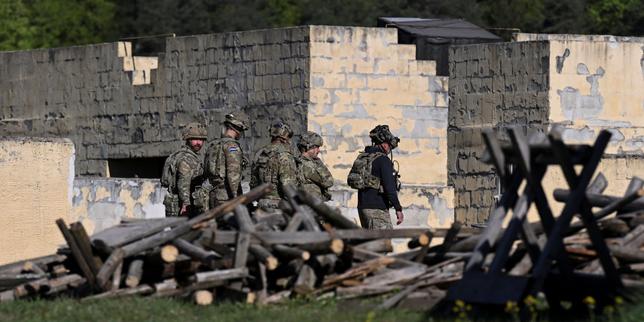
The era of the permanent American security blanket in Europe is fracturing, not because of a sudden shift in military necessity, but due to a fundamental breakdown in the transactional relationship between Washington and Berlin. When the White House signaled its intent to pull thousands of troops out of Germany, it wasn't just a logistical adjustment. It was a calculated strike against a NATO ally that the current administration views more as a reluctant customer than a partner. While the Pentagon initially mapped out a departure for roughly 5,000 personnel, the reality is far more aggressive. The administration is now pushing to remove "significantly more" than that, potentially gutting the very infrastructure that has defined Transatlantic relations since the end of the Cold War.
This move ignores decades of strategic planning for the sake of political leverage. Germany has long served as the central nervous system for U.S. operations across Africa and the Middle East. By hollowing out these bases, the U.S. is not just punishing Berlin for its perceived lack of defense spending; it is dismantling its own ability to project power globally.
The Price of Delinquency
For years, the friction point has been the 2% GDP defense spending target agreed upon by NATO members. Germany, with the largest economy in Europe, has consistently fallen short of this benchmark. In Washington, this is seen as a betrayal of the collective security agreement. The narrative is simple: why should American taxpayers fund the defense of a nation that spends its own surplus on domestic social programs while importing Russian energy?
But the numbers tell a more nuanced story. While Germany’s percentage remains below the target, its actual spending has increased significantly in raw terms. The friction arises because the U.S. administration no longer views the presence of troops as a mutual benefit. Instead, it sees them as a service—one that Germany is supposedly failing to pay for. This perspective transforms a strategic alliance into a protection racket, where the "protection" can be withdrawn if the fee isn't met.
Logistical Nightmares and the Cost of Moving
Moving ten thousand soldiers is not as simple as booking a flight. It involves heavy armor, family housing, schools, and specialized maintenance facilities that have been built up over seventy years. The cost of relocating these assets—likely to Poland or back to the United States—will almost certainly exceed any "savings" found by reducing the footprint in Germany.
The Pentagon knows this. Military planners are currently scrambling to figure out how to maintain readiness while their primary European hubs are being dismantled. Ramstein Air Base and the Landstuhl Regional Medical Center are irreplaceable assets. If a soldier is wounded in a conflict zone in the Middle East, they go to Landstuhl. You cannot simply replicate that infrastructure in a few months in a different country without massive capital investment and years of construction.
The Polish Alternative
Poland has been vocal about its desire to host more American boots. They have even offered billions of dollars to fund a permanent U.S. base, colloquially dubbed "Fort Trump" in diplomatic circles. This creates a dangerous incentive structure within NATO. By rewarding Poland—a country that has faced its own share of criticism regarding democratic backsliding—while punishing Germany, the U.S. is effectively picking favorites based on who is willing to pay the most and offer the loudest praise.
This shift moves the "tripwire" further east. While this might please Warsaw, it creates a massive instability in the center of Europe. Germany is the logistical heart of the continent. Moving troops to Poland might put them closer to the Russian border, but it detaches them from the robust supply lines and established networks that make the U.S. military effective in a prolonged engagement.
Breaking the German Bond
The psychological impact on the German public cannot be overstated. For generations, the presence of American GIs was a symbol of reconciliation and shared values. Now, it is a bargaining chip. Public opinion in Germany has soured. Polls suggest that a growing number of Germans would actually prefer the troops to leave if the alternative is being constantly threatened with their removal.
When you treat an ally like a vassal, they eventually start looking for ways to exist without you. This withdrawal is accelerating the conversation around "European Strategic Autonomy"—the idea that Europe needs its own military capabilities independent of the United States. While this has been a French fever dream for decades, it is now gaining traction in Berlin.
The Geopolitical Vacuum
Russia is the only clear winner in this scenario. The Kremlin’s long-term goal has always been the decoupling of the United States from European security. Every troop that leaves Germany is a victory for Moscow, achieved without firing a single shot. The administration’s insistence that this move is about "fairness" ignores the reality that American security is inextricably linked to a stable, unified, and defended Europe.
The argument that these troops are better used elsewhere, perhaps in the Pacific to counter China, holds some weight in a vacuum. However, you don't build up one theater by burning down another. The U.S. military is built on a "two-war" capability. Withdrawing from Germany effectively signals that the U.S. is no longer interested in, or capable of, maintaining that standard.
Beyond the 5,000 Soldiers
The original Pentagon plan was a surgical reduction. The new directive is a broad-axe. By targeting a much larger number, the administration is making it clear that this is not about "optimization." It is about a fundamental shift in American foreign policy—away from alliances and toward a transactional isolationism.
The personnel slated for removal aren't just infantry. They are the engineers, the intelligence officers, and the logistics experts who keep the wheels of NATO turning. When they leave, the institutional knowledge leaves with them. You can move a tank in a week; you cannot move a seventy-year-old relationship in a season.
The Economic Fallout
The local economies in German states like Rhineland-Palatinate and Bavaria are heavily dependent on the U.S. military presence. Thousands of German civilians work on these bases. The withdrawal will cause an economic shock to these regions, further fueling anti-American sentiment.
From a purely cold-blooded analyst's perspective, this is a loss of "soft power." The U.S. isn't just a military force in Germany; it is a massive economic engine and a cultural influence. Giving that up for the sake of a campaign talking point about "making allies pay their fair share" is a historic blunder that trades long-term influence for a short-term headline.
A Fragmented Front
If the U.S. continues down this path, the very definition of NATO will change. It will no longer be a collective defense pact; it will be a collection of bilateral agreements where the U.S. provides security to the highest bidder. This fragmentation makes the entire West more vulnerable.
The military-industrial complex in the U.S. is also watching this with gritted teeth. Germany is a major buyer of American hardware. If the security relationship dissolves, there is nothing stopping Berlin from looking toward French or domestic alternatives for their next generation of fighter jets and missile systems. The "savings" from withdrawing troops will be dwarfed by the loss of defense contracts.
The Command Structure at Risk
EUCOM (United States European Command) and AFRICOM (United States Africa Command) are both headquartered in Stuttgart, Germany. The administration has hinted that even these headquarters could be moved. The sheer audacity of such a suggestion shows a total lack of understanding regarding military command and control.
Moving a combatant command headquarters is an undertaking that takes years and billions of dollars. It disrupts the chain of command and creates a period of vulnerability that any adversary would be foolish not to exploit. The fact that this is even being discussed as a "retaliation" for defense spending shows how far the gap between civilian leadership and military reality has grown.
The Real Reason Behind the Move
This isn't about the 2%. It's about a fundamental disdain for the post-WWII international order. The administration sees the current system as one where the U.S. gets "ripped off" by its friends. This worldview ignores the fact that the U.S. designed this system specifically to ensure that it would always be the dominant global power.
By withdrawing from Germany, the U.S. is voluntarily stepping down from its role as the leader of the free world. It is a retreat disguised as a demand for fairness. The long-term consequences will be felt long after the current administration is out of office, as a newly re-armed but alienated Europe begins to chart a course that no longer includes Washington as its primary north star.
The logistics of the withdrawal remain murky, with the Pentagon often appearing to learn about new troop ceilings through the President's public comments rather than through internal memos. This chaotic approach to force management creates a sense of profound uncertainty among the rank-and-file soldiers and their families. They are the ones caught in the middle of a high-stakes game of geopolitical chicken, where the prize is a slightly different number on a balance sheet and the cost is the integrity of the Western alliance.
Every soldier removed from Germany is a signal to the world that American commitments have an expiration date and a price tag. Once that trust is broken, no amount of defense spending from Berlin or anyone else will be able to buy it back. The infrastructure of peace is being traded for the optics of strength, a bargain that history rarely views with favor.