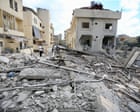
The escalating military campaign in southern Lebanon has crossed a critical threshold, shifting from a targeted counter-insurgency operation into a systematic dismantling of the region’s economic and social geography. While diplomatic channels trade rhetoric over ceasefire terms, the reality on the ground reflects a deliberate strategy designed to render the border zone permanently uninhabitable. Lebanese Prime Minister Najib Mikati’s recent characterization of Israel’s actions as a "scorched earth" policy is not merely political posturing. It is an accurate description of a military doctrine that prioritizes the total eradication of civilian infrastructure to create a permanent buffer zone.
This transformation of the conflict carries profound implications for the future of Lebanese sovereignty and regional stability. By looking beyond the daily bombardment schedules and examining the structural destruction of agricultural lands, water networks, and ancient villages, a clearer picture emerges. This is not temporary tactical maneuvering. It is a long-term geopolitical realignment enforced through high-explosive ordnance and systematic demolition.
The Strategy of Permanent Displacement
Military campaigns typically seek to neutralize an enemy force before allowing a return to the status quo. What is unfolding in southern Lebanon breaks from this traditional model. The Israeli Defense Forces (IDF) are employing a doctrine that targets the physical environment itself, ensuring that even if hostilities cease tomorrow, human habitation cannot resume for years.
This approach relies heavily on the use of white phosphorus and heavy artillery to strip away the olive groves and agricultural fields that form the backbone of the southern Lebanese economy. The destruction is absolute. Olive trees that took decades to mature are reduced to ash, poisoning the soil and eliminating the primary source of income for tens of thousands of families.
"A border devoid of cover is a border that can be monitored with absolute clarity from across the fence."
The tactical rationale presented by military planners is straightforward. By removing vegetation and flattening structures, they eliminate the physical cover utilized by Hezbollah fighters. Yet, the scale of the destruction suggests an ulterior objective. When entire villages are systematically wired with explosives and detonated in controlled demolitions—long after opposition forces have withdrawn—the goal shifts from neutralizing immediate threats to enforcing demographic engineering. The message to the displaced population is clear: there is nothing left to return to.
Breaking the Infrastructure Backbones
The erasure of the southern landscape extends far beyond the visible ruins of residential blocks. To truly understand the depth of the crisis, one must look at the targeted destruction of critical utility corridors.
Water infrastructure has been hit with calculated precision. Pumping stations along the Litani River and localized artesian wells have been disabled or outright destroyed. In a region where water security is intrinsically tied to political autonomy, the loss of these systems paralyzes local governance. Reservoirs have been cracked by targeted strikes, draining vital supplies into the parched earth.
The Breakdown of Southern Utilities
- Electrical Grids: Sub stations and transmission lines have been severed, cutting off power to hospitals and civilian shelters.
- Water Networks: Pumping facilities are offline, forcing remaining residents to rely on contaminated local sources.
- Logistical Arteries: Secondary roads connecting agrarian villages to major urban hubs like Tyre have been cratered, preventing the flow of humanitarian aid.
Without electricity to pump water or roads to transport medical supplies, the remaining civilian population faces an impossible choice. They can stay and risk slow starvation, or they can join the hundreds of thousands already displaced in overcrowded schools and public parks in Beirut and the north. This is coercion by deprivation, a recognized method of clearing territory without requiring direct physical confrontation with every resident.
The Geopolitical Calculation Behind the Ruin
Israel’s strategic calculus is driven by a desire to fundamentally alter the terms of UN Resolution 1701, which ended the 2006 war. That resolution mandated that the area south of the Litani River be free of any armed personnel except for the Lebanese army and UN peacekeepers (UNIFIL). It failed. Hezbollah built an extensive underground network and maintained a robust presence right up to the Blue Line.
Seeing diplomacy as a dead end, Jerusalem has opted for a kinetic solution. If international bodies cannot guarantee a buffer zone, the IDF will build one out of rubble. By pushing deeper into southern Lebanon, the military aims to establish a cordon sanitaire that protects northern Israeli communities from direct anti-tank fire and cross-border raids.
[Israeli Border] ----> [Flattened Buffer Zone (0-10km)] ----> [Contested Litani Line]
This strategy carries massive risks. History shows that occupying or devastating southern Lebanon rarely yields long-term security. The invasion of 1982 and the subsequent 18-year occupation directly catalyzed the creation and rise of Hezbollah. By flattening villages today, the current campaign may be sowing the seeds for the next generation of asymmetric resistance. Radicalization thrives in the ruins of a destroyed home.
The Paralysis of the Lebanese State
In Beirut, the political class watches the destruction with a mixture of helplessness and calculated detachment. The Lebanese Armed Forces (LAF) remain on the sidelines, lacking the air defense systems, heavy armor, and political mandate to challenge the IDF incursions. The state is broke, fractured along sectarian lines, and hollowed out by years of economic collapse.
Prime Minister Mikati’s appeals to the international community ring hollow because everyone knows the Lebanese government cannot enforce its own sovereignty. It cannot disarm Hezbollah, nor can it defend its borders. This institutional vacuum allows both Israel and Hezbollah to use Lebanese territory as a canvas for their broader geopolitical confrontation, with the civilian population bearing the entire cost.
The international community's response has followed a predictable script of deep concern and toothless resolutions. Western powers, led by Washington, acknowledge Israel's right to defend itself while issuing mild warnings about civilian casualties. This diplomatic shield gives the IDF the time it needs to complete the physical transformation of the south. By the time a ceasefire is finally brokered, the terrain will have been altered so fundamentally that the old maps will no longer matter.
The Economics of Long-Term Displacement
The financial cost of this scorched earth campaign will cripple Lebanon for a generation. The south is not just a collection of villages; it is a major agricultural engine for the entire country. The destruction of tobacco fields, citrus orchards, and olive presses cuts off a vital source of domestic food production and export revenue.
Rebuilding a flattened village is not just about pouring concrete. It requires clearing unexploded ordnance, replacing shattered water mains, rebuilding electric substations, and decontaminating soil poisoned by heavy munitions. In a nation currently locked out of international credit markets and suffering from hyperinflation, the funds for such a massive reconstruction effort simply do not exist. Gulf Arab states, which traditionally funded post-war reconstruction in Lebanon, are now hesitant to invest billions in infrastructure that could be obliterated again in the next cycle of violence.
This financial paralysis ensures that displacement will become permanent for a significant portion of the population. The social fabric of southern Lebanon is being rewoven in the slums and informal settlements of Beirut’s periphery. This demographic shift threatens to upset the delicate sectarian balance of the country, creating new friction points within an already volatile society.
The IDF’s push deeper into southern Lebanon is redefining the geography of the Levant. The physical erasing of communities along the border is a kinetic fait accompli, designed to ensure that whatever political agreement is reached in the future, the reality on the ground will favor Israeli security parameters at the expense of Lebanese territorial integrity. The scorched earth policy currently underway ensures that even when the guns fall silent, the landscape itself will remain a monument to a conflict that has outgrown its original objectives.


