Linda Noskova stood at the baseline of Centre Court with the weight of an entire nation’s sporting history pressing down on her young shoulders, watching a two-set masterclass evaporate into the stifling London air. Up 6-2, 5-2, and holding five championship points against her close friend and compatriot Karolina Muchova, the 21-year-old Czech looked entirely destined for an easy coronation. Instead, the tennis gods demanded drama, forcing Noskova to confront the ultimate mental test before she could finally secure a 6-2, 5-7, 6-3 victory to claim her maiden Grand Slam title. What looked like a textbook collapse became the ultimate display of modern sports psychology.
The match will be remembered not just for the quality of the tennis, but for the haunting sense of historical repetition that gripped the All England Club during a wild second-set turnaround. For a few agonizing games, the ghost of Jana Novotna’s legendary 1993 heartbreak loomed large over the grass. But Noskova broke the cycle, engineering a gritty reset in the deciding set that proved she possesses a psychological armor far beyond her years.
The Ghosts in the Centre Court Rafters
Tennis history has a cruel habit of archiving trauma. When Noskova began misfiring on her first serves at 5-2 in the second set, the older generation in the Royal Box collectively held their breath. They remembered 1993. They remembered Novotna crying on the shoulder of the Duchess of Kent after blowing a commanding lead against Steffi Graf.
Muchova, an experienced strategist who has battled back from career-threatening injuries, smelled blood in the water. She stopped missing. The crowd, desperate for an extended contest, threw their full vocal support behind the underdog. Suddenly, Noskova looked entirely isolated. Her fourth match point vanished on a double fault that missed the line by inches.
The shift was visceral. A five-game surge from Muchova did more than just level the match; it threatened to break Noskova's spirit entirely. The young Czech walked to her chair before the final set with her index fingers firmly plugged into her ears. She was trying to block out the roaring crowd, but more importantly, she was trying to silence the internal panic that has ruined countless careers on this very lawn.
Breaking the Czech Lineage of Heartbreak
The Czech Republic punches far above its weight in tennis production. The country continuously exports Grand Slam champions, from Martina Navratilova and Petra Kvitova to recent winners like Marketa Vondrousova and Barbora Krejcikova. Yet, this abundance of talent comes with an invisible tax. The expectations are monstrous.
Had Noskova lost this match, the narrative would have been set in stone. She would have been labeled the prodigy who choked under the ultimate spotlight.
Instead, the deciding set became a clinic in emotional regulation. Rather than carrying the baggage of the blown second set into the third, Noskova struck early. She broke Muchova in the second game of the decider, relying on a flat, aggressive backhand that re-established her baseline dominance. She didn't look back.
A Promise Kept to the Sky
The emotional peak of the afternoon arrived long after the final ball drifted wide from Muchova’s racket. As Noskova collapsed onto the grass in a mixture of disbelief and sheer exhaustion, the tennis world witnessed the release of a heavy burden.
During the trophy ceremony, under the watchful eyes of the Princess of Wales and tennis royalty, Noskova looked up. She spoke openly about her mother, Ivana, who passed away just before Wimbledon in 2024 after a long battle with cancer. Wimbledon had been her mother's favorite tournament, a lifelong dream shared between a dedicated parent and a rising star.
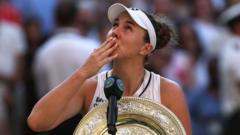
Noskova blew a quiet kiss to the sky. It was a moment of profound personal closure that transcended the simple narrative of winning a sporting event.
Muchova showed immense class in defeat. Her post-match quip, labeling Noskova her "ex-friend" with a warm smile, broke the tension of an otherwise emotionally draining afternoon. The two had shared a grueling doubles campaign at the Paris Olympics, and that deep-rooted familiarity added a layer of complex intimacy to their singles battle.
Ultimately, Wimbledon 2026 did not crown a victim of sporting tragedy. It crowned a young woman who looked directly into the abyss of a historic collapse, plugged her ears, and decided to rewrite the script.