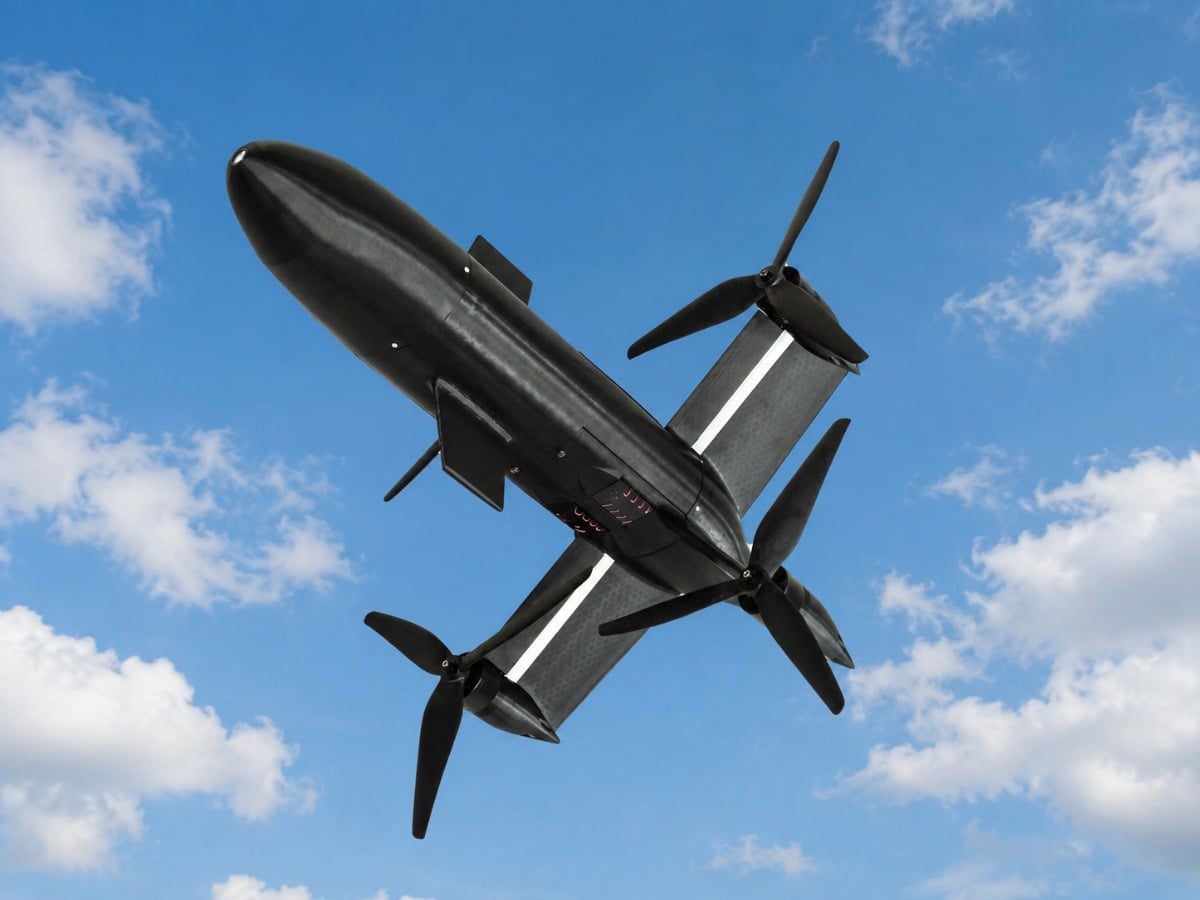
The war in Ukraine exposed a glaring, asymmetric vulnerability in modern air defense. Millions of dollars are being spent to shoot down thousands of dollars. When a $4 million Patriot missile or a $1 million NASAMS interceptor is fired to neutralize a $20,000 Iranian-designed Shahed-136 kamikaze drone, the defender is losing the economic war of attrition long before the ammunition runs out. Lithuania, sitting on NATO’s highly exposed eastern flank, is attempting to solve this geometric imbalance. Local defense firms are quietly developing low-cost, autonomous drone interceptors designed to ram, net, or otherwise disable incoming loitering munitions at a fraction of the cost of traditional rocketry. It is a necessary gamble. If they succeed, they reshape continental defense. If they fail, they risk being overwhelmed by sheer volume in a peer conflict.
The core of the issue is not technological sophistication; it is industrial capacity and economics. European defense ministries have spent decades optimizing for high-end, low-volume weapon systems. These systems are marvels of engineering, but they are entirely unsuited for a theater flooded with hundreds of expendable, slow-flying targets every single week. Lithuania's domestic initiative represents a hard pivot toward high-volume, low-cost attritable hardware.
The Economic Asymmetry of the Sky
Air defense doctrine used to be simple. You built a radar capable of tracking a high-altitude supersonic jet, and you paired it with a missile fast enough to catch it. The arrival of mass-produced kamikaze drones turned this framework upside down. These aerial vehicles fly low, hug the terrain, and possess very small radar cross-sections, making them exceptionally difficult for long-range surveillance systems to detect until they are nearly on top of their targets.
More importantly, the financial equation is ruinous for Western militaries. Consider the standard response to a saturation attack. A wave of twenty loitering munitions approaches a critical infrastructure site. To guarantee interception, doctrine dictates firing two interceptor missiles per target. If those missiles are traditional short-to-medium-range options, that single engagement can easily cost upwards of $30 million. The attacking force, meanwhile, expended roughly $400,000 in lawnmower engines, fiberglass hulls, and commercial-grade GPS guidance chips.
Lithuanian engineers are approaching this as an optimization problem rather than an aerospace engineering challenge. The goal is to match the cost profile of the threat. To do this, the proposed interceptors abandon traditional rocket propulsion in favor of electric multi-rotor or fixed-wing designs. They don't need to fly at Mach 3; they only need to fly at 150 kilometers per hour, which is just fast enough to overtake a loitering munition.
Inside the Autonomous Kill Mechanism
Removing the human-in-the-loop during the terminal phase of flight is where the true engineering friction lies. Traditional counter-drone measures rely heavily on radio-frequency jamming to break the link between the operator and the aircraft. This approach is rapidly becoming obsolete. Modern kamikaze drones are increasingly autonomous, utilizing optical optical-flow cameras and terrain-matching algorithms that require zero external data input once launched. They cannot be jammed because they are not listening to anything.
Therefore, the interceptor must also be completely autonomous during its final run. The Lithuanian prototypes utilize onboard computer vision modules running on low-power, localized processors.
[Incoming Threat Detected]
         │
         ▼
[Ground Radar Cues Interceptor Launch]
         │
         ▼
[Interceptor Navigates via Inertial Guidance]
         │
         ▼
[Onboard Optical Sensor Locks Target]
         │
         ▼
[Terminal Engagement: Kinetic Impact or Net Deployment]
The ground-based radar or acoustic sensor network detects the incoming threat and transmits the initial coordinates to the interceptor launch station. The interceptor is catapulted or vertically launched into the general path of the target. Once its onboard optical sensors pick up the silhouette of the enemy drone, the machine takes complete control.
The kinetic mechanism itself is brutal in its simplicity. While some Western concepts utilize expensive miniature missiles or complex laser systems, Baltic developers are testing two primary methods. The first is a high-speed kinetic rammer—essentially a reinforced, carbon-fiber drone designed to physically collide with the target's propellers or control surfaces. The second involves the deployment of a compressed-air net gun that entangles the rotors of the enemy craft, causing it to fall out of the sky. Both methods eliminate the need for an expensive explosive warhead, simplifies the regulatory pipeline, and significantly lowers manufacturing costs.
The Industrial Bottleneck
Developing a working prototype in a laboratory is a world away from churning out thousands of units under wartime conditions. The Baltic defense sector is nimble, but it lacks the heavy industrial footprint of larger European nations. Lithuania is heavily reliant on global supply chains for components like optical sensors, brushless motors, and specialized lithium-polymer batteries.
During a major crisis, these supply chains clog instantly. A true autonomous defense grid requires thousands of interceptors stockpiled across the country, ready to deploy from automated silos. If a domestic manufacturer relies on a single semiconductor foundry in East Asia for its computer vision chips, the entire defense strategy possesses a single point of failure. Lithuanian firms are attempting to mitigate this by sourcing components exclusively from allied European nations, though this inevitably drives up the unit cost.
There is also the problem of environmental resilience. A kamikaze drone might be launched during a torrential downpour, a blizzard, or through thick fog. Low-cost optical sensors struggle significantly in adverse weather conditions. If an interceptor cannot see its target through winter sleet, the multi-million-dollar Patriot battery must still be fired to protect the grid.
The Countermeasures Dilemma
No weapon system exists in a vacuum. The moment a cheap, autonomous interceptor enters widespread service, the adversary adapts. We are already seeing the first iterations of this evolutionary race in the skies over Eastern Europe.
Kamikaze drones are beginning to sport rear-facing cameras and basic electronic warfare suites of their own. Some are being painted with light-absorbing materials to defeat visual tracking systems, while others fly at altitudes either too high or too low for standard commercial-grade drone hulls to effectively reach. If an incoming drone detects an approaching interceptor, it can execute sudden, pre-programmed evasive maneuvers. To counter this, the interceptor’s algorithms must be sophisticated enough to predict predictive flight paths, a capability that requires more processing power, heavier batteries, and ultimately, a higher price tag.
The danger is that the low-cost interceptor slowly evolves into a complex, expensive missile over successive iterations, defeating the very purpose of its creation. Designers must maintain a strict discipline of simplicity, accepting a lower single-shot kill probability in exchange for the ability to field overwhelming numbers.
The NATO Integration Hurdle
An independent, autonomous weapon system operating within NATO airspace presents severe command-and-control headaches. Air defense is an intricately choreographed dance of identification friend-or-foe (IFF) protocols, airspace deconfliction, and strict chains of command.
Introducing hundreds of small, autonomous interceptor drones that launch automatically without direct human authorization challenges existing military legal frameworks. If an interceptor misidentifies a friendly reconnaissance drone, or worse, a civilian light aircraft, the political fallout would be severe. Lithuania must find a way to seamlessly plug these low-cost systems into the broader NATO Integrated Air and Missile Defense (IAMD) framework, ensuring that the autonomous drones only activate within strictly defined kill boxes where no friendly assets are permitted to fly.
This requires standardized data links and open-architecture software that can talk to American, German, and French radar systems currently deployed in the region. It is a bureaucratic nightmare that often moves far slower than the pace of technological innovation on the battlefield.
Redefining Border Security
The immediate application for Lithuania goes beyond preparing for a conventional military invasion. The Baltic states have faced years of hybrid warfare tactics, including the deliberate exploitation of border spaces. Small, commercial drones are regularly used by smuggling syndicates and state-backed actors to probe border defenses, test radar response times, and map critical infrastructure.
Traditional air defense cannot respond to these grey-zone provocations. You do not fire a guided missile at a quadcopter carrying contraband across a river border. Autonomous, non-lethal interceptors give border guards a proportional, cost-effective tool to clear the skies without escalating a border skirmish into a diplomatic crisis. A net-wielding interceptor can down an intrusive drone, preserve the wreckage for forensic analysis, and signal a hard boundary without a single shot being fired.
The true metric of success for Lithuania's autonomous interceptor program will not be found in glossy promotional videos or defense exhibitions. It will be determined on the factory floor and in the mud of the testing ranges. The nation that successfully breaks the monopoly of the million-dollar missile will dictate the terms of sovereignty in the twenty-first century.