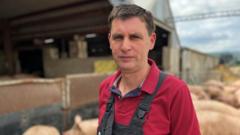
A £2 million emergency package will not save the independent pork sector. While the Scottish Government's newly announced funding throws a temporary lifeline to desperate producers, it fails to fix the deep market failure draining the industry. Independent pig farmers have been losing more than £1 million every single month since March. The cash injection covers barely two months of collective losses, leaving the structural crisis untouched. Giant retail supply chains and corporate abattoirs continue to dictate terms, leaving family-run farms to absorb the financial shock of a broken system.
The crisis has already altered the farming footprint. In the first five months of this year, breeding sow slaughter at Scottish abattoirs surged by nearly 40% compared to the same period last year. Farmers are not just selling livestock. They are liquidation-killing the future of their businesses. Scotland has lost 15% of its independent breeding herd in less than seven months, and four major producers have already shut their gates for good. This is structural attrition. Expanding on this topic, you can find more in: The Anatomy of Executive Interdiction: Decapitating the Election Assistance Commission.
The Fatal Gap in the Pork Supply Chain
At the heart of this collapse is a widening disparity between what it costs to raise a pig and what corporate buyers are willing to pay. Independent producers are trapped between global inflationary pressures and domestic market manipulation. Feed, fuel, and energy costs remain stubbornly high. Yet, the price paid to independent farmers has plummeted far below the standard cost of production.
The mechanism used to distribute the new government bailout exposes this exact flaw. Eligible farmers can claim the difference between what they were paid and 85% of the Standard Pig Price, which represents the UK deadweight average. The fact that the emergency benchmark is set at a deep discount to an already depressed average tells you everything about how low the market has fallen. Observers at The Guardian have provided expertise on this matter.
Independent producers are receiving substantially less than the true value of their livestock. For months, the market has operated under severe distortions. European pork markets have weakened, creating a surplus of cheap imports that domestic supermarkets use as a cudgel to drive down local prices. When global supply chains stutter, processors pass the financial pain downward. It stops at the farm gate.
The farmers cannot pass the costs further down. They cannot re-negotiate with feed mills or electricity providers based on market whims. They simply hold the debt until the bank calls it in.
Anatomy of a Market Collapse
The crisis did not happen overnight. It is the result of a compounding series of bottlenecks, processing disruptions, and seasonal constraints at processing plants. When a processing plant slows down due to staffing shortages or maintenance, pigs back up on farms.
A pig is a highly time-sensitive commodity. Unlike grain, which can sit in a silo for months waiting for better market conditions, a pig grows every day. If a processing plant delays collection by two weeks, those pigs outgrow their contract specifications. They become too heavy for standard processing lines.
When this happens, processors penalize the farmer. The producer is forced to pay for extra feed to maintain animals that are actively losing market value. It is a financial double-whammy that can wipe out a year of profit in a matter of weeks.
The Import Pressure
Cheaper European pork continues to flood the market, unhindered by the strict welfare standards imposed on domestic producers. British and Scottish pork operates under high-welfare regimes that mandate more space, specific dietary requirements, and a total ban on certain confinement practices used elsewhere in Europe. These standards cost money.
Supermarkets frequently champion local sourcing in their marketing campaigns. Their purchasing departments, however, tell a different story. When cheaper, lower-welfare pork from the Continent becomes available, procurement teams use those prices to squeeze domestic farmers. If the local farmer refuses to accept the lower rate, the supermarket simply adjusts its shelf inventory.
Why Two Million Pounds Cannot Fix a Structural Fracture
Emergency grants offer a brief moment of breathing room, but they act as a sticking plaster on a severed artery. A £2 million fund distributed across an entire national sector provides cash flow relief for a few weeks. It does nothing to alter the power dynamics of the supply chain.
The money flows from taxpayers, passes through the hands of struggling farmers, and ultimately subsidizes the cheap pork supply chain enjoyed by major retailers. The supermarkets and large processors are effectively insulated from the consequences of their pricing strategies because the state steps in to prevent total collapse.
+-------------------------------------------------------------+
|               THE EMERGENCY FUNDING FLOW                    |
+-------------------------------------------------------------+
|  1. Public Funds (£2m) -> 2. Independent Farmers            |
|                                |                            |
|                                v                            |
|                          [Pays Debts]                       |
|                                |                            |
|                                v                            |
|  3. Large Processors/Supermarkets (Keep Buying Below Cost)  |
+-------------------------------------------------------------+
True sustainability requires a market where the baseline price covers production costs and allows for a reasonable margin. If the marketplace refuses to pay for the high welfare standards it demands, the domestic industry will vanish.
Consumer sentiment surveys regularly show that the public wants to support local farming. Quality Meat Scotland recently highlighted that eight out of ten respondents want supermarkets to prioritize local red meat over imported alternatives. This consumer preference is not translating into financial security for the producer. The disconnect happens within the corporate procurement offices that sit between the field and the fork.
The Asymmetry of Vertical Integration
The design of the government's support scheme explicitly excludes producers who share ownership with abattoirs. This rule isolates the independent sector, which is the most vulnerable part of the agricultural economy.
Large, vertically integrated agricultural corporations own both the farms and the processing facilities. When farm-gate prices fall, these integrated giants can absorb the losses on the farming side because they claw back profit margins during the processing and packaging stages. They shift money from one pocket to another.
Independent farmers do not have another pocket. They rely entirely on the single transaction at the abattoir loading dock. When major processors reduce contract volumes or give notice to independent suppliers—as has occurred repeatedly across the country—the independent farmer has nowhere else to take their livestock.
The independent sector is being systematically squeezed out. The loss of 15% of Scotland's breeding sows is an alarm bell for biodiversity, rural employment, and food security. When a farmer culled 40% more breeding sows this year, they were not downsizing temporarily. They were dismantling the biological infrastructure of their herds. Rebuilding a breeding herd takes years of investment and stable market conditions. Neither exists right now.
The Extinction of the Independent Producer
The real battle is over the future of food production. If independent operations continue to close, the entire pork supply chain will fall into the hands of a few corporate integrators. This consolidation reduces competition, limits consumer choice, and makes the food supply chain fragile.
A localized disease outbreak or a single corporate bankruptcy could disrupt national food supplies. Independent farms provide resilience. They anchor rural economies, spending money with local vets, feed merchants, and machinery dealers. When a corporate mega-farm takes over, that local economic circulation disappears, replaced by centralized corporate contracts.
The current system relies on farmers operating at a loss until they break. The £2 million package slows down the clock, but it does not stop it. Farmers want a fair return from the marketplace, not repeated state interventions to keep them from bankruptcy. Until regulation addresses the power imbalance between the handful of grocery giants and the thousands of independent producers, the erosion of British agriculture will continue. The choice is stark: reform the supply chain or watch the independent farmer become extinct.


