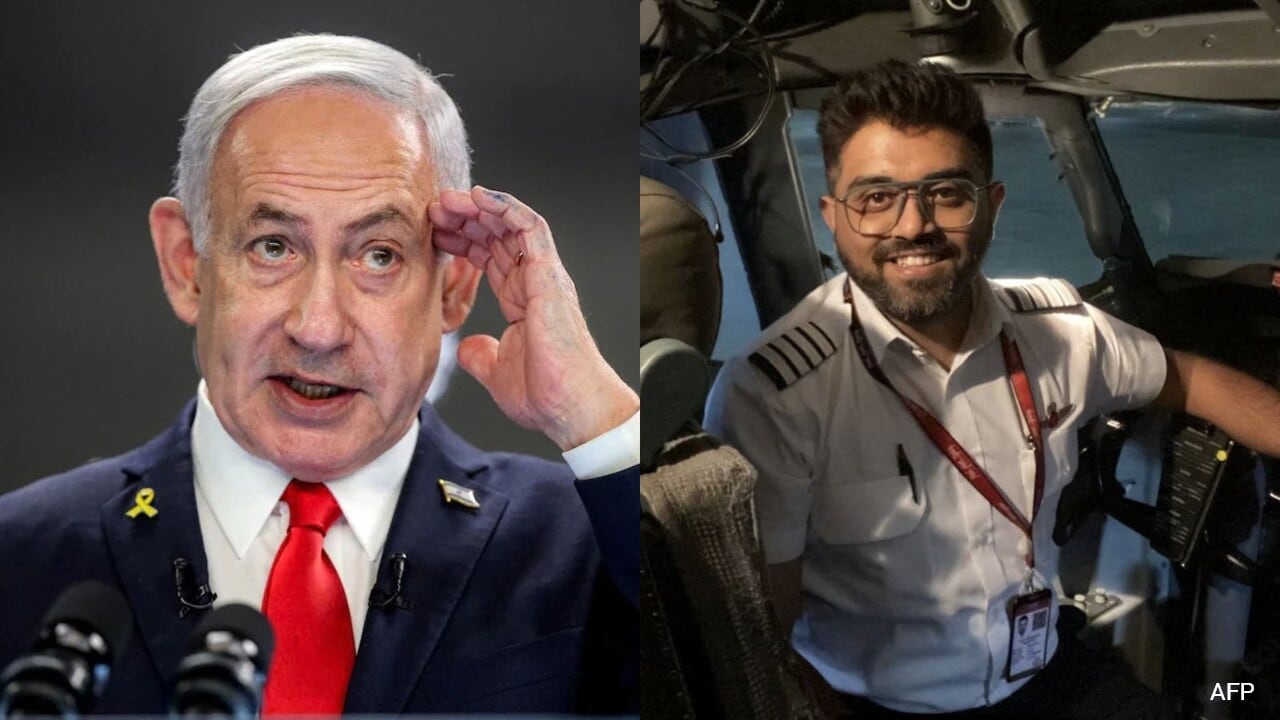
When a commercial flight turns into a high-altitude crime scene, standard aviation safety protocols are rewritten in real time. On a Flydubai service traveling from Dubai to Tel Aviv, Captain Smit Machchhar found himself thrust into an unthinkable cockpit nightmare. An internal assault by a co-pilot plunged the aircraft into a terrifying descent, dropping nearly 14,000 feet in less than thirty seconds. While political leaders like Israeli Prime Minister Benjamin Netanyahu publicly lauded the Indian pilot's extraordinary courage, the incident exposed chilling vulnerabilities in modern flight deck security that the global aviation industry has spent decades ignoring.
Modern commercial aviation operates on a foundational paradox. Cockpit doors were heavily reinforced after the events of September 2001 to keep malicious actors out. Yet, those exact security measures inadvertently created an airtight trap when the threat originates from within the flight deck itself. When a co-pilot initiates a hostile takeover of flight controls, the reinforced barrier transforms from a shield into a cage. Captain Machchhar’s ability to unlock that door while severely wounded stands as an anomaly in crisis response, directly challenging the assumption that internal cockpit threats can be mitigated by physical doors alone.
Industry regulators and commercial carriers treat insider threats as statistical impossibilities. Psychological screening protocols for airline pilots rely heavily on periodic self-reporting, basic aptitude tests, and occasional clinical evaluations. These frameworks fail to account for acute psychological breaks or sudden radicalization. When a pilot or co-pilot decides to weaponize an aircraft, they possess the precise technical knowledge required to bypass automated safety overrides. In the Flydubai incident, the rapid descent initiated from the flight controls demonstrated how quickly an insider can exploit automated systems before passengers or off-duty crew can react.
The human element during high-stress operational anomalies remains the ultimate variable. Captain Machchhar's background as a seasoned line training captain with years of commercial flight experience provided the grit needed to survive the initial knife attack. However, relying on individual physical endurance to resolve a structural security failure is bad engineering. Aviation safety has historically evolved through post-tragedy mandates, yet airline executives remain hesitant to overhaul internal cockpit monitoring systems due to privacy concerns raised by pilot unions.
Continuous cockpit voice and video recording systems, coupled with remote ground-based flight parameter monitoring, face fierce resistance from aviation labor groups. Pilots argue that constant surveillance erodes trust and creates an adversarial workplace culture. This standoff leaves airlines clinging to a binary security model: maximum defense against external intruders, zero operational oversight for internal crew members. The descent over the Middle East proved that this compromise is no longer tenable.
Commercial aviation cannot legislate heroism. Treating Captain Machchhar as a singular symbol of resilience masks the systemic failure that allowed an authorized crew member to turn a commercial jet into a guided missile. Until regulatory bodies mandate multi-person cockpit rules that apply unconditionally during all phases of flight—and introduce biometric or dual-authorization controls for flight surface manipulation—every passenger boarding a commercial airliner remains vulnerable to the person sitting in the right-hand seat.


