The narrative surrounding the women's singles final at Roland Garros seemed pulled directly from a Hollywood script rejection pile. In one corner stood Maja Chwalińska, an unseeded, unsponsored world number 114 who had spent the last three weeks playing the tournament of her life, defying 500-1 pre-tournament odds to become the first female qualifier in history to reach the final in Paris. In the other stood Mirra Andreeva, the 19-year-old prodigy from Siberia who has carried the heavy burden of "the next big thing" since she was a 15-year-old tearing through the draw in Madrid.
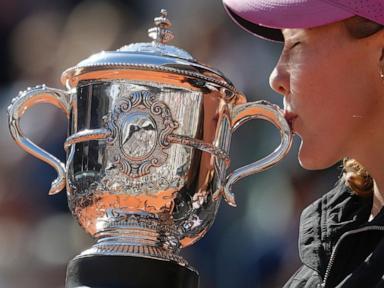
When Andreeva struck a crisp cross-court backhand winner to seal her 6-3, 6-2 victory on Saturday, the fairytale ended exactly how cold, hard modern tennis logic dictated it should. Andreeva dropped to her knees on the red clay of Court Philippe-Chatrier, hiding her face as the reality of her first Grand Slam title set in. She is the youngest woman to hoist the Coupe Suzanne-Lenglen since an 18-year-old Monica Seles won her third consecutive title in 1992. You might also find this related story insightful: Inside the Italian Football Crisis Nobody is Talking About.
To view this match merely as a teenage prodigy fulfilling her destiny, however, misses the far more interesting, brutal reality of how Andreeva actually won this tournament. This was not a triumph of carefree teenage exuberance. It was a calculated, gritty victory achieved by an athlete who spent two weeks fighting immense psychological pressure, geo-political tension, and a swirling 29 mph Parisian wind that threatened to derail the purest of ball-strikers.
Fighting the Demons in the Parisian Wind
The match started in absolute chaos. The tournament organizers opened the roof of Philippe-Chatrier just before the players walked out, exposing the court to punishing wind gusts. The elements immediately wrecked both players' rhythms, resulting in four consecutive breaks of serve to open the match. As reported in latest articles by FOX Sports, the implications are significant.
Chwalińska was the first to find her footing, executing a series of tricky slices, dropshots, and varied spins that briefly unbothered the Russian eighth seed. When the Pole held her serve to love to take a 3-2 lead, the stadium, heavily packed with vocal Polish fans waving white-and-red flags, erupted.
Andreeva looked visibly rattled early on. Her face tells every story; she has historically possessed a tempestuous streak on court that reveals her youth. This time, she didn't boil over. Instead of trying to over-hit through the gale, she adjusted her court positioning, increased her margin over the net, and began utilizing her superior depth to push Chwalińska well behind the baseline.
The adjustment was devastating. Andreeva reeled off nine consecutive games, turning a competitive 2-3 deficit into a 6-3, 5-0 stranglehold.
"I want to thank myself for working so hard and giving my best," Andreeva said during an unusually candid trophy ceremony. "For believing that I can do this, fighting so many demons inside of me. Only I know how tough it was for me, how nervous I was throughout these two weeks."
That self-directed gratitude was telling. While the mainstream tennis press loves to focus on stroke mechanics and natural talent, Andreeva went out of her way to publicly thank her psychologist, who was watching via video link from Florida. For an athlete who has spent four years under a microscopic lens, the battle was entirely internal.
2026 French Open Women's Final Stats
+-----------------------------------+-----------------+-------------------+
| Stat                              | Mirra Andreeva  | Maja Chwalińska   |
+-----------------------------------+-----------------+-------------------+
| First Serve Percentage            | 78%             | 69%               |
| Second Serve Points Won           | 67%             | 20%               |
| Break Points Converted            | 7 of 12         | 3 of 8            |
| Total Winners                     | 25              | 10                |
| Unforced Errors                   | 26              | 29                |
| Total Points Won                  | 62              | 41                |
+-----------------------------------+-----------------+-------------------+
The Conchita Martínez Factor
You cannot understand Andreeva's transformation from a volatile phenom into a clinical Grand Slam champion without looking at her player box. Sitting there was Conchita Martínez, the 1994 Wimbledon champion and former world number two who finished as the runner-up at Roland Garros in 2000.
Martínez has spent the last two years systematically rebuilding Andreeva's approach to structural point construction. Under the Spaniard's guidance, Andreeva has learned the value of defensive neutrality. She no longer feels the urgency to hunt for winners from disadvantageous positions.
Against Chwalińska, whose game thrives on disrupting rhythm and coaxing errors through variety, Andreeva displayed a veteran’s patience. She hit 25 winners to Chwalińska’s 10, but more importantly, she kept her unforced error count to a disciplined 26 despite the heavy winds.
The starkest discrepancy lay in the second-serve points. Andreeva won a staggering 67% of her second-serve opportunities, while Chwalińska won just 20%. Andreeva's ability to protect her second delivery under extreme pressure prevented the Pole from ever mounting a serious comeback in the second set, even when Andreeva blinked while trying to serve out the match at 5-0.
The Quiet Storm Beyond the Baseline
Tennis does not exist in a vacuum. Andreeva's run to the title required navigating a minefield of external pressures that would have crushed most veteran players. Competing under a neutral flag due to ongoing global conflicts, she has routinely faced hostile environments.
Her semifinal match against Ukrainian 15th seed Marta Kostyuk was a masterclass in emotional regulation. Played against a backdrop of intense political friction, and ending with the now-customary refused handshake from Kostyuk, Andreeva kept her head down and carved out a 6-1, 6-3 victory. She did not seek approval from the crowds; she simply went about her work.
By the time she reached the final, she was thoroughly accustomed to playing the villain, or at least the obstacle, to a grander narrative. The Parisian crowd desperately wanted Chwalińska to complete her miracle run. Every unforced error from Andreeva was met with cheers; every winner from Chwalińska brought down the house.
Andreeva’s response was a masterclass in isolation. She locked her eyes on the clay, took her time between points, and let her heavy baseline depth do the talking.
The Changing of the Guard
Andreeva's victory feels like a definitive line in the sand for the WTA Tour. She is the first player born after 2005 to reach—and win—a Grand Slam singles final.
For the past few seasons, women's tennis has been dominated by a relatively established core. Andreeva’s breakthrough changes that equation entirely. Her rapid financial and athletic ascent is staggering. In 2022, she earned just over $25,000 in prize money. By the midpoint of this 2026 season, her career earnings have rocketed past the $9.5 million mark, fueled by back-to-back WTA 1000 titles in Dubai and Indian Wells last year, and capped by the ultimate prize in Paris.
The sport often chews up and spits out teenage prodigies who find success too early. The hype can become a cage. Yet, by actively addressing her mental struggles on the global stage and relying on the seasoned tactical mind of Martínez, Andreeva looks less like a flash in the pan and more like an impending era.
As Mary Pierce handed her the Coupe Suzanne-Lenglen, Andreeva spoke a few flawless sentences of French to the crowd, instantly winning over an audience that had spent the previous two hours pulling for her opponent. It was a savvy, mature move from a player who understands that the tennis court is a stage, but the locker room and the history books only respect trophies. The fairytale belonged to Chwalińska, but the future belongs to Andreeva.