The sea leaves a metallic taste in the back of the throat that no amount of fresh water can wash away. For more than two hundred and fifty days, sailors aboard the USS Abraham Lincoln lived in that taste. They watched the gray horizons of the Middle East stretch into infinity, clocking twelve-hour shifts while machinery strained and supply stores dwindled. Among them was Joshua Aviles, a young man who believed that wearing the uniform of a superpower bought something sacred for the people he loved. He believed it bought safety.
Back in Key West, Florida, his father was counting down the hours.
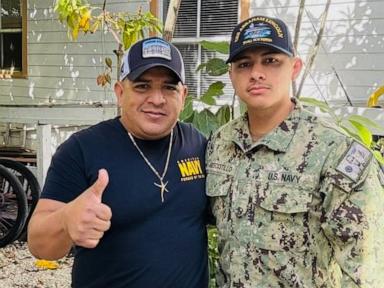
Luis Manuel Aviles had lived inside the quiet rhythm of American life for nineteen years. He was a handyman. He fixed things that were broken, patched drywall, screwed loose hinges back into place, and built a modest existence with a work permit that allowed him to earn an honest living. Originally from Nicaragua, his world was bounded by the walls of the houses he repaired and the safe return of his children. When his son Joshua signed up for the Navy, it was done with a specific, hopeful calculation. Joshua thought the uniform would shield his family. He thought it would clear a path through the tangled, unforgiving thicket of immigration law so that his father would no longer have to wake up every morning wondering if the knock on the door would end their lives as they knew it.
Instead, the door was opened from the outside.
On a Saturday morning, Luis stepped out of his house to take his car to the mechanic. He didn't pack a bag. He didn't say an extended goodbye. He simply walked toward his vehicle, wrapped in the ordinary routine of a weekend errand. That was when Border Patrol agents stopped him.
Consider what happens next: the machinery of the state does not pause for sentiment. Within hours, Luis was transferred into the custody of Immigration and Customs Enforcement, slated for deportation. The Department of Homeland Security issued a crisp, unyielding statement defending the action, noting that having a family member in the military is not a free pass to violate the nation's laws. Legalism operates with a cold, geometric precision. It draws lines in ink and treats human lives as variables to be subtracted.
Thousands of miles away, floating somewhere in the Arabian Sea, Joshua received the message.
He was in the middle of a record-breaking deployment, a grueling stretch at sea that tested the limits of mental endurance. For months, his sister Katherine had been mailing him care packages filled with basic food items and hygiene products because supplies on the vessel were running thin. She had spent hundreds of dollars trying to feed her brother across oceans, only to find that some boxes never even reached him. And now, the final coordinate of his homecoming—the anchor keeping him sane through twenty-four-hour rotations of grueling labor—was gone.
"I don't know how I can mentally continue working," Joshua wrote in a public post after the news broke, his words strained by exhaustion and betrayal. He was fighting for a country that was actively unmaking his home.
This is not an isolated administrative glitch. It is the raw mechanical output of a mass deportation agenda that has systematically rolled back protections for military families. Programs like military parole-in-place were once designed to offer a fragile bridge, allowing parents and spouses of active-duty service members to regularize their status without leaving the country. They were meant to ensure that those who bear the heaviest burdens of national defense do not carry the private terror of family separation. But policy priorities shift. Definitions of national security narrow. And the spouses and parents of troops find themselves caught in enforcement sweeps that treat them as administrative targets rather than human pillars of military households.
Investigations reveal that dozens of military parents and spouses have been swept into detention. Some have already been pushed across borders before advocates could intervene. Behind these statistics lie quiet kitchens, unfinished handiwork, and phone calls made across distorted satellite connections.
Arguing policy in the abstract is easy. It is clean. It allows bureaucrats to talk about the rule of law without ever smelling the exhaust of a handyman's car in Key West or tasting the stale air of a naval warship. But laws are executed by humans upon humans. When a government detains the father of a sailor who has spent over nine months away from land without a break, it sends an unambiguous message about who belongs inside the national family and who is merely tolerated until paperwork fails them.
Joshua's ship is finally turning back. The deployment is ending. For months, Luis kept watch for that return, longing to wrap his arms around his son. He wanted to celebrate the survival of a young man who endured a floating fortress at the edge of the world.
Instead, the son will return to a house that is empty, quiet, and guarded only by the memory of a father who went to fix a car and never came back.