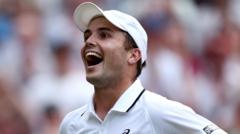
The grass at Wimbledon does not care about your pedigree. By the end of the first week, the pristine, emerald lawns of the All England Club have been chewed up by the sliding, desperate outstretches of the world’s elite, leaving behind patches of raw, brown dirt. It looks less like a country club and more like a battleground. For a young player surviving on a wildcard entry, that dirt is everything. It is the exact place where reputation dies and raw nerve takes over.
Arthur Fery stands in the middle of it, drenched in sweat, looking like a man who has successfully snuck into a high-society gala and decided to flip the buffet tables.
To the casual observer checking a scoreboard, it is a nice story. A British underdog making a run. A local boy capitalizing on a home-court advantage. But scoreboards are inherently dishonest. They reduce a agonizing, psychological war of attrition down to cold, binary digits. They do not show you the tremor in a twenty-two-year-old’s forearm when he is serving for a set against a player who makes more money in a month than most people see in a decade. They do not capture the suffocating weight of thousands of expectant eyes, gasping in unison at every missed first serve.
To understand what is happening on these courts, you have to look past the statistics. You have to look at the invisible stakes.
The Quiet Panic of the Court
Tennis at this level is not a game of skill. Everyone here can hit a yellow ball at one hundred and thirty miles per hour into a space the size of a dinner plate. Instead, it is an exercise in emotional survival.
When an unseeded player steps onto the lawn against a seasoned veteran, a predictable script usually unfolds. The underdog starts with a burst of adrenaline. They play loose. They hit lines. The crowd roars, sensing a fairytale. But adrenaline is a toxic fuel source; it burns hot and leaves a heavy ash. By the ninety-minute mark, the veteran has figured out the rhythm. The veteran slows down the pace, bounces the ball an extra three times before serving, and watches the underdog’s internal clock begin to fracture.
Consider what happens next: the underdog starts rushing. The swing tightens by a fraction of a millimeter. That tiny, almost invisible change in muscle tension translates to a ball flying two inches long. Game, set, match. The natural order is restored.
But Fery apparently missed the memo regarding this script.
Watching him navigate the pressure of a grand slam run is an exercise in studying defiance. Where other young players look to their player’s box for reassurance after a brutal unforced error, Fery stares straight ahead. His eyes are wide, fixed on the baseline. He looks like he has forgotten how to blink.
There is a specific kind of arrogance required to win when you are not supposed to. It is not a loud, bragging arrogance, but a quiet, stubborn refusal to accept that the person across the net is better than you just because a computer ranking says so. Fery moves with the frantic, brilliant energy of someone who knows exactly how fleeting this moment is. He isn’t trying to prolong the experience; he is trying to consume it whole.
The Anatomy of the Advantage
People who do not play tennis often talk about "taking advantage" of an opponent's weakness as if it were a simple tactical choice. Just hit it to their backhand. Just drop-shot them because they look tired.
It is never that simple. In reality, exploiting an advantage requires a terrifying amount of courage.
Imagine standing on a court where every mistake is amplified by a wall of sound. You notice your opponent is favoring their left ankle, or perhaps their breathing has become slightly too ragged between points. To exploit that, you have to change your game plan. You have to stop playing the safe, deeply ingrained patterns you have practiced ten thousand times since you were seven years old. You have to take a risk.
Fery’s current run is built entirely on these micro-gambles.
During a pivotal break point in his recent match, the logical play was a deep, cross-court rally ball to reset the point. It was what any coach would advise. Instead, Fery stepped into a rising ball, took it on the half-volley, and hit a short, angled slice that barely cleared the net. It was an incredibly risky shot. If he misses it, he looks foolish, the momentum shifts, and the match likely spirals away from him.
He didn't miss.
The ball died in the grass, and the stadium erupted. That is what it means to stand tall. It means having the audacity to trust your hands when your mind is screaming at you to play it safe. It is the realization that against the best in the world, passivity is just a slow, polite way of losing.
The Mirage of the Home Crowd
There is a myth that playing in front of a home crowd is an unmitigated blessing. We see the flags waving, we hear the chanting, and we assume it acts as a wind at the player's back.
But the truth is far more complicated. A home crowd is a volatile beast. It is fueled by hope, and hope is an incredibly heavy thing to carry on your shoulders. When you are winning, they are a tidal wave. But when you hit a double fault, the silence that falls over the stadium is not empty—it is heavy with disappointment. You can actually feel the collective deflation of ten thousand people. It settles in your lungs.
To survive that, a player has to build a wall.
Fery seems to treat the crowd not as a savior, but as background noise. He acknowledges them with a quick, sharp pump of his fist after a crucial game, but then the wall goes right back up. He understands an ugly truth that many young athletes learn too late: the crowd cannot hit a single ball for you. When the score is deuce in the fifth set, you are entirely alone in the universe.
This brings us to the core of why this run matters. It is not just about a British player winning matches at a British tournament. It is about watching a human being discover, in real-time, exactly what they are made of under the harshest possible spotlight.
Every match Fery plays right now is a referendum on his own potential. He is answering questions about his nerve, his stamina, and his right to belong on this stage—questions he probably wasn’t sure of the answers to himself just a few weeks ago. The technical adjustments, the tactical shifts, the physical preparation—they are all just a preamble to this psychological test.
The dirt on Fery’s kit is getting darker with every round. The lawns are disappearing, replaced by the gritty, unglamorous surface underneath. That suits him perfectly. The elegance of the tournament is fading away, leaving behind nothing but a pure contest of wills, where the boy who refused to blink is suddenly looking like the most dangerous man in the draw.


