Cold.
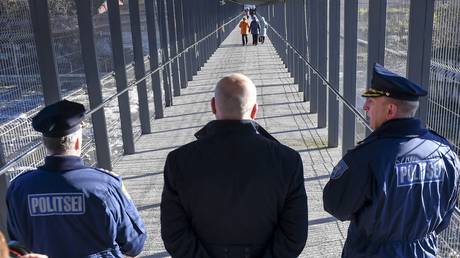
That is the first thing you notice about the Narva River in November, long before the politics reach you. The water moves dark and heavy between two worlds, separating the medieval stone walls of Hermann Castle in Estonia from the brooding towers of Ivangorod Fortress in Russia. For decades, the Friendship Bridge spanning that narrow stretch of water was a mundane artery of daily life. Grandmothers carried bags of cheap Russian sugar back to Estonia. Estonian workers commuted across for factory shifts. Truckers idled in long, smoky queues, trading cigarettes and complaints about customs paperwork while waiting for the barrier to lift.
Now, the concrete dragon's teeth sit like jagged gray molars across the asphalt. Razor wire glints under the harsh sodium streetlights. And in Moscow, behind the thick red brick walls of the Kremlin, the response to this hardening of the Baltic frontier has been swift, sharp, and deeply revealing.
To understand what happens when a Baltic state seals its border with Russia, you have to look past the dry diplomatic cables and the predictable press briefings from Kremlin spokesperson Dmitry Peskov. You have to look at the people standing at the edge of the concrete, clutching worn passports, realizing that the map beneath their feet has just shifted permanently.
The Anatomy of a Sudden Silence
Let us invent a character to walk us through the frost, though thousands of real people share her exact dilemma. Call her Elena. She is fifty-eight, an ethnic Russian born in Soviet-era Estonia, holding an Estonian passport and speaking a melodic blend of both languages. Her sister lives twenty minutes away in Kingisepp, just across the Russian border. For thirty years after the collapse of the Soviet Union, that twenty-minute drive was an inconvenience, a matter of border stamps and occasional delays.
Today, Elena stands at the pedestrian crossing in Narva with a suitcase full of winter clothes for her nephew, staring at closed gates and armed guards. Estonia, alongside Latvia and Lithuania, has systematically choked off border crossings, citing national security threats, hybrid warfare, and the weaponization of migration by Moscow. Finland, just across the Gulf, did the exact same thing across its entire 1,340-kilometer frontier.
When Estonia and its Baltic neighbors tightened the screws—shutting down vehicle traffic at Narva, closing smaller checkpoints like Saatse and Luhamaa to night traffic or altogether, and warning citizens against any travel to Russia—the Kremlin did not react with quiet resignation. Moscow reacted with calibrated fury.
Dmitry Peskov, the longtime voice of Vladimir Putin, stepped up to the microphones and framed the closures not as a defensive measure by small nations terrified of a belligerent neighbor, but as an act of self-harm and pathological Russophobia. In the Kremlin's telling, the Baltic states are cutting off their own noses to spite their faces, destroying centuries-old economic ties and punishing ordinary citizens at the behest of Western masters in Brussels and Washington. Maria Zakharova, the Russian Foreign Ministry's sharp-tongued spokesperson, went further, calling the border restrictions a manifestation of modern extremism and warning of inevitable retaliatory measures.
Listen closely to that rhetoric, though, and you hear something else beneath the bravado. You hear the sound of a door slamming shut on Russia's historical doorstep.
Why the Kremlin Cannot Afford to Shrug
Geopolitics often feels like a cold game of Risk played by men in tailored suits, moving plastic armies across cardboard continents. In reality, it is much closer to a claustrophobic neighborhood dispute where one neighbor has spent years tearing down the fence, and the other neighbors have finally decided to build a twelve-foot brick wall with broken glass cemented into the top.
For centuries, the Baltic states—Estonia, Latvia, and Lithuania—were Moscow's window to the West. Peter the Great fought a twenty-one-year war against Sweden just to secure this coastline, founding St. Petersburg on the marshy banks of the Neva River so Russia could breathe European air. Even after the Baltic republics regained their independence in 1991, Moscow viewed the region as its "near abroad," a sphere of influence where Russian language, Russian transit, and Russian political leverage remained deeply embedded.
That illusion died in February 2022, when Russian tanks rolled into Ukraine.
In Tallinn, Riga, and Vilnius, the invasion of Ukraine was not watched as a distant foreign crisis. It was watched as a terrifying preview. These are small nations. Estonia has a population of roughly 1.3 million people—smaller than the city of Munich. Latvia has 1.8 million. Lithuania has 2.8 million. Collectively, the three Baltic states have fewer people than the Moscow metropolitan area alone. When your neighbor has a history of occupying your land, deporting your grandparents to Siberia, and openly questioning your right to exist as a sovereign state, you do not wait for the tank columns to form before locking the front door.
The Kremlin knows this. That is why the border closures sting so badly in Moscow. Every concrete barrier dropped on a Baltic highway is a physical rejection of Russian influence. It turns the Kaliningrad exclave—Russia's heavily militarized outpost wedged between Poland and Lithuania—into an increasingly isolated island. It forces Russian freight to take longer, vastly more expensive routes. More importantly, it shatters the narrative that Russia remains the indispensable center of gravity in Eastern Europe.
The Invisible Weapon at the Crossing
If you ask someone in Brussels or Washington why a Baltic state suddenly closes a border crossing on a Tuesday afternoon, the official answer involves words like "hybrid threats" and "instrumentalized migration." Those are sterile, bureaucratic terms. Let us strip away the jargon and look at what actually happens on the ground.
Imagine you own a house, and your neighbor begins quietly unlocking your back gate in the middle of the night, guiding dozens of lost, desperate strangers onto your porch, and then locking the gate behind them so they cannot leave. Your neighbor never fires a shot. They never step onto your lawn themselves. Yet your household is suddenly overwhelmed, your resources are strained, and panic spreads through your family.
This is the exact tactic European intelligence agencies accuse Moscow and its ally Minsk of orchestrating. Beginning in 2021 on the Belarusian borders with Lithuania and Poland, and later expanding to the Russian borders with Finland and Estonia, groups of migrants from the Middle East, Africa, and South Asia began arriving at remote northern forest checkpoints. Many carried brand-new Russian tourist or student visas, escorted directly to the border zone by Russian security services, and handed bicycles to cross into European territory.
In the freezing temperatures of a Baltic winter, this is not merely a policy dispute; it is a humanitarian trap designed to destabilize democratic governments. Baltic border guards were suddenly forced to choose between letting unvetted crowds pour into the European Union's passport-free Schengen zone or leaving freezing families stranded in the no-man's-land between two countries.
Estonia, Latvia, and Lithuania watched Finland close every single one of its eastern border crossings in late 2023 and 2024 after hundreds of undocumented migrants arrived via Russia in a matter of weeks. The Baltic capitals took notes. When similar groups began testing the Estonian checkpoints at Narva and the southeastern crossings, Tallinn did not hesitate. They closed the gates, installed anti-tank obstacles, and warned that any border post could be shut permanently within minutes.
When the Kremlin condemns these closures, it conveniently omits the fact that Russia's own Federal Security Service—the FSB—tightly controls the border zones on the Russian side. Nobody walks up to the Estonian border through a restricted Russian military zone without the explicit permission, or active assistance, of Moscow. The Kremlin creates the fire, and then scolds the neighbors for buying fire extinguishers.
Living in the Shadow of the Wire
It is easy to cheer for strong borders from the safety of an armchair three thousand miles away. It is much harder when you actually live along the seam.
I have walked through border towns in Eastern Europe where the economic lifeblood was tied directly to the movement of people and goods across the frontier. When a border closes, the silence is physical. The small currency exchange booths shutter their windows. The cafes that once served hot borscht to exhausted truck drivers at three in the morning turn off their neon signs. Gas stations near the highway sit empty, their attendants staring out at four lanes of pristine, unused asphalt.
In Narva, where nearly ninety percent of the population speaks Russian as their first language, the border closure cuts straight through families. For people like our hypothetical Elena, the political reality is suffocating. Many Russian-speaking residents in the Baltics feel caught between two worlds that no longer tolerate ambiguity. To the Estonian state, the border must be sealed to protect democracy and sovereignty from an aggressive dictatorship. To the Kremlin, those same Russian speakers are treated as props in a propaganda war—pawns to be cited in angry speeches about "discrimination" while Moscow's own policies make their lives infinitely harder.
Even commercial transit has withered. Before 2022, Baltic ports like Riga, Tallinn, and Klaipeda thrived on moving Russian coal, fertilizers, and timber to global markets. European Union sanctions choked off most of that trade, and the physical border closures delivered the final blow. Today, the railway tracks linking Russia to the Baltic coast carry a fraction of their historical volume. Rust is slowly reclaiming sidings that once hummed twenty-four hours a day.
And yet, if you talk to ordinary citizens in Tallinn or Vilnius—even those paying higher prices for goods or dealing with disrupted travel—you rarely find regret. You find a grim, clear-eyed resolve. The Baltic peoples remember history with a sharpness that Western Europe often lacks. They remember 1940, when Soviet troops marched in under the pretext of "mutual assistance" treaties. They remember the midnight knocks on the door, the cattle cars bound for Kazakhstan and Siberia, the fifty years of occupation that followed.
To them, economic inconvenience is a cheap price to pay for keeping the wolf outside the door.
The Kremlin's Retaliation Playbook
So what does Moscow actually do when a Baltic state locks the gate? The Kremlin rarely accepts a strategic setback without trying to extract a cost. Over the past two years, a clear pattern of Russian retaliation has emerged, moving along three distinct tracks.
First comes the diplomatic and legal squeeze. Moscow routinely expels Baltic diplomats, closes consulates in St. Petersburg and Pskov, and places Baltic prime ministers, interior ministers, and even museum directors on the Russian Interior Ministry's "wanted" list. In early 2024, Russia took the unprecedented step of placing Estonian Prime Minister Kaja Kallas on a criminal wanted list over the removal of Soviet-era World War II monuments. It was a symbolic gesture—Kallas is not exactly planning a weekend holiday in Moscow—but it sent a chilling message: in the Kremlin's eyes, Baltic leaders are criminals subject to Russian jurisdiction.
Second comes the invisible war in the shadows. When the physical border closes, the conflict shifts to the airwaves, the seabed, and the digital sphere. Baltic countries have experienced massive spikes in GPS jamming originating from the Kaliningrad region, forcing commercial airliners to abort landings and rely on older navigation instruments. Undersea telecommunications cables and gas pipelines connecting Estonia and Finland have been mysteriously damaged by dragging anchors. Cyberattacks on Baltic government ministries, banks, and railway networks have become a daily reality.
Third comes the economic chokehold on whatever remnants of trade remain. Russian customs authorities deliberately slow down inspections for Baltic trucks carrying non-sanctioned goods, leaving drivers stranded in freezing parking lots for days. Moscow threatens to cut off the remaining energy links, though the Baltic states beat them to the punch by accelerating their historic disconnection from the Soviet-era BRELL electricity grid, synchronizing instead with continental Europe.
The Confusion of a New Iron Curtain
Let us be honest about something that pundits often gloss over: nobody knows exactly where this ends, and that uncertainty is exhausting.
When the Berlin Wall fell in 1989, and when the Soviet Union dissolved two years later, the prevailing wisdom in the West was that borders were becoming obsolete. Trade, tourism, and shared prosperity were supposed to dissolve ancient hatreds. We built bridges—literally, like the Friendship Bridge over the Narva—believing that commerce would tame empire.
We were wrong.
Watching the razor wire unspool across Eastern Europe feels like watching history run in reverse. It is deeply unsettling to realize that the peaceful, borderless Europe of the past three decades was not the permanent end of history, but a fragile, temporary truce. For security planners in NATO headquarters, the closed Baltic borders are a necessary hardening of the alliance's eastern flank—a tripwire made of concrete and steel designed to deter any Russian miscalculation. For families split across the Narva River, it is a quiet tragedy unfolding in slow motion.
The Kremlin's angry response to the Baltic border closures is ultimately a confession of failure. For twenty years, Moscow tried to bend Estonia, Latvia, and Lithuania to its will through energy blackmail, cyber warfare, disinformation campaigns, and economic pressure. Every single tactic backfired, driving the Baltic nations deeper into NATO, strengthening their resolve, and convincing them that the only safe border with Russia is a closed one.
By evening, the lights come on along both banks of the Narva River. On the Russian side, the stone walls of Ivangorod Fortress are illuminated by warm spotlights, projecting a carefully curated image of imperial grandeur. Across the dark, fast-moving water, the Estonian flag snaps in the Baltic wind above Hermann Castle. Between them, the bridge stands empty, silent, and locked—a monument not to friendship, but to the hard truth that good fences are the only thing keeping the peace.


