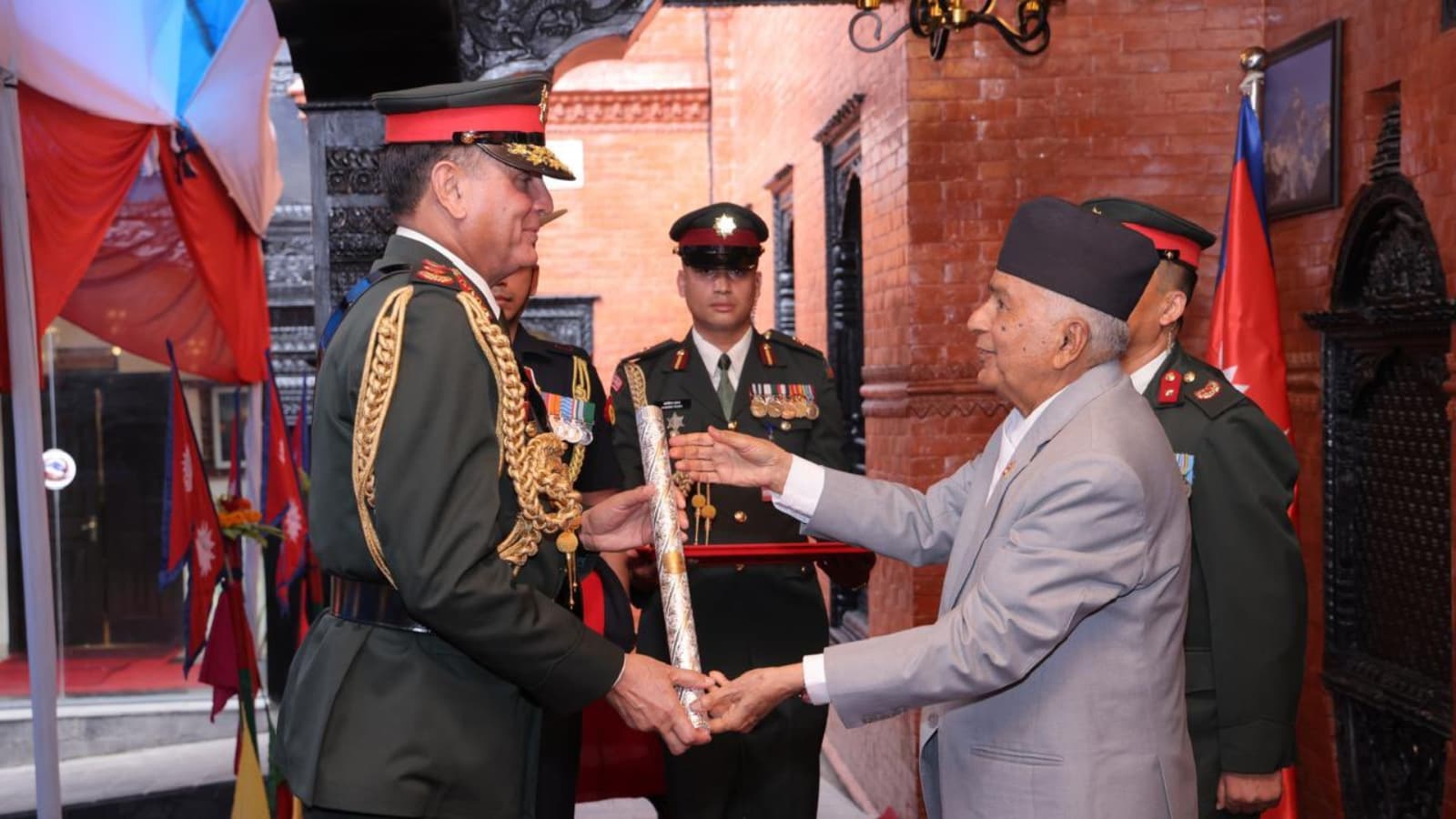
Indian Army Chief General Dhiraj Seth received the honorary rank of General of the Nepali Army from Nepal President Ramchandra Paudel during a formal investiture ceremony at Sheetal Niwas in Kathmandu. This diplomatic ritual, dating back to 1950, is far more than routine military pageantry. It serves as a vital anchor for bilateral relations between New Delhi and Kathmandu, surviving decades of political turbulence, changing governing coalitions, and shifting geopolitical winds in South Asia.
The Weight of History
Traditions in statecraft often risk becoming hollow shells, performed simply because past administrations did so. Yet the reciprocal exchange of honorary army chief ranks between India and Nepal carries functional utility. Since its formal inception, the practice has provided a direct, insulated channel of communication between two militaries that share an open border and deep historical linkages. For a different view, check out: this related article.
When General Seth accepted the rank in Kathmandu, he stepped into a lineage spanning generations of military commanders. The ceremony transcends personal honors. It institutionalizes a mutual recognition that the defense architectures of both nations remain fundamentally intertwined, regardless of which political party holds power in either capital.
Beyond the Ceremonial Parade
Critics often dismiss these high-level visits as expensive photo opportunities with little strategic output. That perspective ignores the substance packed behind closed doors during such tours. Alongside the investiture at Rashtrapati Bhawan, General Seth held extensive talks with his Nepali counterpart, General Ashok Raj Sigdel, and received briefings from the Director General of Military Operations of the Nepali Army. Similar insight regarding this has been provided by BBC News.
These discussions address practical security cooperation. Intelligence sharing, border management, and coordination on regional stability form the core of these closed-session dialogues. Furthermore, the visit included the transfer of military and medical equipment to the Nepal Army, translating diplomatic goodwill into tangible material support.
Navigating Regional Realities
Geopolitics in the Himalayan region has grown increasingly complex. Major powers vie for influence in Kathmandu, offering infrastructure financing, technological partnerships, and strategic investments. Against this backdrop of competing external pressures, the military-to-military relationship functions as a steadying constant.
India and Nepal share open borders, shared cultural touchpoints, and deep-rooted societal connections often characterized as the Roti Beti Ka Rishta. Yet shared heritage does not automatically eliminate contemporary friction points. Territorial disagreements, domestic political shifts in Nepal, and nationalist sentiments occasionally strain diplomatic channels.
Military diplomacy bypasses some of the populist rhetoric that frequently infects civilian political discourse. By maintaining professional camaraderie between top commanders, both nations preserve an operational safety valve. If a crisis erupts along the border or within the region, commanders who have broken bread and exchanged institutional respect can pick up a secure phone line and de-escalate tensions before politicians can weaponize the incident.
The Human Element on the Ground
Diplomacy is forged at the top, but it is sustained at the grass roots. On the final leg of his itinerary, General Seth traveled to Pokhara for an Ex-Servicemen Rally. Thousands of Gurkha veterans and their families rely on pensions, medical care, and institutional support systems managed through Indian Army channels.
For these veterans, the presence of the Indian Army Chief validates their decades of service. It reinforces a human bridge that spans across national boundaries. Over thirty thousand Nepali citizens currently serve in the ranks of the Indian Army, alongside lakhs of pensioners residing across the hills of Nepal. This demographic reality anchors bilateral stability far more effectively than any treaty signed in a conference room.
When General Seth addressed student officers at the Army Command and Staff Course in Shivapuri, he spoke to the future leadership of the Nepali military. Cultivating professional military education partnerships ensures that future generations of officers in both nations speak a common operational language.
The brass insignia pinned to General Seth’s uniform in Kathmandu will sit quietly in a display case once his tenure concludes. But the institutional trust reinforced during those three days in August dictates how two neighboring armies will respond when the next geopolitical storm hits the Himalayas.