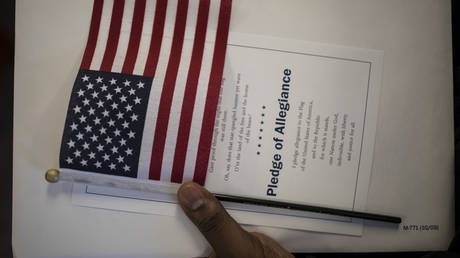
Foreign nationals seeking permanent residency in the United States now face a sharpened ideological vetting process that effectively weaponizes social media history and political speech. While the Department of Homeland Security (DHS) has long screened for ties to terrorism or criminal activity, recent internal directives and expanded surveillance have shifted the focus toward "antisemitic" speech and support for radical movements as grounds for denying green cards. This shift represents a fundamental change in how the U.S. government defines "good moral character," a vague but powerful legal standard used to block applicants who haven't actually broken any laws.
The current friction stems from a massive expansion of the "extreme vetting" protocols that began nearly a decade ago but have recently found a new, specific target. U.S. Citizenship and Immigration Services (USCIS) officers are increasingly instructed to scrutinize an applicant’s digital footprint for statements that could be interpreted as inciting violence or promoting discriminatory ideologies. For many applicants, particularly those from the Middle East or those active in campus politics, a single shared post or a "like" on a controversial video can now result in a Form I-485 denial.
The Good Moral Character Trap
At the heart of these denials is a broad legal catch-all known as the "Good Moral Character" (GMC) requirement. Most people assume that if they haven't been arrested or lied on their taxes, they pass the test. They are wrong. Federal law gives immigration officers significant leeway to determine if an individual’s presence "adversely reflects" on the United States.
By linking political speech—specifically speech deemed antisemitic or supportive of groups like Hamas—to a lack of GMC, the government has created a workaround for traditional First Amendment protections. While the Constitution protects the speech of people on U.S. soil, the government maintains that the privilege of becoming a permanent resident can be revoked based on the content of that speech. This is a gatekeeping mechanism that functions outside the typical courtroom environment, where "incitement" has a very high legal bar. In an immigration interview, the bar is whatever the officer decides it is.
The Algorithm of Exclusion
The process isn't just about human officers reading Facebook feeds. The Department of State and DHS have integrated sophisticated social media screening tools into the visa and green card application pipelines. When an applicant submits their handles, automated systems flag keywords associated with banned organizations, specific conflicts, and controversial slogans.
These flags don't automatically trigger a denial, but they do trigger a "Security Advisory Opinion" or an "enhanced interview." During these sessions, applicants are grilled on their personal beliefs and their understanding of specific historical events. If an applicant’s explanation doesn't align with the current administration’s definitions of acceptable discourse, the "security risk" label is applied. Once that label is attached, the burden of proof shifts entirely to the immigrant to prove they are not a threat—a nearly impossible task when the criteria for "threat" remain classified.
When Political Speech Becomes a Security Threat
The distinction between political protest and "support for terrorism" has blurred. In the wake of global protests regarding the conflict in Gaza, the U.S. government has faced intense domestic pressure to crack down on foreign students and workers who participate in demonstrations. Lawmakers have openly called for the revocation of visas for anyone expressing support for "resistance" movements.
This pressure has trickled down into the administrative weeds of USCIS. We are seeing cases where individuals are flagged for participating in campus walkouts or for donating to charities that the government later claims have tangential links to sanctioned entities. The logic is simple: if you support a cause that the U.S. government opposes, your "moral character" is in question. This isn't about public safety in the physical sense; it’s about ideological alignment.
The Problem of Definition
One of the biggest hurdles for applicants is the lack of a fixed definition for what constitutes "antisemitic" speech in the context of immigration law. While the U.S. has adopted the International Holocaust Remembrance Alliance (IHRA) working definition in some capacities, applying it to immigration law creates a minefield.
- Criticism of Government Policy: Does a post criticizing the Israeli government count as antisemitic? Under some interpretations, yes.
- Historical Context: Is sharing a map of historical Palestine a sign of "eliminatist" intent?
- Guilt by Association: Does following a specific account on X (formerly Twitter) indicate endorsement of everything that account posts?
For a veteran immigration officer, these nuances are often lost. The safest bet for an officer, from a career perspective, is to deny the application. No one gets fired for being too tough on a potential "extremist," but a single mistake that lets in a controversial figure can lead to a congressional inquiry.
The Business of Uncertainty
The impact of these denials stretches far beyond the individuals involved. It creates a climate of fear that ripples through the tech and medical sectors—industries that rely heavily on H-1B holders transitioning to green cards. When a high-level engineer or a specialized surgeon sees their permanent residency denied over a three-year-old retweet, the message to the rest of the community is clear: silence is the only safe path.
Companies are now finding themselves in the awkward position of having to hire "digital cleaners" or specialized legal counsel to audit the social media histories of their foreign-born employees. This adds a new layer of cost and complexity to the already Byzantine American immigration system. It also pushes talent elsewhere. Countries like Canada and the UK have their own vetting processes, but they are generally viewed as more predictable and less influenced by the shifting winds of U.S. domestic politics.
Silicon Valley’s Silent Panic
In tech hubs like San Jose and Austin, the green card backlog is already a decade long for many. Adding an ideological purity test to the end of that ten-year wait is causing a quiet exodus. Venture capitalists are reporting that founders are increasingly opting to start companies in Dubai or Singapore rather than risk the "black box" of U.S. immigration vetting. The risk isn't just about being kicked out; it's about the permanent stain on one's global record that a "security denial" from the United States carries.
The Legal Challenges Ahead
There is a growing movement among civil rights attorneys to challenge these denials in federal court. The argument is twofold: first, that the government is violating the Administrative Procedure Act by using "secret" criteria to make life-altering decisions; and second, that the First Amendment should protect legal residents from viewpoint discrimination.
However, the "consular non-reviewability" doctrine is a massive obstacle. Traditionally, courts are extremely hesitant to second-guess the decisions of immigration officials regarding who gets to enter or stay in the country. This creates a zone of near-total executive power. To win, a plaintiff would have to prove that the government acted in bad faith or that the denial was based on a clearly unconstitutional policy.
What Applicants Are Doing Now
The reality on the ground is that applicants are scrubbing their digital lives.
- Deleting accounts: Many are closing accounts that date back to their teenage years.
- Changing names: Using pseudonyms or initials to avoid being indexed by automated scrapers.
- Professional Audits: Paying thousands of dollars for firms to scan their history for "problematic" keywords.
Even these measures are no guarantee. The government has access to archived data and can demand that applicants provide access to "private" or "deleted" content during the interview. The interview itself has become a psychological gauntlet where an applicant's reaction to a specific question can be just as important as their answer.
The Shrinking Definition of American Values
The U.S. has always prided itself on being a marketplace of ideas, but the current vetting climate suggests the market is closed to certain buyers. By using the green card process to punish unpopular or offensive speech, the government is effectively stating that permanent residency is a reward for ideological conformity.
This isn't just about "antisemitism" or any single political issue. It’s about the precedent. Today, the target is speech related to the Middle East. Tomorrow, it could be speech regarding climate change, reproductive rights, or trade policy, depending on who holds the keys to the White House. When "moral character" becomes a proxy for "political agreement," the immigration system ceases to be a functional administrative process and becomes a tool for social engineering.
The burden of this policy falls hardest on those who believed that the American system was built on the protection of dissent. They are finding out, often after years of contributing to the economy and the community, that their right to stay is contingent on their willingness to stay silent. This creates a class of residents who are physically present but intellectually suppressed, perpetually looking over their shoulders at a digital ghost that might one day end their American dream.
The gatekeepers aren't just looking for criminals anymore; they are looking for "wrongthink." And in the digital age, everyone has a trail that can be twisted to fit a narrative of un-Americanism.
Ensure your social media is private, your public comments are measured, and your legal counsel is briefed on the latest USCIS field manuals before you step into that interview room.